
Sci Rep. 2019;9(1):11131.
Prognostic implications of soluble programmed death-ligand 1 and its dynamics during chemotherapy in unresectable pancreatic cancer.
제1저자 박현경 · 교신저자 오도연
소속 (4)
- Department of Internal Medicine, Seoul National University Hospital, Seoul, Korea.
- Cancer Research Institute, Seoul National University College of Medicine, Seoul, Korea.
- Department of Internal Medicine, Seoul National University Hospital, Seoul, Korea. ohdoyoun@snu.ac.kr.
- Cancer Research Institute, Seoul National University College of Medicine, Seoul, Korea. ohdoyoun@snu.ac.kr.
Abstract
In pancreatic cancer, acquiring a sufficient amount of tumor tissue is an obstacle. The soluble form of PD-L1 (sPD-L1) may have immunosuppressive activity. Here, we evaluated the prognostic implications of sPD-L1 in unresectable pancreatic cancer. We prospectively enrolled 60 patients treated with first-line FOLFIRINOX chemotherapy. We collected blood samples at diagnosis, first response assessment and disease progression. Serum sPD-L1 levels were measured using enzyme-linked immunosorbent assays. The median sPD-L1 level was 1.7 ng/mL (range, 0.4-5.7 ng/mL). Patients with low sPD-L1 level (<4.6 ng/mL) at diagnosis showed better overall survival (OS) than those with high sPD-L1 level (P = 0.015). Multivariate analysis identified sPD-L1 and the neutrophil-to-lymphocyte ratio as independent prognostic factors for OS. During chemotherapy, more patients achieved complete response (CR)/partial response (PR) as their best response when sPD-L1 was decreased at the first response assessment (P = 0.038). In the patients who achieved CR/PR as their best response, sPD-L1 was significantly higher at the time of disease progression than at the first response assessment (P = 0.025). In conclusion, the sPD-L1 level at diagnosis exhibits a prognostic value in pancreatic cancer. Furthermore, sPD-L1 dynamics correlate with disease course and could be used to understand various changes in the tumor microenvironment during chemotherapy.
Figures
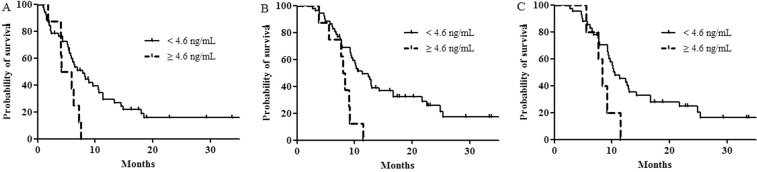
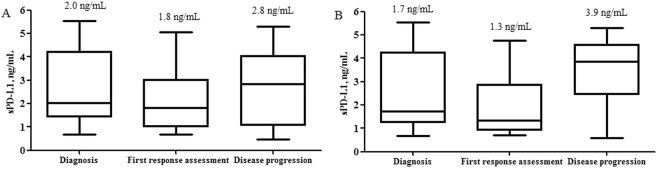
그림 출처: PubMed Central 공개 논문 (PMC6668419)
Conflict of interest statement
The authors declare no competing interests.
그 밖의 정보
- 출판 형태
- Journal Article, Research Support, Non-U.S. Gov't
- 저널
- Scientific reports · eISSN 2045-2322
- 전자 출판
- 2019-07-31
- MeSH
- Antineoplastic Combined Chemotherapy Protocols / therapeutic use · B7-H1 Antigen / metabolism · Biomarkers, Tumor / metabolism · Disease Progression · Female · Fluorouracil / therapeutic use · Humans · Irinotecan / therapeutic use · Leucovorin / therapeutic use · Male · Middle Aged · Oxaliplatin / therapeutic use · Pancreatic Neoplasms / drug therapy / metabolism / pathology · Prognosis · Prospective Studies · Tumor Microenvironment / drug effects
- Substances
- B7-H1 Antigen · Biomarkers, Tumor · CD274 protein, human · folfirinox · Oxaliplatin · Irinotecan · Leucovorin · Fluorouracil
- 참고문헌
- 30편