National Leading Laboratory for Stem Cell Research, Seoul National University College of Medicine, Seoul, Korea.
Department of Internal Medicine, Seoul National University Hospital, Seoul, Korea.
Department of Molecular Medicine and Biopharmaceutical Sciences, Graduate School of Convergence Science and Technology, Seoul National University, Seoul, Korea.
National Leading Laboratory for Stem Cell Research, Seoul National University College of Medicine, Seoul, Korea. hyosoo@snu.ac.kr.
Department of Internal Medicine, Seoul National University Hospital, Seoul, Korea. hyosoo@snu.ac.kr.
Department of Molecular Medicine and Biopharmaceutical Sciences, Graduate School of Convergence Science and Technology, Seoul National University, Seoul, Korea. hyosoo@snu.ac.kr.
Abstract
Sildenafil is known to reduce cardiac hypertrophy through cGMP-dependent protein kinase (cGK) activation. Studies have demonstrated that cGK has a central switching role in modulating vascular smooth muscle cell (VSMC) phenotype in response to vascular injury. Here, we aimed to examine the effects of cGK activation by sildenafil on neointimal formation and platelet aggregation. After vascular injury, neointimal hyperplasia in rat carotid arteries was significantly reduced in the sildenafil-treated group. This effect of sildenafil was accompanied by the reduction of viability and migration of VSMCs. Further experiments showed that the increased cGK activity by sildenafil inhibited platelet-derived growth factor-induced phenotype change of VSMCs from a contractile form to a synthetic one. Conversely, the use of cGK inhibitor or gene transfer of dominant-negative cGK reversed the effects of sildenafil, increasing viability of VSMCs and neointimal formation. Interestingly, sildenafil significantly inhibited platelet aggregation induced by ADP or thrombin. This effect was reversed by cGK inhibitor, suggesting that sildenafil inhibits platelet aggregation via cGK pathway. This study demonstrated that sildenafil inhibited neointimal formation and platelet aggregation via cGK pathway. These results suggest that sildenafil could be a promising candidate for drug-eluting stents for the prevention of both restenosis and stent thrombosis.
Figures
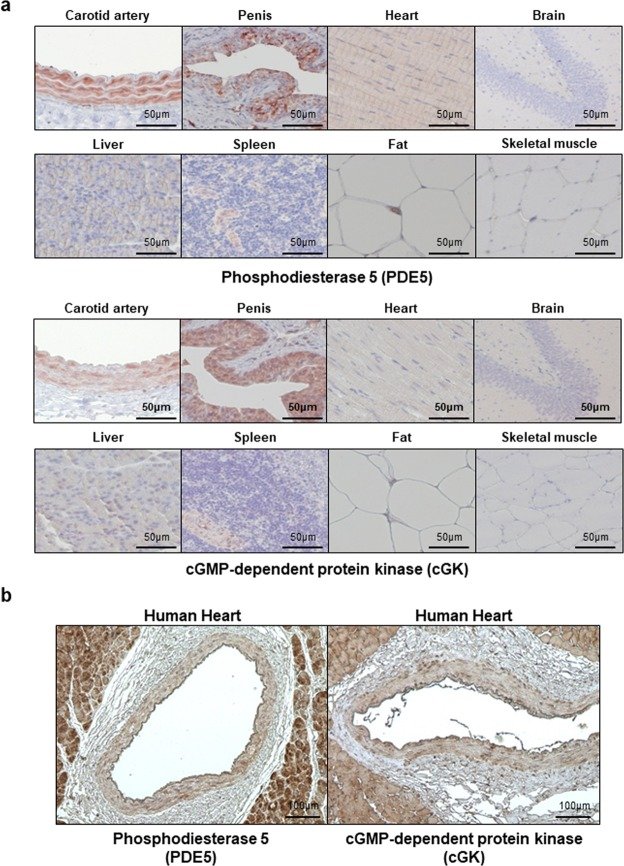
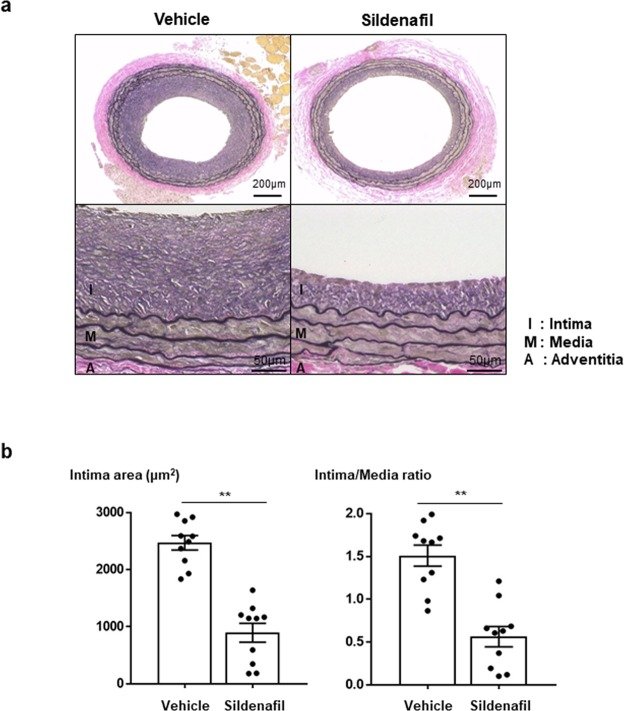
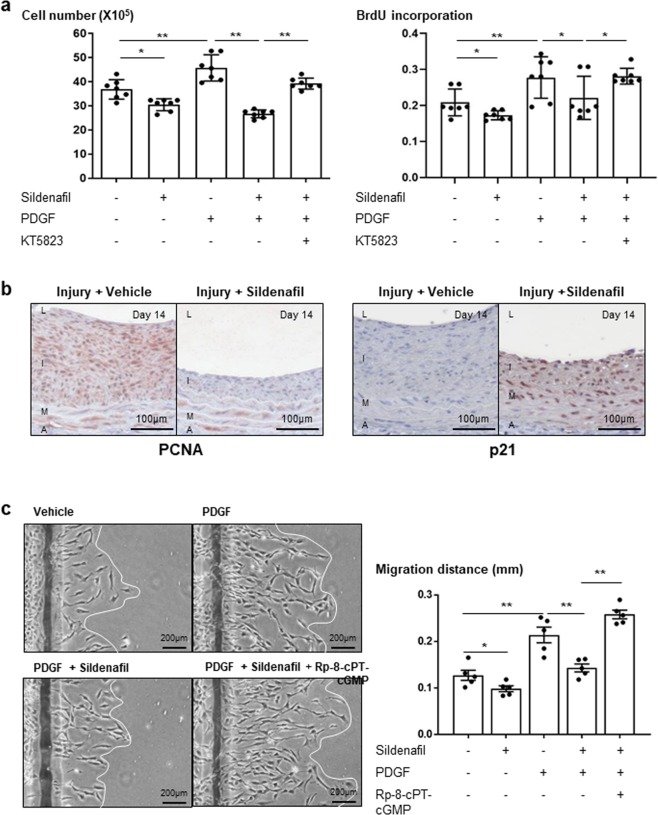
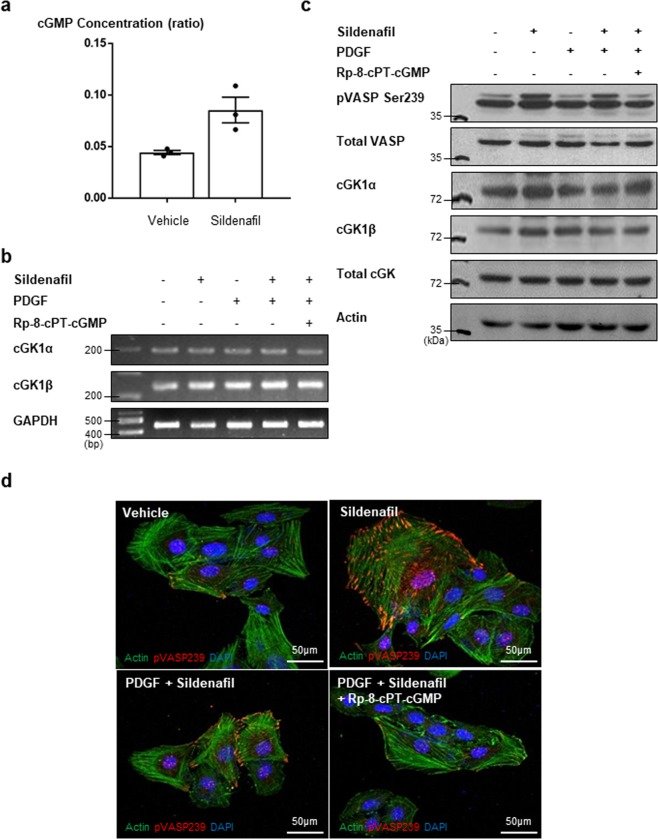
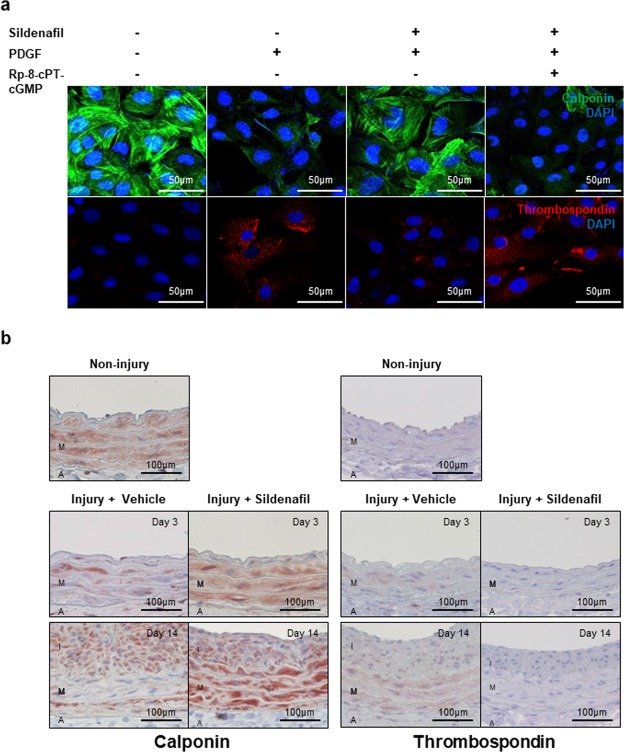
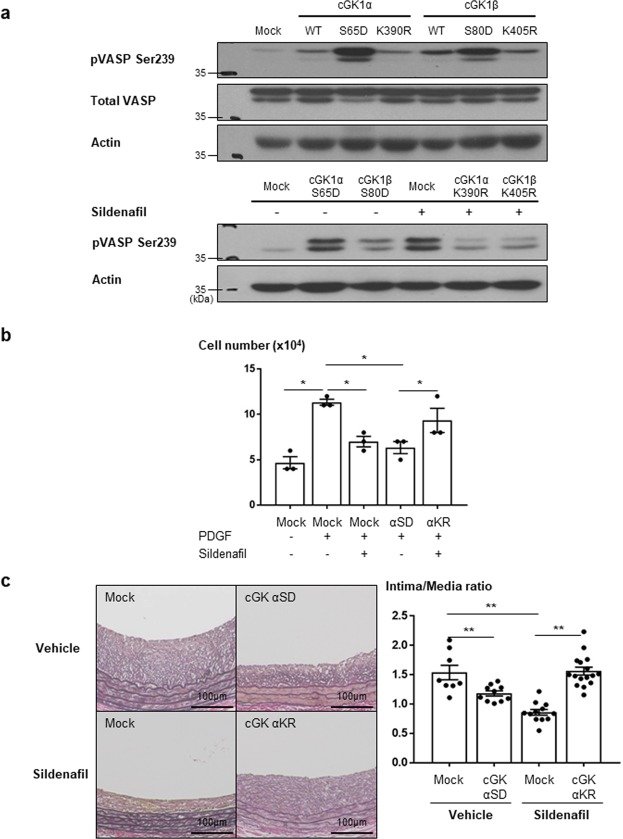
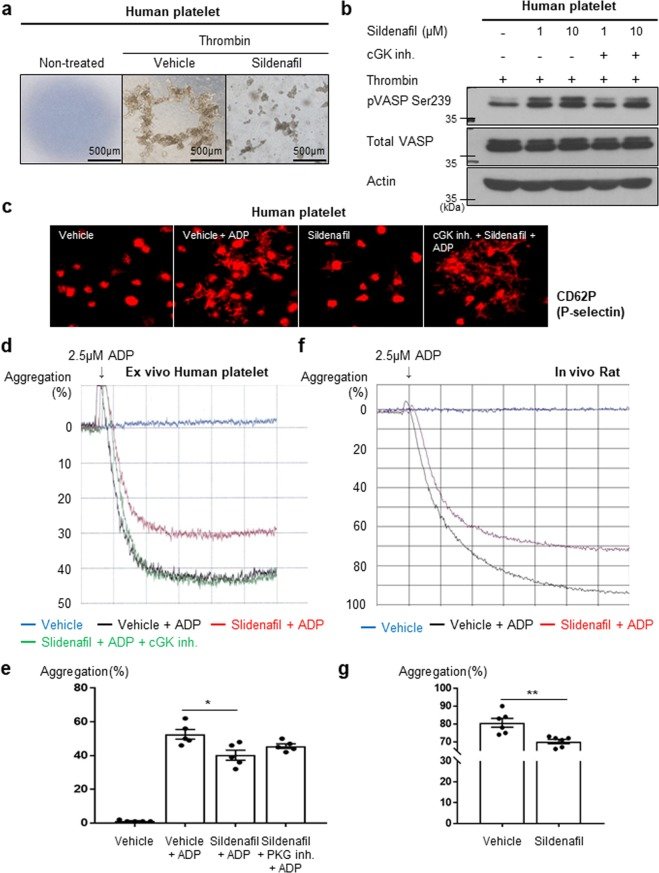
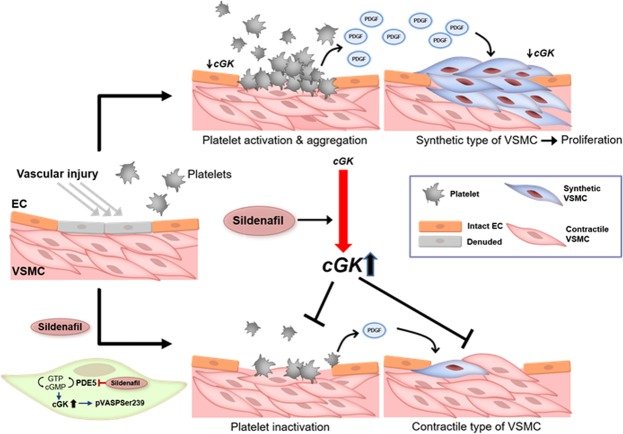
Figure 1Expression of PDE5 and cGK in the vessel wall. (a) Representative figures of the expression patterns of PDE5 and cGK in various organs using immunohistochemistry. Strong expression of both PDE5 and cGK were observed in the smooth muscle cell layer of the vessel wall and in the rat penile tissue. Compared to the intensity of these markers, the heart showed weaker expression (n = 3). (b) In the human heart, the smooth muscle layer of the coronary artery strongly expressed both PDE5 and cGK (n = 10).Figure 2Inhibitory effect of sildenafil on neointimal formation after angioplasty. (a) Representative figures of the vessels at 2 weeks after balloon injury in rat carotid arteries (n = 10). Compared to the vehicle-treated group, the sildenafil-treated group significantly reduced neointimal hyperplasia. I = Intima, M = Media, A = Adventitia. Scale bar = 200 µm. (b) Quantitative graphs of Intima to Media (I/M) ratio and intimal area at 2 weeks after balloon injury. Graphs show significantly reduced I/M ratio and intimal area in the sildenafil-treated group (n = 10). **P < 0.01.Figure 3Inhibitory effect of sildenafil on proliferation and migration of VSMCs in vitro and in vivo. (a) Tryphan blue exclusion assay and BrdU incorporation assay demonstrated that sildenafil treatment reduced the proliferation of VSMCs, which was reversed by the cGK inhibitor (KT5823). cGK inh. = cGK inhibitor. * and ** indicate P < 0.05, **P < 0.01 respectively. (n = 7) (b) Immunohistochemical staining for PCNA (n = 6) or p21 (n = 3) expressions in the carotid artery wall. Sildenafil treatment decreased PCNA-positive cells and increased p21-positive cells in the vessels. Scale bar = 100 µm. (c) Wound migration assay shows that sildenafil treatment significantly inhibited VSMC migration (n = 5). Moreover, this effect was reversed by the cGK inhibitor (Rp-8-cPT-cGMP), suggesting that the inhibitory effect of sildenafil on proliferation and migration of VSMCs might be mediated via the cGK pathway. Scale bar = 100 µm. (d) Quantification graph of migration assay. ** indicates P < 0.01.Figure 4Effects of sildenafil on cGK activity. (a) Enzyme immunoassay for cGMP shows that the concentration of cGMP increased in VSMCs with sildenafil treatment. P values is 0.05 between two groups (n = 3). (b) RT-PCR shows that sildenafil treatment did not change the expression cGK Ια and cGK Ιβ. cGK inh. = cGK inhibitor (n = 3). (c) Western blot analysis indicates that sildenafil treatment increased VASP phosphorylation (a substrate of cGK), but did not change the level of cGK itself. The phosphorylation of VASP by sildenafil was reversed by cGK inhibitor. pVASP Ser 239 = phospho-VASP at serine239 (n = 3). (d) Immunofluorescence staining for pVASP shows the similar effect with the previous western blot. pVASP239 = phospho-VASP at serine239 (n = 3). Scale bar = 50 µm.Figure 5Effects of sildenafil on VSMC phenotype modulation. (a) Immunofluorescence staining for calponin and thrombospondin. PDGF treatment increased the level of thrombospondin (a marker of synthetic form of VSMC) and decreased the level of calponin (a marker for contractile form). Sildenafil treatment inhibited the effect of PDGF on these markers. Finally, cGK inhibitor reversed the effect of sildenafil, suggesting that sildenafil could modulate VSMC phenotype via the cGK pathway. Scale bar = 50 µm. cGK inh. = cGK inhibitor (n = 3). (b) Immunohistochemical staining for calponin and thrombospondin. The arterial wall at 3 days and 2 weeks after injury showed that sildenafil treatment elevated the expression of calponin and reduced the level of thrombospondin. Scale bar = 100 µm (n = 3).Figure 6In vitro and in vivo effects of sildenafil mediated via cGK pathway. (a) Western blot assay (upper panel) demonstrates the activity of active form (S65D) and dominant negative (K390R) of cGK1 α and β. Lower panel shows that cGK activation by sildenafil was reversed by gene transfer of dominant-negative of α subtype of cGK1. pVASP Ser 239 = phospho-VASP at serine239 (n = 3). (b) The graphs show that the inhibitory effect of sildenafil on cell viability was reversed by the gene transfer of dominant-negative of cGK1α (αKR). The gene transfer of active form of cGK1α (αSD) reduced the increased viability by PDGF treatment (n = 3). * indicates P < 0.05. (c) In vivo sections at 2 weeks after injury demonstrated that the transfer of lentiviral vector expressing active form of cGK(αSD) showed a similar effect as sildenafil-treated group, which was reversed by the transfer of lentiviral vector expressing dominant-negative form of cGK (αKR) (n = 10). Scale bar = 100 µm. ** indicates P < 0.01.Figure 7Inhibition of platelet aggregation by sildenafil. (a) Sildenafil treatment inhibited the aggregatory effect of thrombin on human platelets. Scale bar = 500 µm. (b) Western blot for VASP phosphorylation (indicates inhibitory activity of platelet aggregation) shows that the increased VASP phosphorylation by sildenafil was reversed by cGK inhibitor in human platelets (n = 3). cGK inh. = cGK inhibitor. pVASP Ser 239 = phospho-VASP at serine239. (c) Immunofluorescence staining for P-selectin(C62P), an activated platelet marker, shows that the aggregation of platelets induced by ADP was inhibited by sildenafil treatment. Moreover, this effect of sildenafil was reversed by cGK inhibitor, suggesting that sildenafil could inhibit platelet aggregation through the cGK pathway (n = 3). (d) Platelet aggregometer with platelet rich-plasma from a human donor showed that cGK activation by sildenafil treatment reduced ADP-induced platelet aggregation. In addition, this reduced platelet aggregation by sildenafil was reversed by cGK inhibitor (n = 5). (e) Quantitative graph of ex vivo aggregation study suing human platelets (n = 5). * indicates P < 0.05. (f) Representative figure of platelet aggregometer with platelet rich-plasma from rat peripheral blood treated with vehicle or sildenafil for 2 weeks (n = 6). (g) The quantitative graph also shows that sildenafil treatment inhibited platelet aggregation in vivo (n = 6). ** indicates P < 0.01.Figure 8Schematic figure of the role of cGK and sildenafil treatment in the vessel and platelets. After vascular injury such as balloon angioplasty or stent implantation, endothelial cells (ECs) are denuded, resulting in the downregulation of nitric oxide. Subsequently, the level of cGK in VSMCs and platelets decreases. VSMCs are converted to a synthetic form from a contractile form by the decreased cGK activity. Furthermore, the decreased cGK in platelets facilitates platelet aggregation. In addition, activated platelets produce PDGF which can stimulate VSMC proliferation. In contrast, sildenafil treatment can prevent the decrease of cGK activity in VSMCs and platelets, leading to the inhibition of both neointimal growth and platelet aggregation.
그림 출처: PubMed Central 공개 논문 (PMC6533301)
Conflict of interest statement
The authors declare no competing interests.
그 밖의 정보
출판 형태
Journal Article, Research Support, Non-U.S. Gov't
저널
Scientific reports · eISSN 2045-2322
전자 출판
2019-05-23
MeSH
Angioplasty · Animals · Cell Movement / drug effects · Cell Proliferation / drug effects · Cyclic GMP-Dependent Protein Kinases / metabolism · Cyclic Nucleotide Phosphodiesterases, Type 5 / metabolism · Muscle, Smooth, Vascular / drug effects / metabolism · Myocytes, Smooth Muscle / drug effects / metabolism · Neointima / metabolism · Platelet Aggregation / drug effects · Rats · Signal Transduction / drug effects · Sildenafil Citrate / pharmacology · Vascular System Injuries / metabolism
Substances
Sildenafil Citrate · Cyclic GMP-Dependent Protein Kinases · Cyclic Nucleotide Phosphodiesterases, Type 5