SCI 발표논문

SCI 발표논문

← SCI 발표논문 목록

J Korean Med Sci. 2015;30(1):24-33.

Cardiac resynchronization therapy and QRS duration: systematic review, meta-analysis, and meta-regression.

, , , , , , ,

제1저자 강시혁, 오일영 · 교신저자 오세일

소속 (3)
  1. Department of Internal Medicine, Seoul National University College of Medicine and Seoul National University Bundang Hospital, Seongnam, Korea.
  2. Department of Internal Medicine, Seoul National University College of Medicine and Seoul National University Hospital, Seoul, Korea.
  3. Medical Research Collaborating Center, Seoul National University Hospital, Seoul, Korea.

Abstract

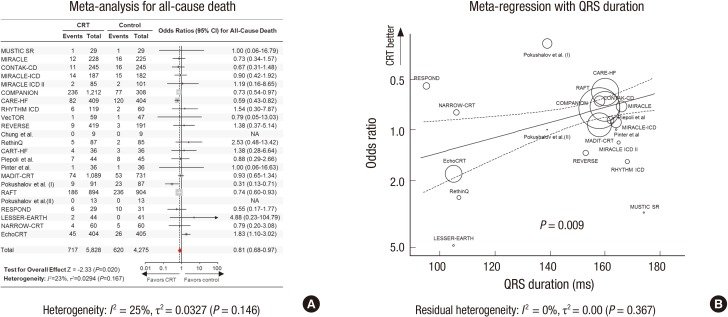
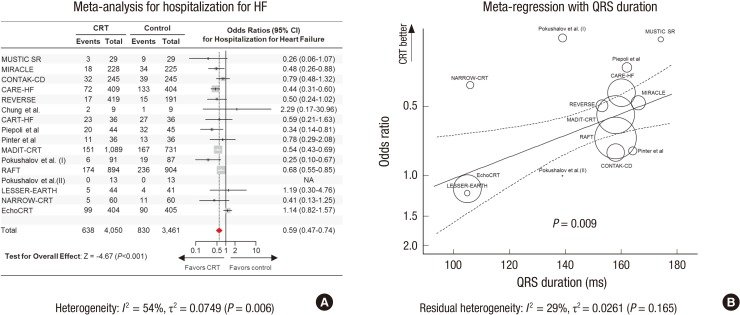
Cardiac resynchronization therapy (CRT) has been shown to reduce the risk of death and hospitalization in patients with advanced heart failure with left ventricular dysfunction. However, controversy remains regarding who would most benefit from CRT. We performed a meta-analysis, and meta-regression in an attempt to identify factors that determine the outcome after CRT. A total of 23 trials comprising 10,103 patients were selected for this meta-analysis. Our analysis revealed that CRT significantly reduced the risk of all-cause mortality and hospitalization for heart failure compared to control treatment. The odds ratio (OR) of all-cause death had a linear relationship with mean QRS duration (P=0.009). The benefit in survival was confined to patients with a QRS duration ≥145 ms (OR, 0.86; 95% CI, 0.74-0.99), while no benefit was shown among patients with a QRS duration of 130 ms (OR, 1.00; 95% CI, 0.80-1.25) or less. Hospitalization for heart failure was shown to be significantly reduced in patients with a QRS duration ≥127 ms (OR, 0.77; 95% CI, 0.60-0.98). This meta-regression analysis implies that patients with a QRS duration ≥150 ms would most benefit from CRT, and in those with a QRS duration <130 ms CRT implantation may be potentially harmful.

Keywords

Cardiac Resynchronization TherapyHeart FailureMeta-Analysis

Figures
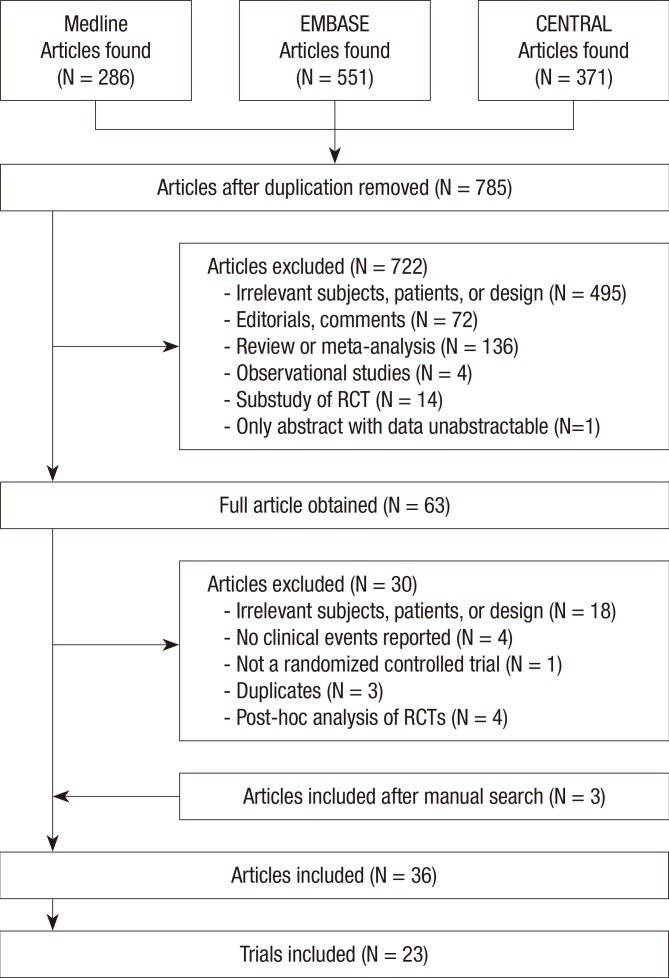
Fig. 1
Fig. 1 Flow diagram of systematic review. The flow diagram depicts the detailed process of systematic literature review according the statement of the Preferred Reporting Items for Systematic Reviews and Meta-Analyses (PRISMA) statement. RCT, randomized controlled trial.
Fig. 2
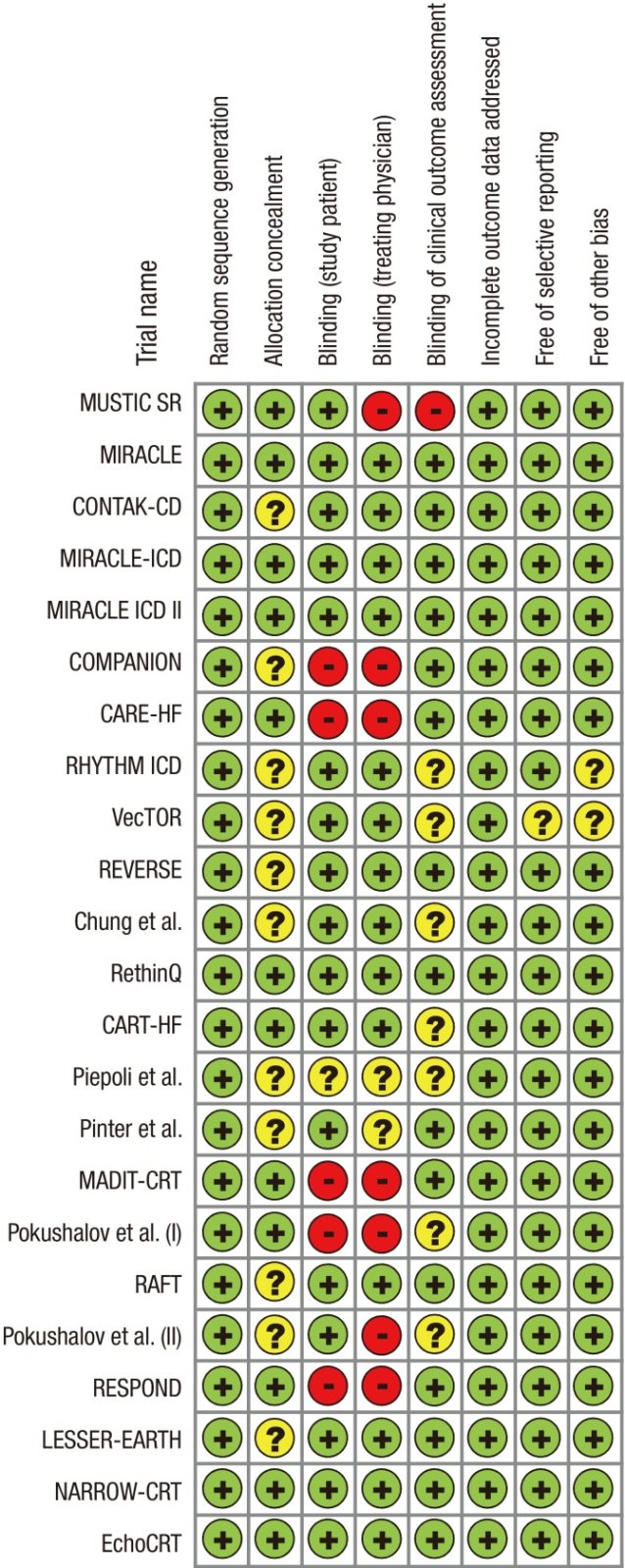
Fig. 2 Risk of bias assessment. Risk of bias of each included trial was assessed with the Cochrane Collaboration's tool. This 'risk of bias' summary presents all of the judgments in a cross-tabulation of study by entry. Green represents 'Yes (low risk of bias)'; yellow, 'Unclear'; red, 'No (high risk of bias)'.
Fig. 3
Fig. 3 Meta-analysis and meta-regression for all-cause mortality. (A) Forest plot with odds ratios (OR) for all-cause death after cardiac resynchronization therapy (CRT) compared to control treatment for individual trials and the pooled population. The squares and the horizontal lines indicate the ORs and the 95% confidence intervals (CI) for each included trial. The size of each square is proportional to the statistical weight of a trial in the meta-analysis. A diamond indicates the effect estimate derived from the meta-analysis, with the center indicating the point estimate and the left and the right ends the 95% CI. (B) OR of CRT compared to control as a function of the mean QRS duration of participants at enrollment. ORs are displayed on a logarithmic scale. Circles represent the individual studies, and the size of each circle is proportional to the statistical weight of a trial in the meta-analysis. The fitted meta-regression function is drawn in a solid line accompanied by the upper and lower bounds for the 95% mean prediction interval (dotted lines).
Fig. 4
Fig. 4 Meta-analysis and meta-regression for hospitalization for heart failure (HF). (A) Forest plot with odds ratios (OR) for hospitalization for HF after cardiac resynchronization therapy (CRT) compared to control treatment for individual trials and the pooled population. The squares and the horizontal lines indicate the ORs and the 95% confidence intervals (CI) for each trial included. The size of each square is proportional to the statistical weight of a trial in the meta-analysis. A diamond indicates the effect estimate derived from the meta-analysis, with the center indicating the point estimate and the left and the right ends the 95% CI. (B) OR for HF hospitalization after CRT compared to control as a function of the mean QRS duration of participants at enrollment. ORs are displayed on a logarithmic scale. Circles represent the individual studies, and the size of each circle is proportional to the statistical weight of the trial in the meta-analysis. The fitted meta-regression function is drawn in a solid line accompanied by the upper and lower bounds for the 95% mean prediction interval (dotted lines).

그림 출처: PubMed Central 공개 논문 (PMC4278024)

Conflict of interest statement

The authors have no potential financial conflicts on this subject.

그 밖의 정보
출판 형태
Journal Article, Meta-Analysis, Systematic Review
저널
Journal of Korean medical science · eISSN 1598-6357
전자 출판
2014-12-23
MeSH
Bundle-Branch Block / physiopathology · Cardiac Resynchronization Therapy / methods · Cardiac Resynchronization Therapy Devices · Defibrillators, Implantable · Electrocardiography · Heart Failure / mortality / physiopathology / therapy · Humans · Myocardial Contraction / physiology · Treatment Outcome · Ventricular Dysfunction, Left / mortality / physiopathology / therapy
참고문헌
48편