
Sci Rep. 2019;9(1):13207.
Step-wise endoscopic approach to palliative bilateral biliary drainage for unresectable advanced malignant hilar obstruction.
제1저자 최진호 · 교신저자 이상협
소속 (3)
- Department of Internal Medicine, Liver Research Institute, Seoul National University College of Medicine, Seoul, Korea.
- Department of Internal Medicine, Liver Research Institute, Seoul National University College of Medicine, Seoul, Korea. gidoctor@snuh.org.
- Department of Gastroenterology and Hepatology, Cleveland Clinic, Cleveland, USA.
Abstract
The ideal type of stent utilized at index endoscopic retrograde cholangiopancreatography (ERCP) in management of malignant hilar obstruction (MHO) remains unclear. We aimed to determine the ideal stent choice in patients with MHO. In this retrospective study, patients with unresectable MHO were separated into the plastic stent (PS) group and the self-expandable metal stent (SEMS) group. The primary outcome was the risk and rate of rescue percutaneous transhepatic biliary drainage (PTBD). The secondary outcomes were the progression-free survival, the overall survival and the PTBD-free period (days). Thirty-six patients in the PS group and 38 patients in the SEMS group were enrolled. The risk for PTBD was higher in SEMS group (HR = 2.205, 95% C.I. 0.977-4.977, P = 0.057). The rate of PTBD was significantly lower in the PS group. (22.2% vs 50.0%, P = 0.017) There were no differences in overall survival and progression-free survival (410 and 269 in the PS group, 395 and 266 in the SEMS group, P = 0.663 and P = 0.757). The PTBD-free period was significantly longer in the PS group. (836.43 vs 586.40, P = 0.039) Although comparable in clinical efficacy, utilization of PS at index ERCP may reduce patient's discomfort by avoiding PTBD and prolonging PTBD-free period in patients with MHO.
Figures
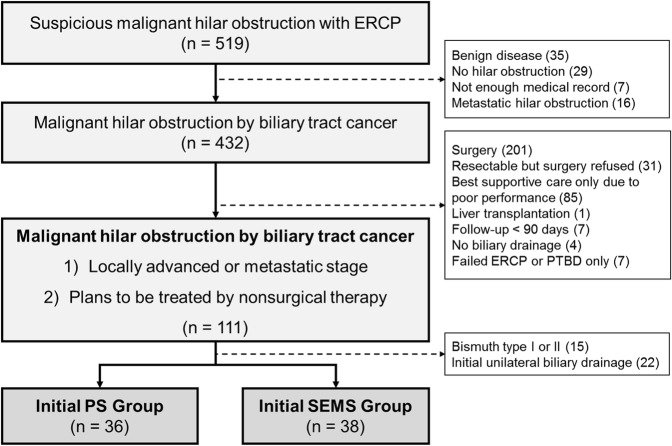
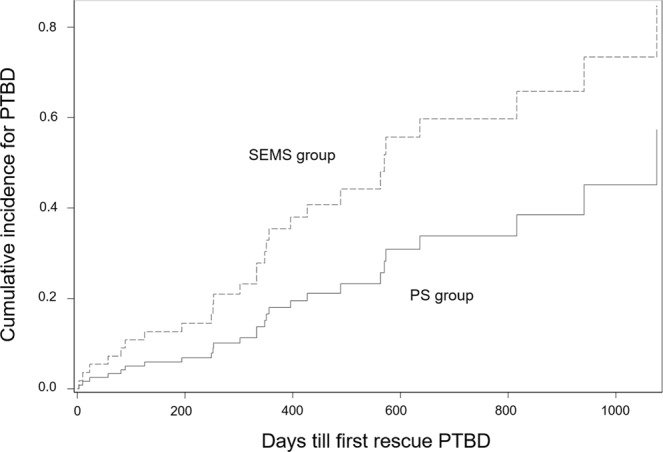
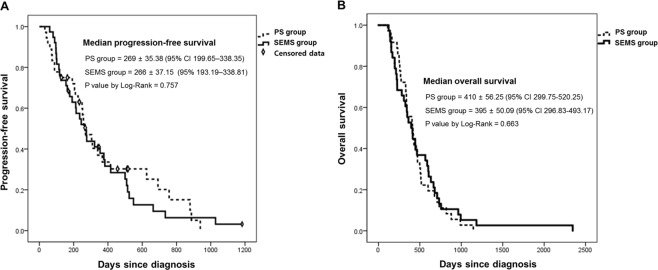
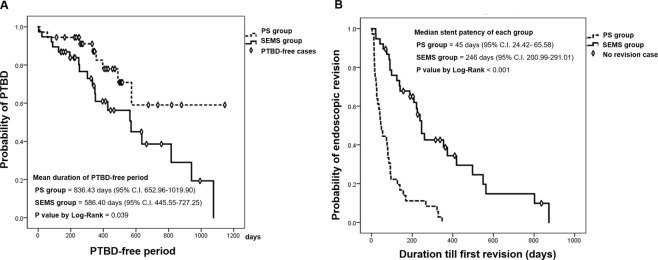
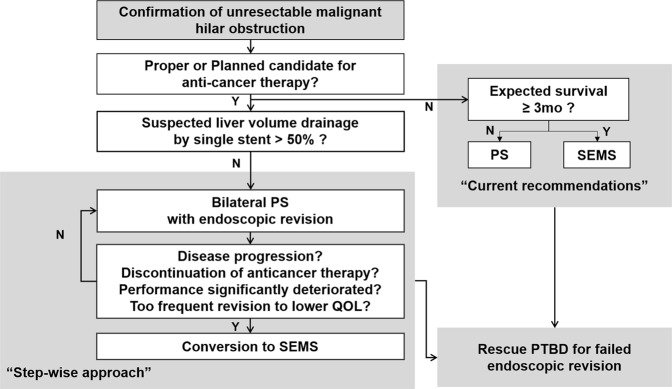
그림 출처: PubMed Central 공개 논문 (PMC6744501)
Conflict of interest statement
The authors declare no competing interests.
그 밖의 정보
- 출판 형태
- Journal Article, Research Support, Non-U.S. Gov't
- 저널
- Scientific reports · eISSN 2045-2322
- 전자 출판
- 2019-09-13
- MeSH
- Aged · Bile Duct Neoplasms / mortality / surgery / therapy · Bile Ducts, Intrahepatic / surgery · Cholangiopancreatography, Endoscopic Retrograde / instrumentation / methods · Drainage · Female · Gallbladder Neoplasms / mortality / surgery / therapy · Humans · Kaplan-Meier Estimate · Klatskin Tumor / surgery / therapy · Male · Middle Aged · Plastics · Retrospective Studies · Self Expandable Metallic Stents · Stents* · Treatment Outcome
- Substances
- Plastics
- 참고문헌
- 23편