
JACC Asia. 2023;3(2):198-207.
Cost-Effectiveness of Clopidogrel vs Aspirin Monotherapy After Percutaneous Coronary Intervention: Results From the HOST-EXAM Study.
제1저자 황도연, 김희림 · 교신저자 이태진, 김효수
소속 (9)
- Department of Internal Medicine and Cardiovascular Center, Seoul National University Hospital, Seoul, South Korea.
- Department of Public Health Sciences, Graduate School of Public Health, Seoul National University, Seoul, South Korea.
- Institute of Health and Environment, Seoul National University, Seoul, South Korea.
- Department of Cardiology, Ulsan University Hospital, Ulsan, South Korea.
- Cardiovascular Center, Korea University Guro Hospital, Seoul, South Korea.
- Division of Cardiology, Department of Internal Medicine, Chungbuk National University College of Medicine, Chungbuk, South Korea.
- Keele Cardiovascular Research Group, Centre for Prognosis Research, Institute for Primary Care and Health Sciences, Keele University, Staffordshire, United Kingdom.
- Cardiovascular Research Foundation, New York, New York, USA.
- St. Francis Hospital, Roslyn, New York, USA.
Abstract
BACKGROUND The HOST-EXAM (Harmonizing Optimal Strategy for Treatment of Coronary Artery Disease-Extended Antiplatelet Monotherapy) trial showed superior efficacy and safety of clopidogrel monotherapy compared with aspirin monotherapy during the chronic maintenance period after percutaneous coronary intervention (PCI).
OBJECTIVES The goal of this study was to investigate the cost-effectiveness of clopidogrel monotherapy compared with that of aspirin monotherapy.
METHODS A Markov model was developed for patients in the stable phase after PCI. From the perspectives of the South Korean, UK, and U.S. health care systems, the lifetime health care costs and quality-adjusted life-years (QALYs) of each strategy were estimated. Transition probabilities were obtained from the HOST-EXAM trial, and health care costs and health-related utilities were obtained from data and literature for each country.
RESULTS From the perspective of the South Korean health care system, the base-case analysis showed that clopidogrel monotherapy was $3,192 higher in lifetime health care costs and 0.139 lower in QALYs compared with aspirin. This result was greatly influenced by the numerically but insignificantly higher cardiovascular mortality of clopidogrel compared with aspirin. In the analogous UK and U.S. models, clopidogrel monotherapy was projected to decrease health care costs by £1,122 and $8,920 per patient compared with aspirin monotherapy while reducing QALYs by 0.103 and 0.175, respectively.
CONCLUSIONS Based on empirical data from the HOST-EXAM trial, clopidogrel monotherapy was projected to lead to reduced QALYs compared with aspirin during the chronic maintenance period after PCI. These results were affected by a numerically higher rate of cardiovascular mortality in clopidogrel monotherapy reported from the HOST-EXAM trial. (Harmonizing Optimal Strategy for Treatment of Coronary Artery Stenosis-Extended Antiplatelet Monotherapy [HOST-EXAM]; NCT02044250).
© 2023 The Authors.
Keywords
aspirinclopidogrelcoronary artery diseasecost-effectivenesspercutaneous coronary intervention
Figures
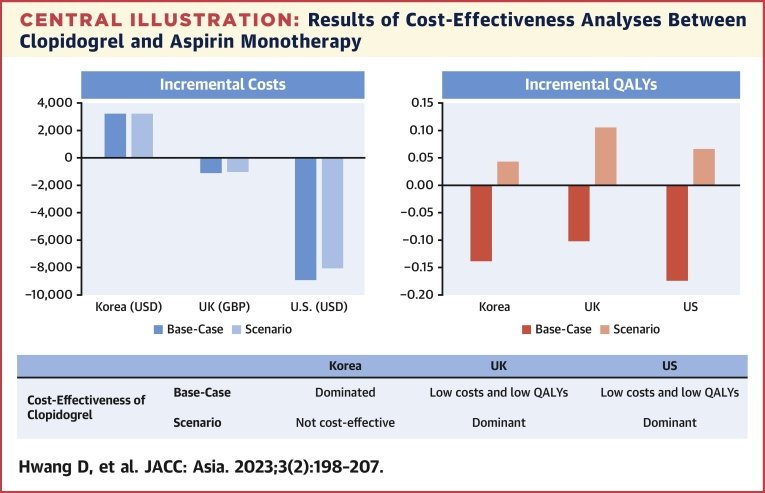
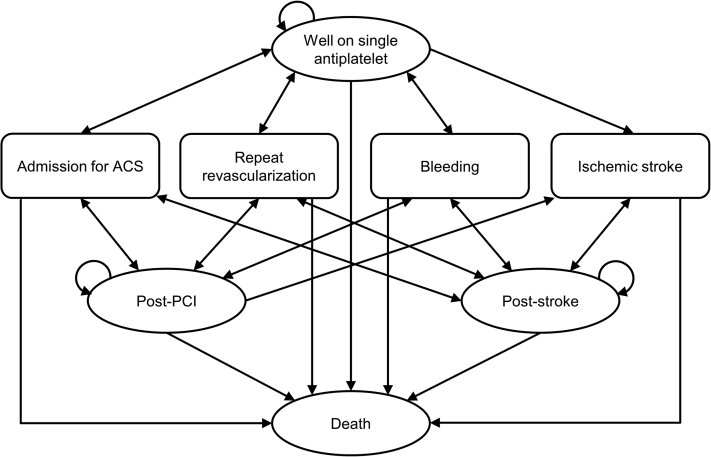
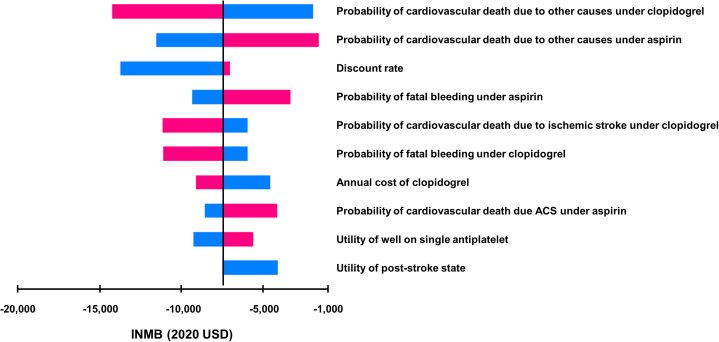
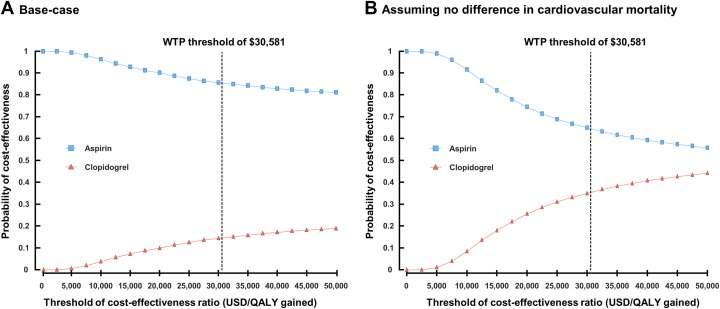
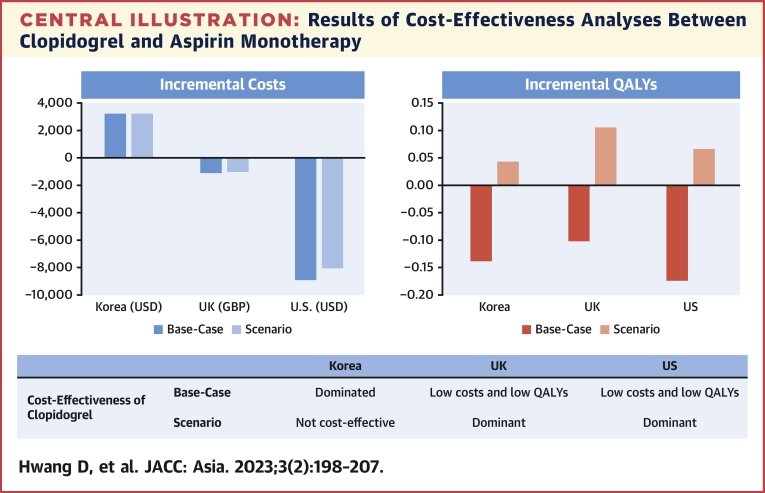
그림 출처: PubMed Central 공개 논문 (PMC10167521)
Comment · 정정
Conflict of interest statement
The funding sources were a consortium of 4 pharmaceutical Companies (ChongKunDang, SamJin, HanMi, and DaeWoong), grants from the Patient-Centered Clinical Research Coordinating Center (grant numbers HI19C0481 and HC19C0305), grants from Seoul National University Hospital (06-2011-3280, 06-2011-3680, and 06-2010-1560), and Korea Health Technology R&D Project (grant number HI17C2085) funded by the Ministry of Health & Welfare, South Korea. The funders had no role in study design, data collection, analysis, interpretation, or writing of the manuscript. Dr H.-S. Kim has received research grants or speaker fees from Daiichi Sankyo, Boston Scientific, Terumo, Biotronik, and Dio, as well as Medtronic, Abbott Vascular, Edwards Lifesciences, AmGen, and Boehringer Ingelheim. Dr Koo has received institutional research grants from Abbott Vascular and Philips. Dr Park has received fees from Daiichi Sankyo, AstraZeneca, Sanofi, Bristol Myers Squibb, Bayer AG, and Pfizer outside of the submitted work. Dr Mamas has received unrestricted education grants from Abbott, Terumo, and Medtronic; and speaker fees from Daiichi Sankyo, Bristol Myers Squibb, and Terumo. Dr Cohen has received research grant support from AstraZeneca and Daiichi Sankyo; and consulting income from MyoKardia, a subsidiary of Bristol Myers Squibb. There was no financial relationships with any organizations that might have an interest in this work in the previous 3 years. No other relationships or activities that could appear to have influenced the submitted work. All other authors have reported that they have no relationships relevant to the contents of this paper to disclose.
그 밖의 정보
- 출판 형태
- Journal Article
- 저널
- JACC. Asia · eISSN 2772-3747
- 전자 출판
- 2023-03-14
- 데이터
- ClinicalTrials.gov: NCT02044250
- 참고문헌
- 28편