
NPJ Digit Med. 2020;3:54.
Artificial intelligence for the diagnosis of heart failure.
제1저자 박진주, 최동주 · 교신저자 최동주, 이승룡
소속 (2)
- 1Division of Cardiology, Department of Internal Medicine, Seoul National University Bundang Hospital, Seongnam, Republic of Korea.
- 2Department of Computer Science and Engineering, Kyung Hee University, Yongin, Republic of Korea.
Abstract
The diagnosis of heart failure can be difficult, even for heart failure specialists. Artificial Intelligence-Clinical Decision Support System (AI-CDSS) has the potential to assist physicians in heart failure diagnosis. The aim of this work was to evaluate the diagnostic accuracy of an AI-CDSS for heart failure. AI-CDSS for cardiology was developed with a hybrid (expert-driven and machine-learning-driven) approach of knowledge acquisition to evolve the knowledge base with heart failure diagnosis. A retrospective cohort of 1198 patients with and without heart failure was used for the development of AI-CDSS (training dataset, n = 600) and to test the performance (test dataset, n = 598). A prospective clinical pilot study of 97 patients with dyspnea was used to assess the diagnostic accuracy of AI-CDSS compared with that of non-heart failure specialists. The concordance rate between AI-CDSS and heart failure specialists was evaluated. In retrospective cohort, the concordance rate was 98.3% in the test dataset. The concordance rate for patients with heart failure with reduced ejection fraction, heart failure with mid-range ejection fraction, heart failure with preserved ejection fraction, and no heart failure was 100%, 100%, 99.6%, and 91.7%, respectively. In a prospective pilot study of 97 patients presenting with dyspnea to the outpatient clinic, 44% had heart failure. The concordance rate between AI-CDSS and heart failure specialists was 98%, whereas that between non-heart failure specialists and heart failure specialists was 76%. In conclusion, AI-CDSS showed a high diagnostic accuracy for heart failure. Therefore, AI-CDSS may be useful for the diagnosis of heart failure, especially when heart failure specialists are not available.
© The Author(s) 2020.
Keywords
Heart failureOutcomes research
Figures
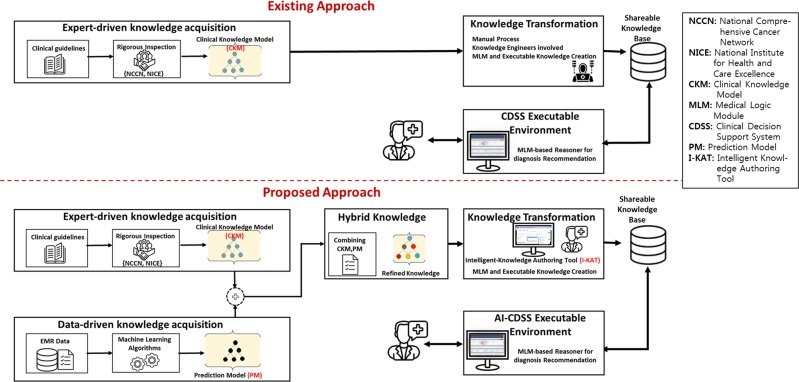
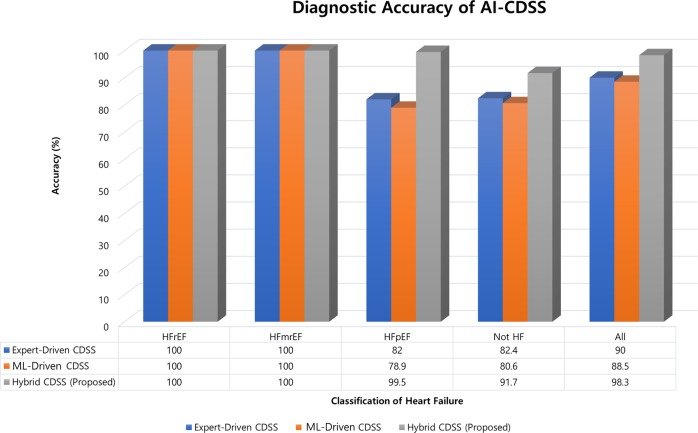
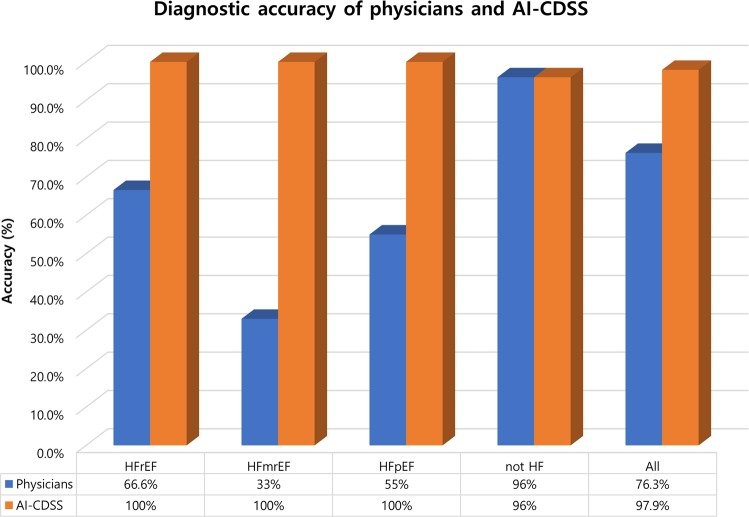
그림 출처: PubMed Central 공개 논문 (PMC7142093)
Conflict of interest statement
Competing interestsThe authors declare no competing interests.
그 밖의 정보
- 출판 형태
- Journal Article
- 저널
- NPJ digital medicine · eISSN 2398-6352
- 전자 출판
- 2020-04-08
- 참고문헌
- 20편