
Sci Rep. 2019;9(1):15662.
Neoadjuvant therapy versus upfront surgery in resectable pancreatic cancer according to intention-to-treat and per-protocol analysis: A systematic review and meta-analysis.
제1저자 이윤석, 이종찬 · 교신저자 황진혁
소속 (3)
- Department of Internal Medicine, Inje University College of Medicine, Ilsan Paik Hospital, Goyang, Republic of Korea.
- Department of Internal Medicine, Seoul National University College of Medicine, Seoul National University Bundang Hospital, Seongnam, Republic of Korea.
- Department of Internal Medicine, Seoul National University College of Medicine, Seoul National University Bundang Hospital, Seongnam, Republic of Korea. woltoong@snu.ac.kr.
Abstract
The effectiveness of neoadjuvant therapy (NAT) remains unclear in resectable pancreatic cancer (PC) as compared with upfront surgery (US). The aim of this study was to investigate the survival gain of NAT over US in resectable PC. PubMed and EMBASE were searched for studies comparing survival outcomes between NAT and US for resectable PC until June 2018. Overall survival (OS) was analyzed according to treatment strategy (NAT versus US) and analytic methods (intention-to-treat analysis (ITT) and per-protocol analysis (PP)). In 14 studies, 2,699 and 6,992 patients were treated with NAT and US, respectively. Although PP analysis showed the survival gain of NAT (HR 0.72, 95% CI 0.68-0.76), ITT analysis did not show the statistical significance (HR 0.96, 95% CI 0.82-1.12). However, NAT completed with subsequent surgery showed better survival over US completed with adjuvant therapy (HR 0.82, 95% CI 0.71-0.93). In conclusion, the supporting evidence for NAT in resectable PC was insufficient because the benefit was not demonstrated in ITT analysis. However, among the patients who completed both surgery and chemotherapy, NAT showed survival benefit over adjuvant therapy. Therefore, NAT could have a role of triaging the patients for surgery even in resectable PC.
Figures
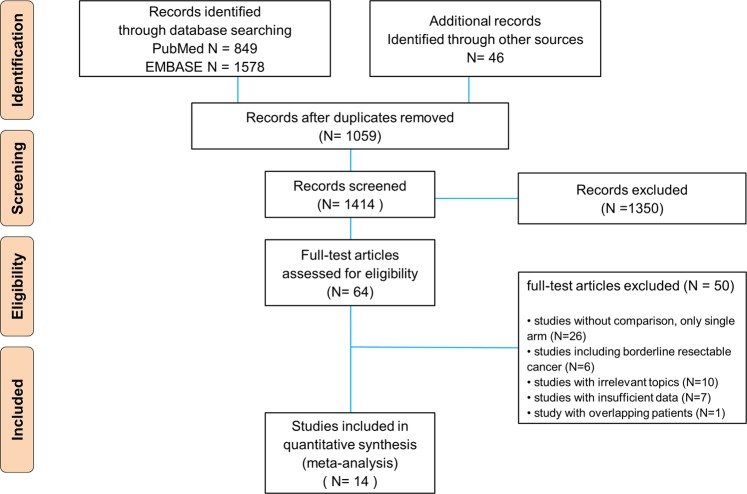
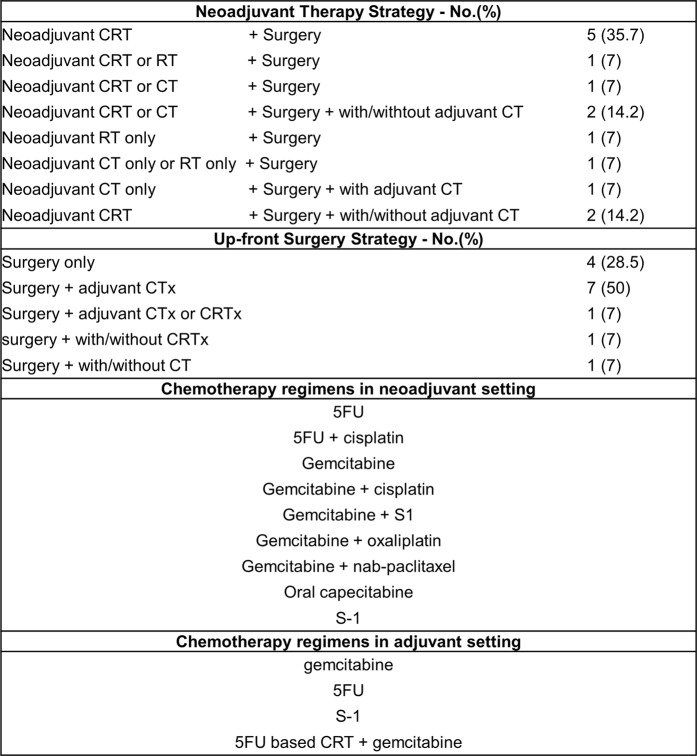
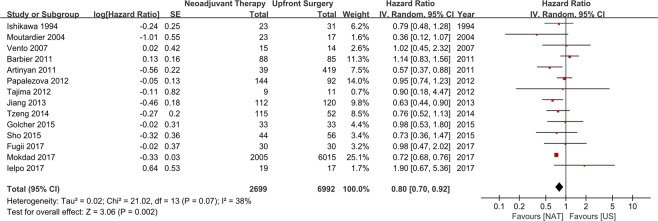
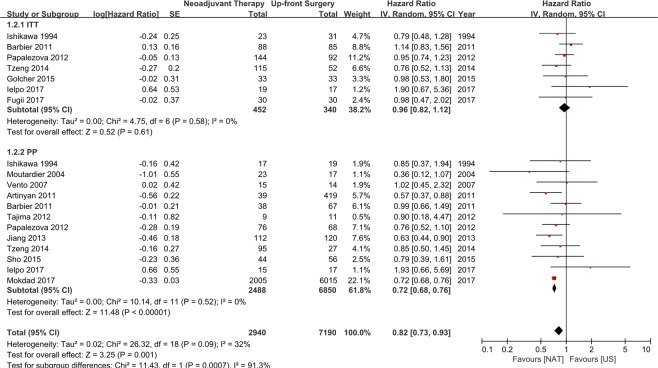
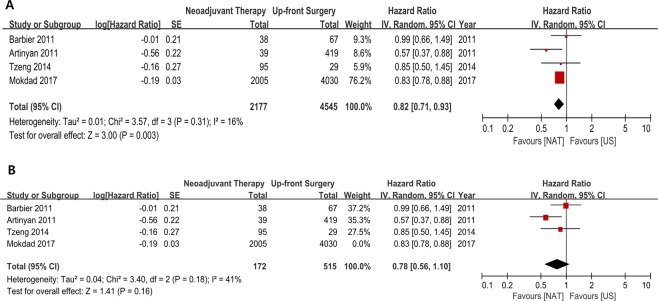
그림 출처: PubMed Central 공개 논문 (PMC6821820)
Conflict of interest statement
The authors declare no competing interests.
그 밖의 정보
- 출판 형태
- Comparative Study, Journal Article, Meta-Analysis, Research Support, Non-U.S. Gov't, Systematic Review
- 저널
- Scientific reports · eISSN 2045-2322
- 전자 출판
- 2019-10-30
- MeSH
- Humans · Intention to Treat Analysis* · Neoadjuvant Therapy* · Pancreatic Neoplasms / surgery / therapy
- 참고문헌
- 38편