
Sci Rep. 2019;9(1):16769.
Distinctive patterns of peripheral neuropathy across the spectrum of plasma cell disorders.
제1저자 변자민, 권영남 · 교신저자 김인호, 성정준
소속 (4)
- Department of Internal Medicine, Seoul National University College of Medicine, Seoul National University Hospital, Seoul, South Korea.
- Department of Neurology, Seoul National University College of Medicine, Seoul National University Hospital, Seoul, South Korea.
- Department of Neurology, Seoul National University College of Medicine, Seoul National University Hospital, Seoul, South Korea. jjsaint@snu.ac.kr.
- Department of Internal Medicine, Seoul National University College of Medicine, Seoul National University Hospital, Seoul, South Korea. ihkimmd@snu.ac.kr.
Abstract
Many patients with plasma cell disorders suffer from peripheral neuropathy, but differential diagnosis with chronic inflammatory demyelinating polyneuropathy (CIDP) is difficult. We aimed to (1) identify factors useful for differential diagnosis between peripheral neuropathy associated with plasma cell disorders versus CIDP and (2) determine whether neuropathy presentations and severity varied across the spectrum of different plasma cell disorders. A retrospective chart review of 18 monoclonal gammopathy of unknown significance (MGUS) patients, 15 POEMS syndrome patients and 34 CIDP patients between January 2005 and December 2016 was conducted. The peripheral neuropathy associated with plasma cell disorders seemed to be more sensory oriented compared to CIDP. MGUS patients were significantly older than CIDP patients (median age 70 vs. 59, respectively, p = 0.027). POEMS syndrome patients showed significantly higher platelet count at the time of neuropathy presentation compared to CIDP (p = 0.028). Lambda type MGUS patients were associated with less severe symptoms compared to POEMS syndrome patients despite harboring lambda monoclonal gammopathy as a common denominator. Kappa type MGUS patients showed predominantly axonal type neuropathy compared to its counterpart and POEMS syndrome. Careful inspection of clinical profiles and symptoms of patients presenting with neuropathy can help to discriminate those with underlying plasma cell disorders. The phenotype of neuropathy, platelet count and age at presentation seem to be the most useful indicators.
Figures
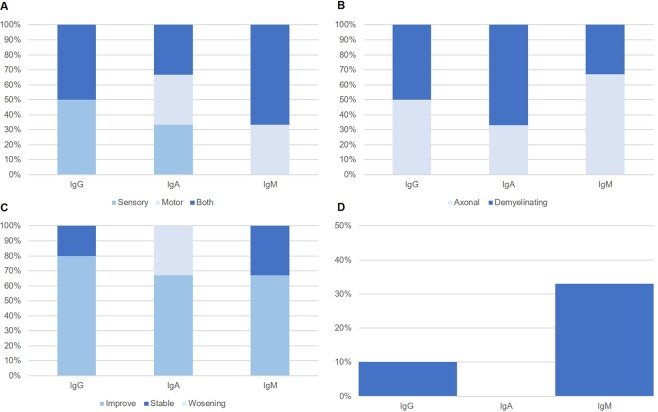
그림 출처: PubMed Central 공개 논문 (PMC6856063)
Conflict of interest statement
The authors declare no competing interests.
그 밖의 정보
- 출판 형태
- Journal Article, Research Support, Non-U.S. Gov't
- 저널
- Scientific reports · eISSN 2045-2322
- 전자 출판
- 2019-11-14
- MeSH
- Adult · Age Factors · Aged · Aged, 80 and over · Diagnosis, Differential · Female · Humans · Male · Middle Aged · Monoclonal Gammopathy of Undetermined Significance / complications · POEMS Syndrome / diagnosis / etiology / pathology · Platelet Count · Polyradiculoneuropathy, Chronic Inflammatory Demyelinating / diagnosis / etiology / pathology · Retrospective Studies · Severity of Illness Index
- 참고문헌
- 20편