
Clin Mol Hepatol. 2023;29(4):924-944.
Evidence-based hyponatremia management in liver disease.
제1저자 백선하 · 교신저자 김세중
소속 (4)
- Department of Internal Medicine, Hallym University Dongtan Sacred Heart Hospital, Hwaseong, Korea.
- Department of Internal Medicine, Seoul University Bundang Hospital, Seongnam, Korea.
- Center for Artificial Intelligence in Healthcare, Seoul University Bundang Hospital, Seongnam, Korea.
- Department of Internal Medicine, Seoul National University College of Medicine, Seoul, Korea.
Abstract
Hyponatremia is primarily a water balance disorder associated with high morbidity and mortality. The pathophysiological mechanisms behind hyponatremia are multifactorial, and diagnosing and treating this disorder remains challenging. In this review, the classification, pathogenesis, and step-by-step management approaches for hyponatremia in patients with liver disease are described based on recent evidence. We summarize the five sequential steps of the traditional diagnostic approach: 1) confirm true hypotonic hyponatremia, 2) assess the severity of hyponatremia symptoms, 3) measure urine osmolality, 4) classify hyponatremia based on the urine sodium concentration and extracellular fluid status, and 5) rule out any coexisting endocrine disorder and renal failure. Distinct treatment strategies for hyponatremia in liver disease should be applied according to the symptoms, duration, and etiology of disease. Symptomatic hyponatremia requires immediate correction with 3% saline. Asymptomatic chronic hyponatremia in liver disease is prevalent and treatment plans should be individualized based on diagnosis. Treatment options for correcting hyponatremia in advanced liver disease may include water restriction; hypokalemia correction; and administration of vasopressin antagonists, albumin, and 3% saline. Safety concerns for patients with liver disease include a higher risk of osmotic demyelination syndrome.
Keywords
HyponatremiaLiver cirrhosisLiver diseaseWater-electrolyte imbalance
Figures

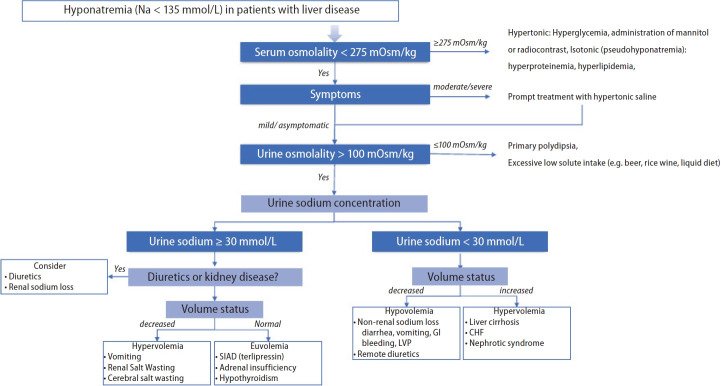
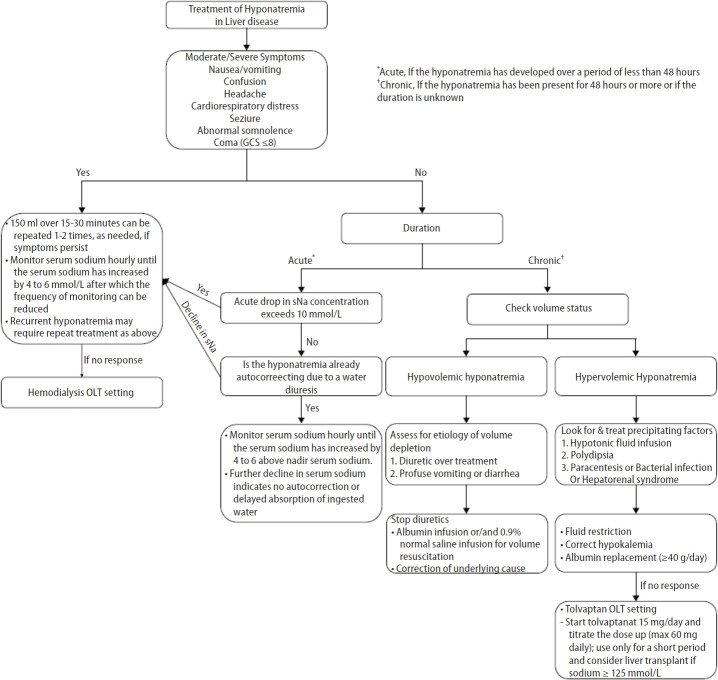

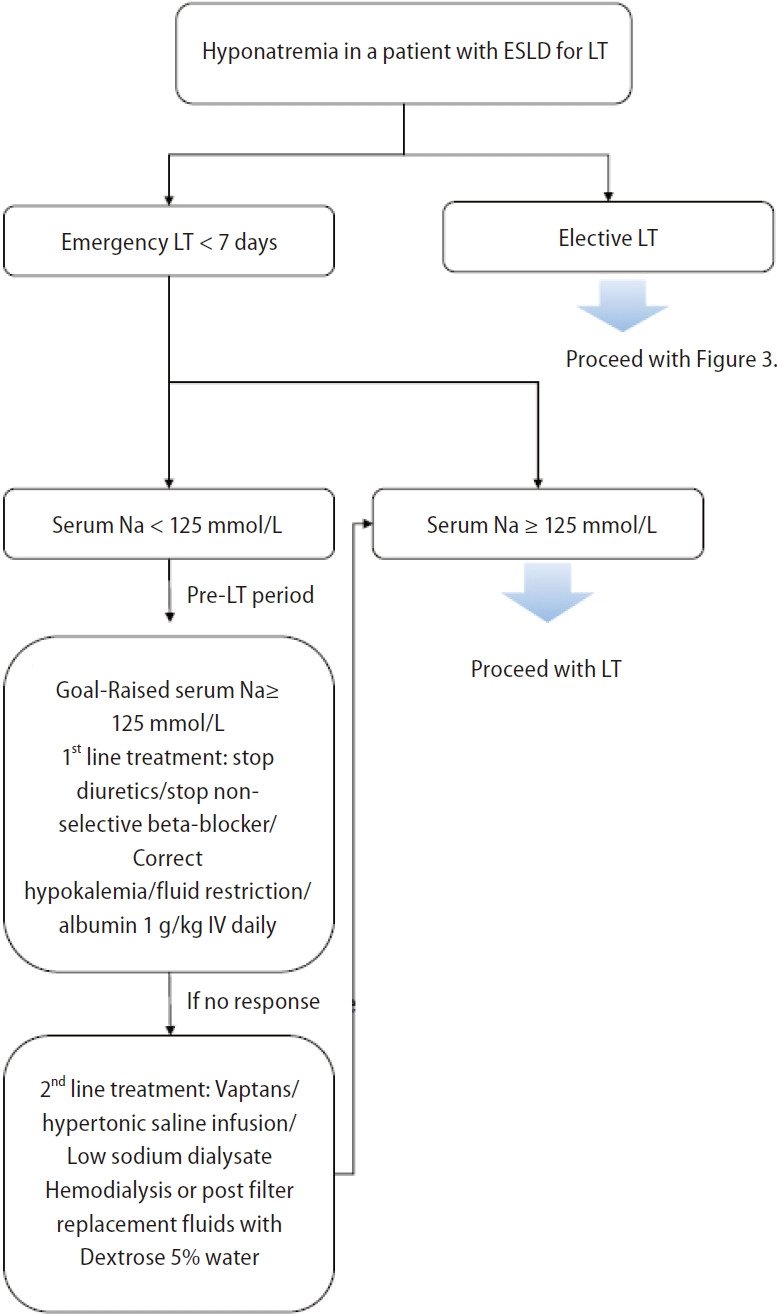
그림 출처: PubMed Central 공개 논문 (PMC10577348)
Comment · 정정
Conflict of interest statement
Conflicts of Interest . The authors have no conflicts to disclose.
그 밖의 정보
- 출판 형태
- Journal Article, Review
- 저널
- Clinical and molecular hepatology · eISSN 2287-285X
- 전자 출판
- 2023-06-05
- MeSH
- Humans · Hyponatremia* / diagnosis / etiology / therapy · Liver Diseases* / complications / diagnosis · Antidiuretic Hormone Receptor Antagonists / therapeutic use · Water
- Substances
- Antidiuretic Hormone Receptor Antagonists · Water
- 연구비
- National Research Foundation of Korea 2021R1C1C1008966
- 참고문헌
- 129편