
Clin Mol Hepatol. 2023;29(3):763-778.
Transarterial radioembolization versus tyrosine kinase inhibitor in hepatocellular carcinoma with portal vein thrombosis.
제1저자 허문행, 조유리 · 교신저자 김윤준
소속 (10)
- Department of Internal Medicine and Liver Research Institute, Seoul National University College of Medicine, Seoul, Korea.
- Center for Liver and Pancreatobiliary Cancer, National Cancer Center, Goyang, Korea.
- Department of Internal Medicine and Yonsei Liver Center, Severance Hospital, Yonsei University College of Medicine, Seoul, Korea.
- Department of Radiology, Severance Hospital, Yonsei University College of Medicine, Seoul, Korea.
- Department of Radiology, Seoul National University College of Medicine, Seoul, Korea.
- Department of Internal Medicine, Samsung Medical Center, Sungkyunkwan University School of Medicine, Seoul, Korea.
- Department of Radiology, Samsung Medical Center, Sungkyunkwan University School of Medicine, Seoul, Korea.
- Department of Internal Medicine, Ewha Womans University College of Medicine, Seoul, Korea.
- Department of Internal Medicine, Korea University Anam Hospital, Korea University College of Medicine, Seoul, Korea.
- Department of Radiology, National Cancer Center, Goyang, Korea.
Abstract
BACKGROUND/AIMS Transarterial radioembolization (TARE) has shown promising results in treating advanced hepatocellular carcinoma (HCC) with portal vein tumor thrombosis (PVTT). However, whether TARE can provide superior or comparable outcomes to tyrosine kinase inhibitor (TKI) in patients with HCC and PVTT remains unclear. We compared the outcomes of TARE and TKI therapy in treatment-naïve patients with locally advanced HCC and segmental or lobar PVTT.
METHODS This multicenter study included 216 patients initially treated with TARE (n=124) or TKI (sorafenib or lenvatinib; n=92) between 2011 and 2021. Baseline characteristics were balanced using propensity score matching (PSM) or inverse probability of treatment weighting (IPTW). The primary outcome was overall survival (OS). The secondary outcomes included progression-free survival (PFS) and objective response rate (ORR).
RESULTS In the unmatched cohort, the median OS of the TARE and TKI groups were 28.2 and 7.2 months, respectively (p<0.001), and the TARE group experienced significantly and independently longer OS compared to the TKI group (adjusted hazard ratio=0.41, 95% confidence interval=0.28-0.60, p<0.001). Similar results were observed in the study cohorts balanced with IPTW (p=0.003) or PSM (p=0.004). Although PFS was comparable between the two groups, the TARE group showed a trend of prolonged PFS in a subpopulation of patients with Vp1 or Vp2 PVTT (p=0.052). In the matched cohorts, the ORR of the TARE group was 53.0-56.7%, whereas that of the TKI group was 12.3-15.0%.
CONCLUSION For patients with advanced HCC with segmental or lobar PVTT and well-preserved liver function, TARE may provide superior OS compared to sorafenib or lenvatinib.
Keywords
Hepatocellular carcinomaLenvatinibPortal vein tumor thrombusSorafenibTransarterial radioembolization
Figures
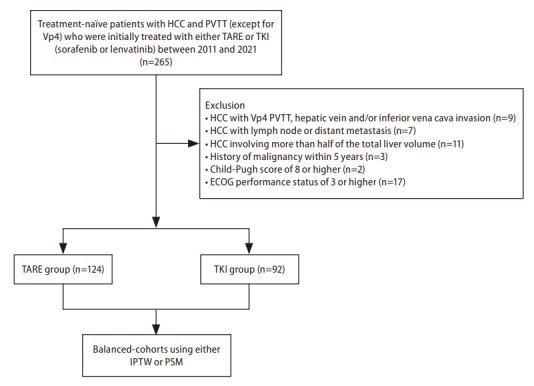
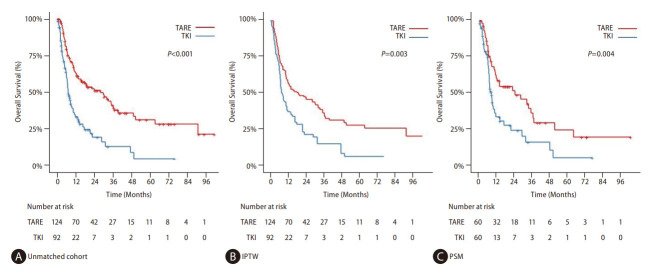
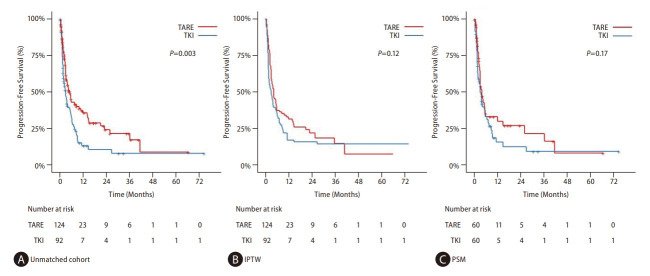
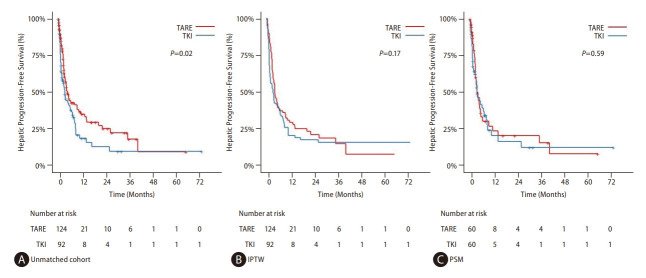
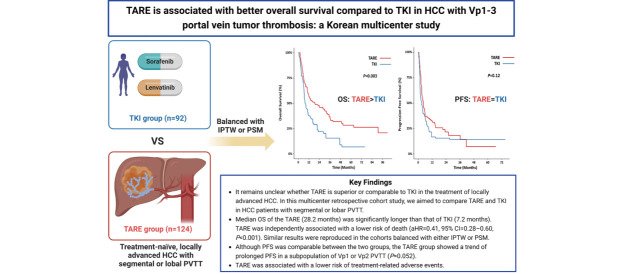
그림 출처: PubMed Central 공개 논문 (PMC10366806)
Comment · 정정
Conflict of interest statement
Conflicts of Interest . Dr. Yoon Jun Kim receives research grants from BTG, Boston Scientific, AstraZeneca, Gilead Sciences, Samjin, BL&H, and Bayer, and lecture feesfrom Roche, Abbvie, Eisai, Boston Scientific, BMS, BTG, Bayer, MSD, Novo Nordisk, Green Cross Cell, Boehringer Ingelheim, and Gilead Sciences. The other authors have nothing to disclose that would be relevant for the publication of this manuscript.
그 밖의 정보
- 출판 형태
- Multicenter Study, Journal Article
- 저널
- Clinical and molecular hepatology · eISSN 2287-285X
- 전자 출판
- 2023-05-30
- MeSH
- Humans · Carcinoma, Hepatocellular* / complications / therapy · Sorafenib / therapeutic use · Liver Neoplasms* / pathology · Tyrosine Kinase Inhibitors · Portal Vein / pathology · Retrospective Studies · Protein Kinase Inhibitors / therapeutic use · Thrombosis* / therapy · Treatment Outcome · Chemoembolization, Therapeutic* / methods · Phenylurea Compounds · Quinolines
- Substances
- Sorafenib · Tyrosine Kinase Inhibitors · Protein Kinase Inhibitors · lenvatinib · Phenylurea Compounds · Quinolines
- 연구비
- Korean Association for Study of the Liver · Korean Liver Foundation · Sirtex Technology PTY LTD · Korea Radioembolization Association
- 참고문헌
- 35편