
Clin Mol Hepatol. 2023;29(2):496-509.
Next-generation sequencing analysis of hepatitis C virus resistance-associated substitutions in direct-acting antiviral failure in South Korea.
제1저자 김경아, 이세준 · 교신저자 정숙향, 김승택
소속 (11)
- Department of Internal Medicine, Inje University Ilsan Paik Hospital, Goyang, Korea.
- Department of Precision Medicine Center/Department of Pathology and Translational Medicine, Seoul National University Bundang Hospital, Seongnam, Korea.
- Department of Internal Medicine, Institute of Gastroenterology, Yonsei University College of Medicine, Seoul, Korea.
- Department of Internal Medicine, Seoul National University Bundang Hospital, Seongnam, Korea.
- Department of Internal Medicine, Inje University Busan Paik Hospital, Busan, Korea.
- Department of Internal Medicine, Chonnam National University Hwasun Hospital, Hwasun, Korea.
- Department of Internal Medicine, Soonchunhyang University Bucheon Hospital, Bucheon, Korea.
- Department of Internal Medicine, Jeonbuk National University Hospital, Jeonju, Korea.
- Department of Internal Medicine, Chungnam National University Hospital, Daejoen, Korea.
- Department of Internal Medicine, Keimyung University School of Medicine, Daegu, Korea.
- Zoonotic Virus Laboratory, Institut Pasteur Korea, Seongnam, Korea.
Abstract
BACKGROUND/AIMS We used next-generation sequencing (NGS) to analyze resistance-associated substitutions (RASs) and retreatment outcomes in patients with chronic hepatitis C virus (HCV) infection who failed direct-acting antiviral agent (DAA) treatment in South Korea.
METHODS Using prospectively collected data from the Korean HCV cohort study, we recruited 36 patients who failed DAA treatment in 10 centers between 2007 and 2020; 29 blood samples were available from 24 patients. RASs were analyzed using NGS.
RESULTS RASs were analyzed for 13 patients with genotype 1b, 10 with genotype 2, and one with genotype 3a. The unsuccessful DAA regimens were daclatasvir+asunaprevir (n=11), sofosbuvir+ribavirin (n=9), ledipasvir/sofosbuvir (n=3), and glecaprevir/pibrentasvir (n=1). In the patients with genotype 1b, NS3, NS5A, and NS5B RASs were detected in eight, seven, and seven of 10 patients at baseline and in four, six, and two of six patients after DAA failure, respectively. Among the 10 patients with genotype 2, the only baseline RAS was NS3 Y56F, which was detected in one patient. NS5A F28C was detected after DAA failure in a patient with genotype 2 infection who was erroneously treated with daclatasvir+asunaprevir. After retreatment, 16 patients had a 100% sustained virological response rate.
CONCLUSION NS3 and NS5A RASs were commonly present at baseline, and there was an increasing trend of NS5A RASs after failed DAA treatment in genotype 1b. However, RASs were rarely present in patients with genotype 2 who were treated with sofosbuvir+ribavirin. Despite baseline or treatment-emergent RASs, retreatment with pan-genotypic DAA was highly successful in Korea, so we encourage active retreatment after unsuccessful DAA treatment.
Keywords
Drug resistance, viralGenotypeHepatitis C virusNext-generation sequencing
Figures

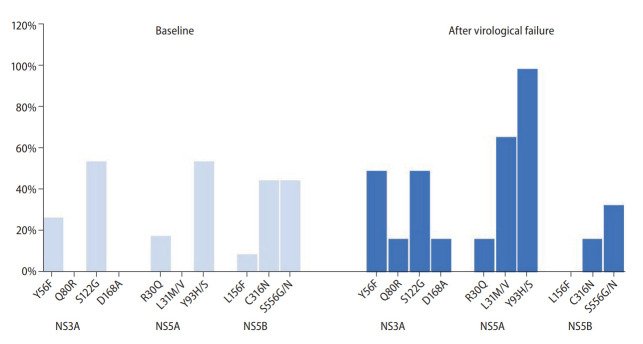
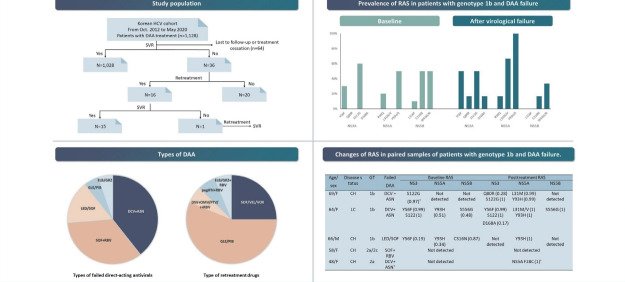
그림 출처: PubMed Central 공개 논문 (PMC10121280)
Comment · 정정
Conflict of interest statement
Conflicts of Interest . The authors have no conflictsto disclose.
그 밖의 정보
- 출판 형태
- Journal Article
- 저널
- Clinical and molecular hepatology · eISSN 2287-285X
- 전자 출판
- 2023-03-06
- MeSH
- Humans · Antiviral Agents / therapeutic use · Sofosbuvir / therapeutic use · Hepatitis C, Chronic* / drug therapy · Hepacivirus / genetics · Ribavirin / therapeutic use · Cohort Studies · Drug Resistance, Viral / genetics · Hepatitis C* / drug therapy · Genotype · High-Throughput Nucleotide Sequencing · Viral Nonstructural Proteins / genetics · Drug Therapy, Combination · Carbamates · Imidazoles · Pyrrolidines · Valine / analogs & derivatives · Isoquinolines · Sulfonamides
- Substances
- Antiviral Agents · Sofosbuvir · Ribavirin · Viral Nonstructural Proteins · daclatasvir · Carbamates · Imidazoles · Pyrrolidines · Valine · asunaprevir · Isoquinolines · Sulfonamides
- 연구비
- National Institute of Infectious Disease 2020-E5105-02 · National Institute of Infectious Disease 2020-E5104-02 · Korea Disease Control and Prevention Agency
- 참고문헌
- 40편