
Clin Hypertens. 2023;29(1):15.
Feasibility, credence, and usefulness of out-of-office cuffless blood pressure monitoring using smartwatch: a population survey.
제1저자 장용준 · 교신저자 이해영
소속 (5)
- Seoul National University College of Medicine, Seoul, South Korea.
- Department of Electrical and Computer Engineering, College of Engineering, Seoul National University, Seoul, South Korea.
- Division of Cardiology, Department of Internal Medicine, Bucheon St. Mary's Hospital, College of Medicine, The Catholic University of Korea, 101 Daehak-Ro, Jongno-Gu, Seoul, 03080, South Korea.
- Department of Internal Medicine, Seoul National University College of Medicine, Seoul, South Korea. hylee612@snu.ac.kr.
- Department of Internal Medicine, Seoul National University Hospital, Seoul, South Korea. hylee612@snu.ac.kr.
Abstract
BACKGROUND Cuffless blood pressure (BP) measurement, enabled by recent advances in wearable devices, allows for BP monitoring in daily life. This study aims to evaluate the feasibility, cresdence, and usefulness of cuffless BP monitoring through a population survey.
METHODS During the "Daily BP Measurement with Your Galaxy Watch" campaign held by the Korean Society of Hypertension, participants were asked to share their experiences with cuffless BP measurement using a smartwatch application through an online survey. The questionnaire included questions about age, underlying medical conditions, smartwatch utilization, experience with BP calibration, the reliability of BP values measured by a smartwatch, and willingness to use the BP monitoring function in the future.
RESULTS A total of 1071 participants responded to the survey. The largest age group (decile) was 50-59 years old (33.3%), followed by 40-49 years old (29.9%). Although nearly half of the participants (47.5%) had no chronic diseases, 40.1% reported having hypertension. BP monitoring was the most frequently utilized smartwatch function (95.8%), followed by heart rate measurement (87.1%). 31.8% of participants reported that BP values measured by the smartphone application were "very accurate and helpful," while 63.5% rated them as "slightly lower (44.4%)" or "higher (19.1%)" compared to the standard home BP monitoring device. 93% of the participants reported utilizing the BP monitoring function at least once a week. Regarding the BP calibration process, most participants (93.9%) calibrated the BP measurement application themselves, and 50.8% rated the difficulty level as "very easy."
CONCLUSION Cuffless BP measurement using a smartwatch application was feasible in the general population, including the self-calibration process. However, the satisfaction level in terms of accuracy is still modest, indicating a need for further development.
© 2023. The Author(s).
Keywords
Blood pressure monitoringCuffless blood pressure monitoringHypertensionSmartwatchSurvey
Figures
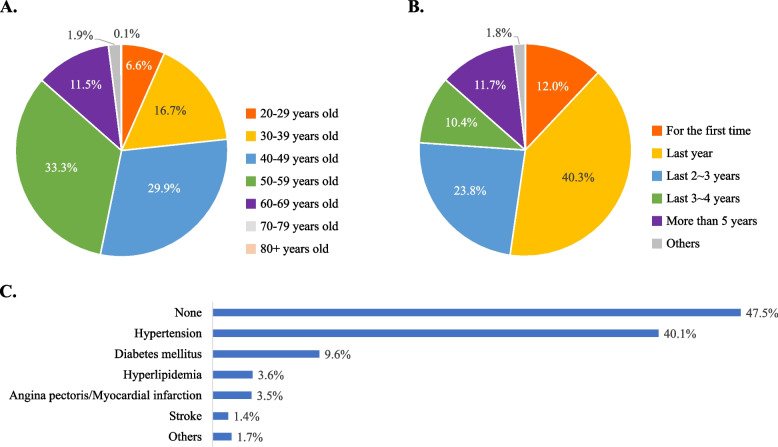
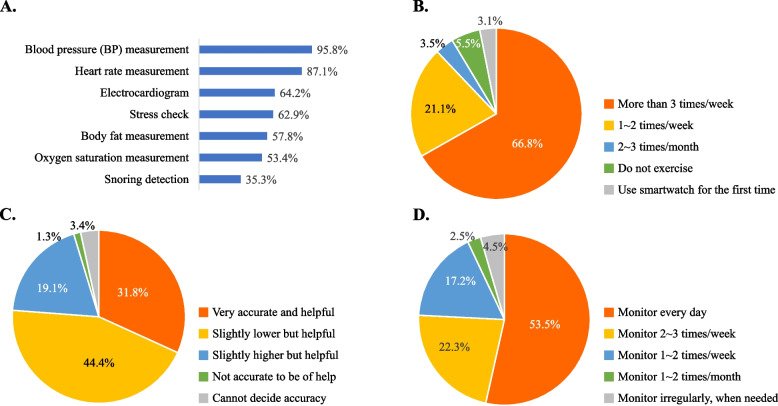
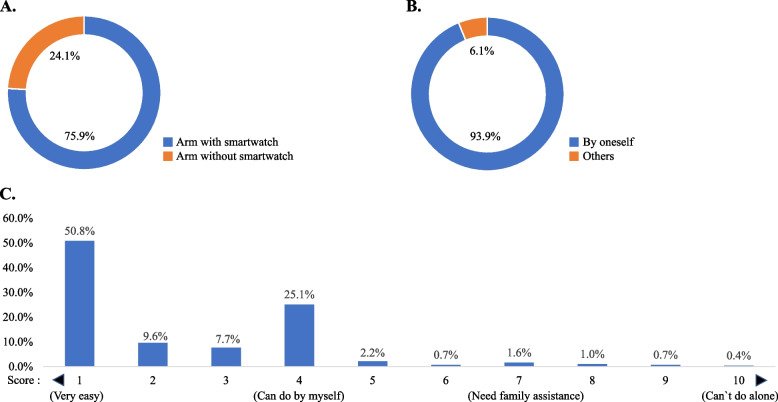
그림 출처: PubMed Central 공개 논문 (PMC10234022)
Conflict of interest statement
The authors declare that they have no competing interests.
그 밖의 정보
- 출판 형태
- Journal Article
- 저널
- Clinical hypertension · ISSN 2056-5909
- 전자 출판
- 2023-06-01
- 참고문헌
- 21편