
Sci Rep. 2019;9(1):18103.
Renin Angiotensin Aldosterone System Blockades Does Not Protect Residual Renal Function in Patients with Hemodialysis at 1 Year After Dialysis Initiation: A Prospective Observational Cohort Study.
제1저자 유경돈, Clara Tammy Kim · 교신저자 이정표
소속 (10)
- Department of Internal Medicine, Ulsan University Hospital, Ulsan, Korea.
- Institute of Life and Death Studies, Hallym University, Chuncheon, Korea.
- Department of Internal Medicine, Seoul National University Hospital, Seoul, Korea.
- Department of Internal Medicine, Seoul National University Boramae Medical Center, Seoul, Korea.
- Department of Internal Medicine, Seoul National University College of Medicine, Seoul, Korea.
- Department of Internal Medicine, Yonsei University College of Medicine, Seoul, Korea.
- Department of Internal Medicine, The Catholic University of Korea College of Medicine, Seoul, Korea.
- Department of Internal Medicine, Kyungpook National University School of Medicine, Daegu, Korea.
- Department of Internal Medicine, Seoul National University Boramae Medical Center, Seoul, Korea. nephrolee@gmail.com.
- Department of Internal Medicine, Seoul National University College of Medicine, Seoul, Korea. nephrolee@gmail.com.
Abstract
The beneficial effects of renin angiotensin aldosterone system (RAAS) blockade on residual renal function (RRF) in patients who have just initiated hemodialysis (HD) have been inconclusive. In this study, 935 patients with incident HD from a nationwide prospective observational cohort in Korea were included for analysis. The primary outcome showed that RRF as demonstrated by urine volume changes over 0, 3, and 12 months differed between the RAAS blockade and control groups. Mixed-effects linear regression was used to compare RRF between the groups. Patients in the RAAS group had a greater proportion of higher urine volume at study enrollment compared to the control group, but there was no difference in baseline characteristics, heart function, and dialysis-related indices. After adjusting for confounding factors, the RAAS group did not provide a significant benefit to RRF in a mixed-effects linear regression (p = 0.51). Male gender, high Charlson comorbidity index, diuretic use, and high weekly ultrafiltration volume were associated with faster decline in RRF. The RAAS group failed to provide a protective effect for the development of anuria 1 year after initiating dialysis based on the multivariate logistic regression (OR 0.73 95% CI 0.25-2.13, p = 0.57). In Korean patients with incident HD, RAAS blockade did not provide a protective effect for RRF after 1 year. Further research is needed to clarify the optimal treatment for preserving RRF in HD patients.
Figures
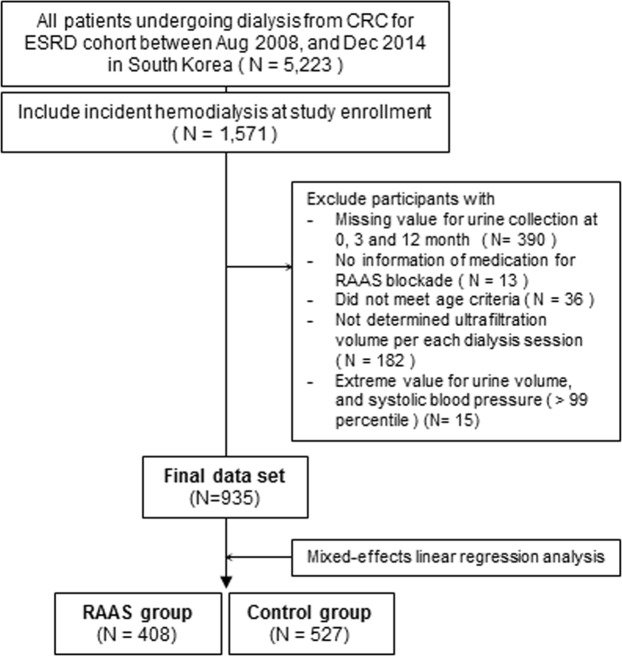
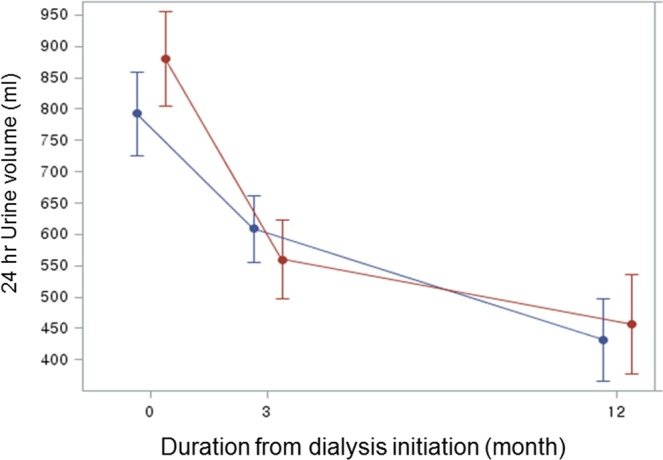
그림 출처: PubMed Central 공개 논문 (PMC6889305)
Conflict of interest statement
The authors declare no competing interests.
그 밖의 정보
- 출판 형태
- Journal Article, Multicenter Study, Observational Study, Research Support, Non-U.S. Gov't
- 저널
- Scientific reports · eISSN 2045-2322
- 전자 출판
- 2019-12-02
- MeSH
- Aged · Angiotensin-Converting Enzyme Inhibitors / therapeutic use · Anuria / etiology · Calcium Channel Blockers / therapeutic use · Case-Control Studies · Diuretics / therapeutic use · Female · Humans · Hypertension / drug therapy · Kidney / physiopathology · Kidney Function Tests · Male · Middle Aged · Prospective Studies · Renal Dialysis / adverse effects · Renal Insufficiency / drug therapy / etiology · Renin-Angiotensin System / drug effects
- Substances
- Angiotensin-Converting Enzyme Inhibitors · Calcium Channel Blockers · Diuretics
- 참고문헌
- 35편