
Invest New Drugs. 2011;29(6):1449-58.
Phase II study of sunitinib as second-line treatment for advanced gastric cancer.
제1저자 방영주 · 교신저자 방영주
소속 (1)
- Department of Internal Medicine, Seoul National University College of Medicine, Yongon-Dong 28, Chongno-Gu, Seoul, 110-799, Republic of Korea. bangyj@snu.ac.kr
Abstract
PURPOSE This phase II, open-label, multicenter study assessed the oral, multitargeted, tyrosine kinase inhibitor sunitinib in patients with advanced gastric or gastroesophageal junction adenocarcinoma who had received prior chemotherapy.
EXPERIMENTAL DESIGN Patients received sunitinib 50 mg/day on Schedule 4/2 (4 weeks on treatment, followed by 2 weeks off treatment). The primary endpoint was objective response rate; secondary endpoints included clinical benefit rate, duration of response, progression-free survival (PFS), overall survival (OS), pharmacokinetics, pharmacodynamics, safety and tolerability, and quality of life.
RESULTS Of 78 patients enrolled, most had gastric adenocarcinoma (93.6%) and metastatic disease (93.6%). All were evaluable for safety and efficacy. Two patients (2.6%) had partial responses and 25 patients (32.1%) had a best response of stable disease for ≥6 weeks. Median PFS was 2.3 months (95% confidence interval [CI], 1.6-2.6 months) and median OS was 6.8 months (95% CI, 4.4-9.6 months). Grade ≥ 3 thrombocytopenia and neutropenia were reported in 34.6% and 29.4% of patients, respectively, and the most common non-hematologic adverse events were fatigue, anorexia, nausea, diarrhea, and stomatitis. Pharmacokinetics of sunitinib and its active metabolite were consistent with previous reports. There were no marked associations between baseline soluble protein levels, or changes from baseline, and measures of clinical outcome.
CONCLUSIONS The progression-delaying effect and manageable toxicity observed with sunitinib in this study suggest that although single-agent sunitinib has insufficient clinical value as second-line treatment for advanced gastric cancer, its role in combination with chemotherapy merits further study.
Figures
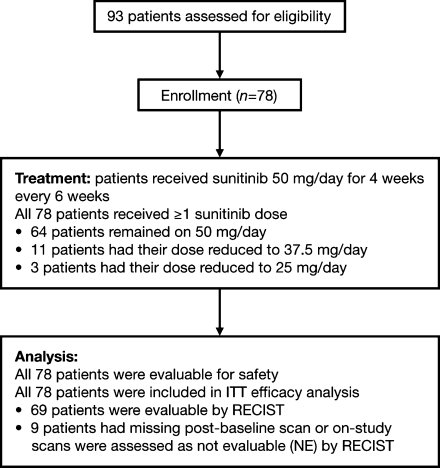
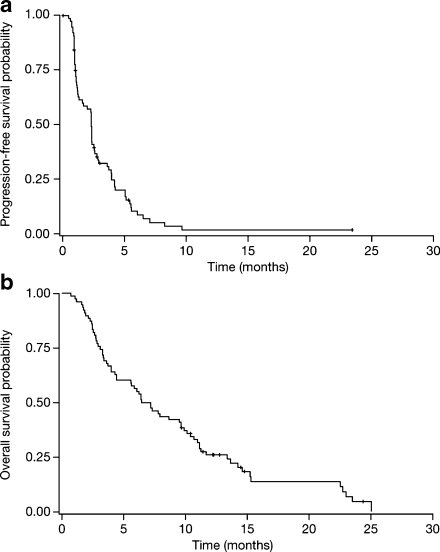
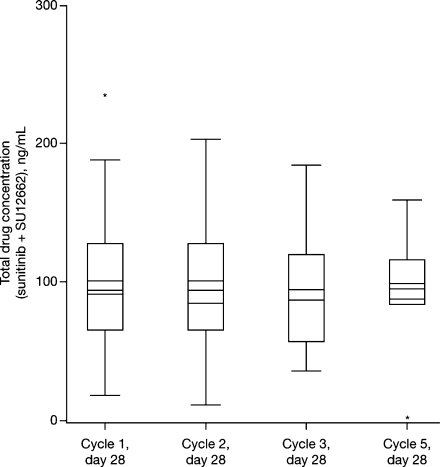
그림 출처: PubMed Central 공개 논문 (PMC3171673)
그 밖의 정보
- 출판 형태
- Clinical Trial, Phase II, Journal Article, Multicenter Study, Research Support, Non-U.S. Gov't
- 저널
- Investigational new drugs · eISSN 1573-0646
- 전자 출판
- 2010-05-12
- MeSH
- Adenocarcinoma / drug therapy / pathology · Adult · Aged · Antineoplastic Agents / adverse effects / pharmacokinetics / therapeutic use · Disease-Free Survival · Esophagogastric Junction / pathology · Female · Humans · Indoles / adverse effects / pharmacokinetics / therapeutic use · Male · Middle Aged · Protein Kinase Inhibitors / adverse effects / pharmacokinetics / therapeutic use · Pyrroles / adverse effects / pharmacokinetics / therapeutic use · Quality of Life · Stomach Neoplasms / drug therapy / pathology · Sunitinib · Treatment Outcome
- Substances
- Antineoplastic Agents · Indoles · Protein Kinase Inhibitors · Pyrroles · Sunitinib
- 참고문헌
- 45편