
Sci Rep. 2019;9(1):14707.
Urinary myo-inositol is associated with the clinical outcome in focal segmental glomerulosclerosis.
제1저자 안정남, 현진성, 이정표, 황금숙 · 교신저자 이정표, 황금숙
소속 (13)
- Department of Internal Medicine-Nephrology, Seoul National University Boramae Medical Center, Seoul, Korea.
- Integrated Metabolomics Research Group, Western Seoul Center, Korea Basic Science Institute, Seoul, Korea.
- Graduate School of Pharmaceutical Sciences, Ewha Womans University, Seoul, Korea.
- Kidney Research Institute, Seoul National University, Seoul, Korea.
- Department of Biostatistics, Seoul National University Boramae Medical Center, Seoul, Korea.
- Department of Internal Medicine-Nephrology, Seoul National University Hospital, Seoul, Korea.
- Department of Internal Medicine-Nephrology, Kyung Hee University Hospital at Gangdong, Seoul, Korea.
- Department of Internal Medicine-Nephrology, Kyungpook National University Hospital, Daegu, Korea.
- Department of Internal Medicine, Seoul National University College of Medicine, Seoul, Korea.
- Department of Internal Medicine-Nephrology, Seoul National University Boramae Medical Center, Seoul, Korea. nephrolee@gmail.com.
- Department of Internal Medicine, Seoul National University College of Medicine, Seoul, Korea. nephrolee@gmail.com.
- Integrated Metabolomics Research Group, Western Seoul Center, Korea Basic Science Institute, Seoul, Korea. gshwang@kbsi.re.kr.
- Department of Chemistry and Nano Science, Ewha Womans University, Seoul, Korea. gshwang@kbsi.re.kr.
Abstract
Focal segmental glomerulosclerosis (FSGS) and minimal change disease (MCD) have similar initial histological findings; however, their prognoses are distinct. Therefore, it is of great importance to discriminate FSGS from MCD in the early phase of disease and predict clinical prognosis. A discovery set of 184 urine samples (61 healthy control, 80 MCD, and 43 FSGS) and a validation set of 61 urine samples (12 healthy control, 26 MCD, and 23 FSGS) were collected at the time of kidney biopsy. Metabolic profiles were examined using nuclear magnetic resonance spectroscopy. Of 70 urinary metabolites, myo-inositol was significantly higher in FSGS patients than in control patients (discovery set, 2.34-fold, P < 0.001; validation set, 2.35-fold, P = 0.008) and MCD patients (discovery set, 2.48-fold, P = 0.002; validation set, 1.69-fold, P = 0.042). Myo-inositol showed an inverse relationship with the initial estimated glomerular filtration rate (eGFR) and was associated with the plasma level of soluble urokinase-type plasminogen activator receptor in FSGS patients. Myo-inositol treatment ameliorated the decreased expression of ZO-1 and synaptopodin in an in vitro FSGS model, and as myo-inositol increased, myo-inositol oxygenase tissue expression decreased proportionally to eGFR. Furthermore, urinary myo-inositol exhibited an increase in the power to discriminate FSGS patients, and its addition could better predict the response to initial treatment. In conclusion, urinary myo-inositol may be an important indicator in the diagnosis and treatment of FSGS patients.
Figures
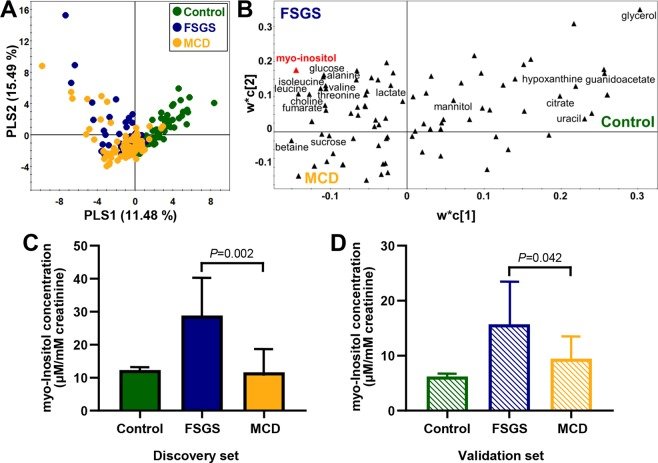
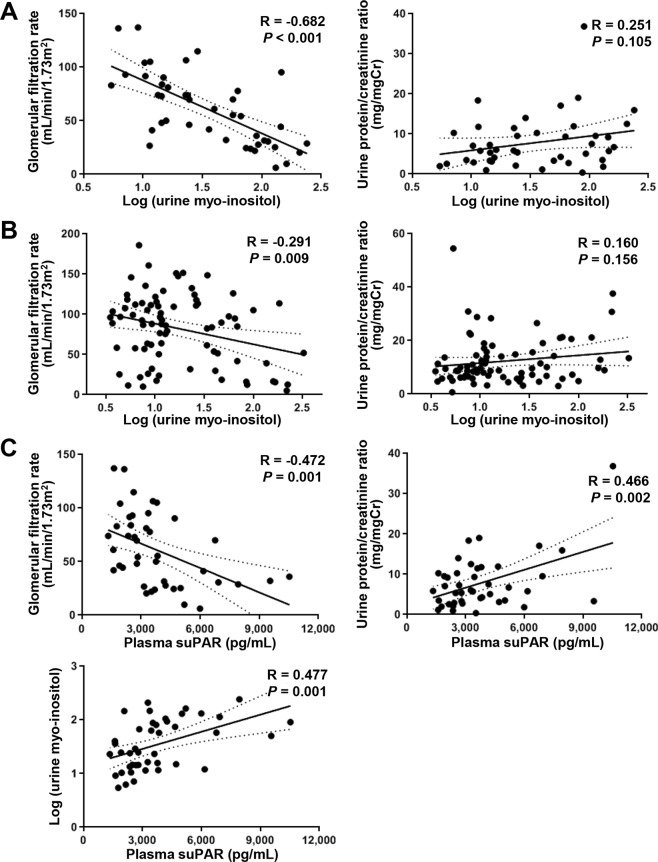
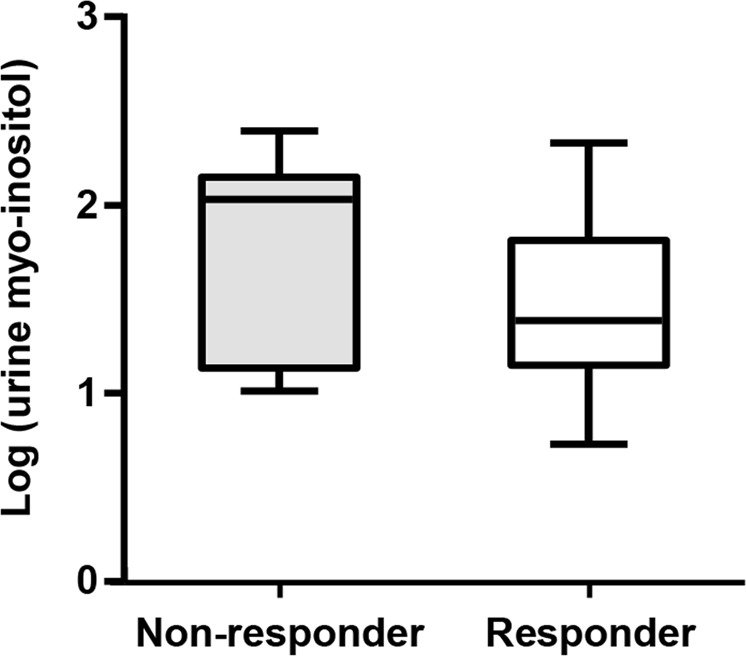
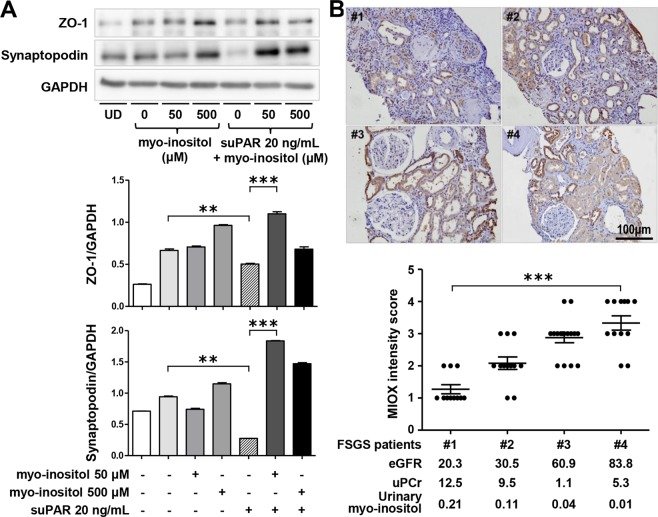
그림 출처: PubMed Central 공개 논문 (PMC6789025)
Conflict of interest statement
The authors declare no competing interests.
그 밖의 정보
- 출판 형태
- Journal Article, Research Support, Non-U.S. Gov't
- 저널
- Scientific reports · eISSN 2045-2322
- 전자 출판
- 2019-10-11
- MeSH
- Adult · Aged · Biomarkers / urine · Cell Line · Female · Glomerular Filtration Rate · Glomerulosclerosis, Focal Segmental / blood / diagnosis / urine · Humans · Inositol / pharmacology / urine · Inositol Oxygenase / metabolism · Kidney / metabolism / pathology · Male · Middle Aged · Nephrosis, Lipoid / urine · Nuclear Magnetic Resonance, Biomolecular · Podocytes / drug effects · Prognosis · Receptors, Urokinase Plasminogen Activator / blood
- Substances
- Biomarkers · PLAUR protein, human · Receptors, Urokinase Plasminogen Activator · Inositol · Inositol Oxygenase · MIOX protein, human
- 참고문헌
- 26편