
J Korean Med Sci. 2014;29 Suppl 2(Suppl 2):S91-6.
Not salt taste perception but self-reported salt eating habit predicts actual salt intake.
제1저자 이하정 · 교신저자 진호준
소속 (4)
- Department of Internal Medicine, Seoul National University College of Medicine, Seoul, Korea. ; Department of Immunology, Seoul National University Postgraduate School, Seoul, Korea.
- Department of Internal Medicine, Seoul National University College of Medicine, Seoul, Korea.
- Research Institute of Salt and Health, Seoul K-Clinic, Seoul, Korea.
- Department of Internal Medicine, Seoul National University College of Medicine, Seoul, Korea. ; Department of Immunology, Seoul National University Postgraduate School, Seoul, Korea. ; Renal Institute, Seoul National University Medical Research Center, Seoul, Korea. ; Department of Internal Medicine, Seoul National University Bundang Hospital, Seongnam, Korea.
Abstract
Excessive dietary salt intake is related to cardiovascular morbidity and mortality. Although dietary salt restriction is essential, it is difficult to achieve because of salt palatability. However, the association between salt perception or salt eating habit and actual salt intake remains uncertain. In this study, we recruited 74 healthy young individuals. We investigated their salt-eating habits by questionnaire and salt taste threshold through a rating scale that used serial dilution of a sodium chloride solution. Predicted 24-hr urinary salt excretions using Kawasaki's and Tanaka's equations estimated dietary salt intake. Participants' mean age was 35 yr, and 59.5% were male. Salt sense threshold did not show any relationship with actual salt intake and a salt-eating habit. However, those eating "salty" foods showed higher blood pressure (P for trend=0.048) and higher body mass index (BMI; P for trend=0.043). Moreover, a salty eating habit was a significant predictor for actual salt intake (regression coefficient [β] for Kawasaki's equation 1.35, 95% confidence interval [CI] 10-2.69, P=0.048; β for Tanaka's equation 0.66, 95% CI 0.01-1.31, P=0.047). In conclusion, a self-reported salt-eating habit, not salt taste threshold predicts actual salt intake.
Keywords
Salt IntakeSalt Taste ThresholdSalt-Eating Habit
Figures

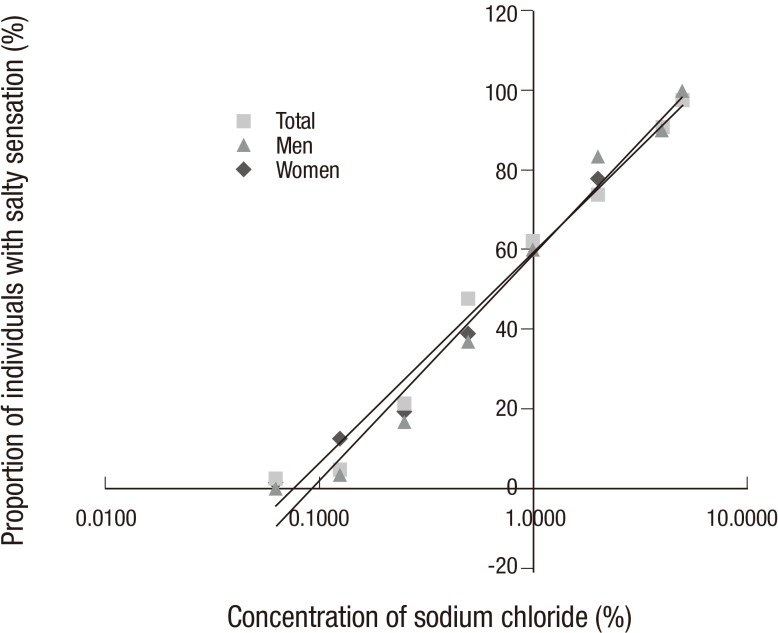

그림 출처: PubMed Central 공개 논문 (PMC4194290)
Conflict of interest statement
The authors have no conflicts of interest to disclose.
그 밖의 정보
- 출판 형태
- Journal Article
- 저널
- Journal of Korean medical science · eISSN 1598-6357
- 전자 출판
- 2014-09-30
- MeSH
- Adult · Algorithms · Blood Pressure · Body Mass Index · Demography · Female · Habits · Humans · Linear Models · Male · Self Report · Sodium Chloride, Dietary / urine · Surveys and Questionnaires · Taste Perception · Taste Threshold · Urine Specimen Collection
- Substances
- Sodium Chloride, Dietary
- 참고문헌
- 30편