
Sci Rep. 2019;9(1):2230.
The impact of sunlight exposure on mortality of patients with end stage renal disease.
제1저자 Una Amelia Yoon, 김용철 · 교신저자 이정표, 김호
소속 (12)
- Department of Biostatistics and Epidemiology, School of Public Health, Seoul National University, Seoul, Korea.
- Department of Internal Medicine, Seoul National University Hospital, Seoul, Korea.
- Department of Neuropsychiatry, Seoul National University Bundang Hospital, Seongnam, Korea.
- Institute of Health and Environment, Seoul National University, Seoul, Korea.
- Department of Internal Medicine, Seoul National University Boramae Medical Center, Seoul, Korea.
- Department of Internal Medicine, Seoul National University College of Medicine, Seoul, Korea.
- Kidney Research Institute, Seoul National University Hospital, Seoul, Korea.
- Department of Medical Science, Seoul National University College of Medicine, Seoul, Korea.
- Department of Internal Medicine, Seoul National University Boramae Medical Center, Seoul, Korea. nephrolee@gmail.com.
- Department of Internal Medicine, Seoul National University College of Medicine, Seoul, Korea. nephrolee@gmail.com.
- Department of Biostatistics and Epidemiology, School of Public Health, Seoul National University, Seoul, Korea. hokim@snu.ac.kr.
- Institute of Health and Environment, Seoul National University, Seoul, Korea. hokim@snu.ac.kr.
Abstract
Recent data suggest that reduced sunlight exposure is associated with increased mortality in the general population. To date, the association between sunlight exposure and mortality in dialysis patients has not been examined. Among 134,478 dialysis patients in the Korean end-stage renal disease (ESRD) cohort from 2001 to 2014, 31,291 patients were enrolled from seven metropolitan cities, and data were analyzed using bi-directional case-crossover design. We examined the association between short-term sunlight exposure and mortality in ESRD patients. We adjusted for temperature, humidity, and daily concentrations of nitrogen dioxide (NO2), sulfur dioxide (SO2), ozone (O3), carbon monoxide (CO), and particle matter (PM10) as confounders. The characteristics of the study population included age (65.6 ± 12.26 (mean ± standard deviation [SD]) years), sex (male, 59.96%; female, 41.04%), comorbidity (diabetes, 53.58%; hypertension, 40.5%), and kidney dialysis type (hemodialysis, 73.02%; peritoneal dialysis, 26.98%). The mean ± SD follow-up time was 4.68 ± 4.37 years. The daily sunlight exposure was significantly decreased in the case group compared with the control group (P = 0.004). Sunlight exposure was associated with all-cause death overall (ORs [95% CI]: 0.99 [0.98-0.99], P = 0.042) in a fully adjusted model. Patients with diabetes (ORs [95% CI]: 0.98 [0.97-0.99], P = 0.016) or aged higher than 75 years (ORs [95% CI]; 0.97 [0.96-0.99], P = 0.020) had higher risks of mortality than patients without diabetes or aged below 75 years, respectively. These findings suggest that sunlight exposure is inversely correlated with all-cause mortality in dialysis patients.
Figures
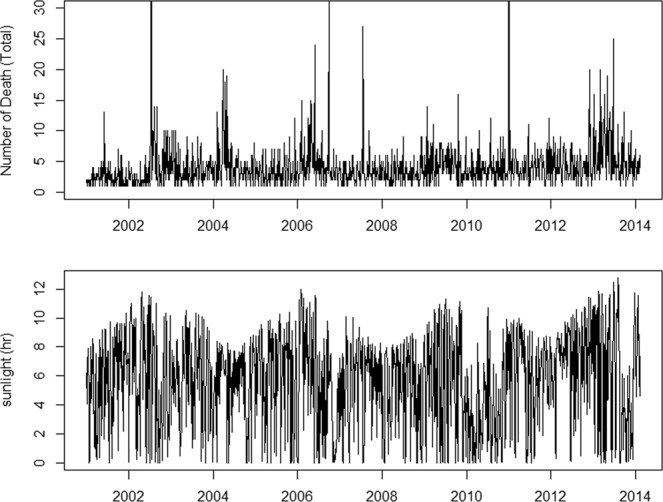
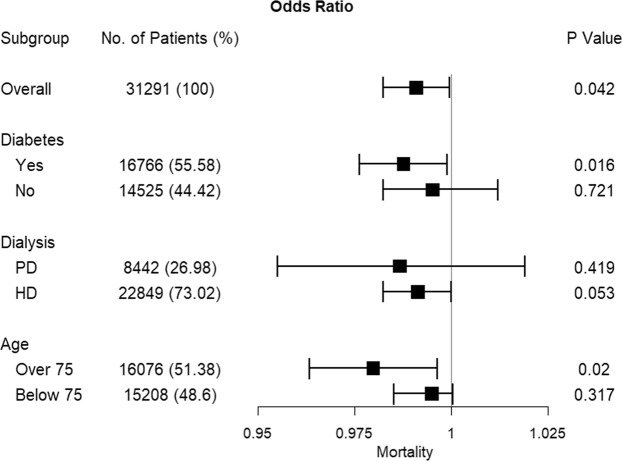
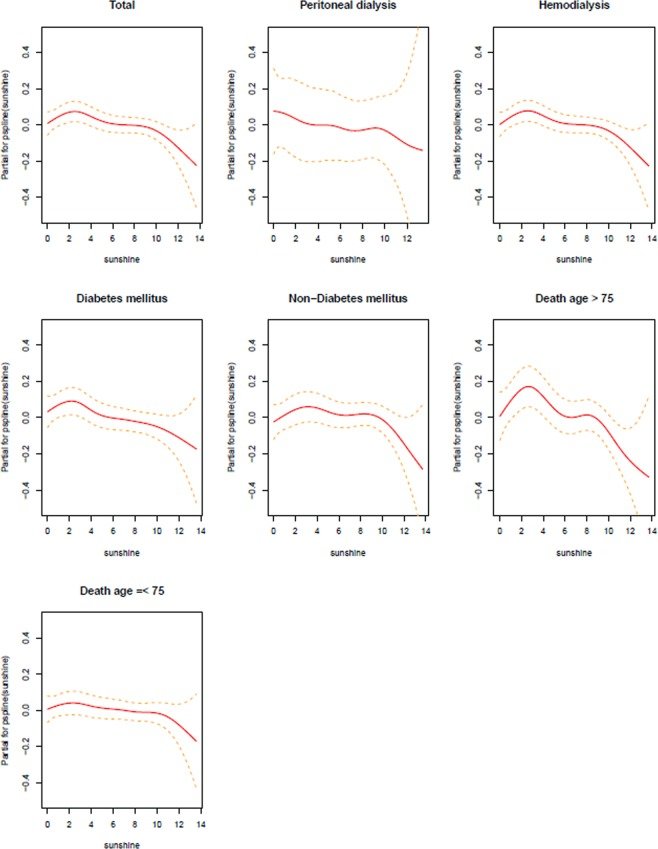

그림 출처: PubMed Central 공개 논문 (PMC6379426)
Conflict of interest statement
The authors declare no competing interests.
그 밖의 정보
- 출판 형태
- Journal Article, Research Support, Non-U.S. Gov't
- 저널
- Scientific reports · eISSN 2045-2322
- 전자 출판
- 2019-02-18
- MeSH
- Aged · Aged, 80 and over · Air Pollution · Cause of Death · Comorbidity · Environmental Exposure* · Female · Humans · Kidney Failure, Chronic / epidemiology / mortality / therapy · Male · Middle Aged · Mortality · Odds Ratio · Public Health Surveillance · Republic of Korea / epidemiology · Sunlight*
- 참고문헌
- 48편