
Sci Rep. 2019;9(1):18055.
Fluctuating renal function and the risk of incident atrial fibrillation: a nationwide population-based study.
제1저자 권순일, 이소령 · 교신저자 최의근
소속 (6)
- Department of Internal Medicine, Seoul National University Hospital, Seoul, Republic of Korea.
- Department of Internal Medicine, Seoul National University Hospital, Seoul, Republic of Korea. choiek17@snu.ac.kr.
- Department of Medical Statistics, College of Medicine, The Catholic University of Korea, Seoul, Republic of Korea.
- Department of Internal Medicine, Seoul Metropolitan Government-Seoul National University Boramae Medical Centre, Seoul, Republic of Korea.
- Liverpool Centre for Cardiovascular Science, University of Liverpool and Liverpool Chest & Heart Hospital, Liverpool, United Kingdom.
- Aalborg Thrombosis Research Unit, Department of Clinical Medicine, Aalborg University, Aalborg, Denmark.
Abstract
Although chronic kidney disease is known to increase the risk of atrial fibrillation (AF), the impact of the variability of renal function on the risk of incident AF is unknown. We aimed to evaluate the association between variability of renal function and the risk of developing AF among the general population. We evaluated a total of 3,551,249 adults who had three annual health check-ups provided by the National Health Insurance Service. The variability of renal function was defined as GFR-VIM, which is variability independent of the mean (VIM) of creatinine-based estimated glomerular filtration rate (eGFR). The study population was divided into four groups (Q1-4) based on the quartiles of GFR-VIM, and the risks of incident AF by each group were compared. During a mean of 3.2 ± 0.5 years follow-up, incident AF occurred in 15,008 (0.42%) subjects. The incidence rates of AF increased from Q1 to Q4 (0.98, 1.42, 1.27, and 1.63 per 1,000 person-years, respectively). Adjusting with multiple variables, Q4 showed an increased risk of incident AF compared to Q1 (hazard ratio (HR) 1.125, 95% confidence interval (CI) 1.071-1.181). Variability of serum creatinine or other definitions of variability showed consistent results. On subgroup analyses, Q4 in males or those with a decreasing trend of eGFR had significantly increased risks of incident AF compared to Q1 (HR 1.127, 95% CI 1.082-1.175; and HR 1.115, 95% CI 1.059-1.173, respectively). High variability of eGFR was associated with an increased risk of incident AF, particularly in males or those with decreasing trends of eGFR during follow-up.
Figures
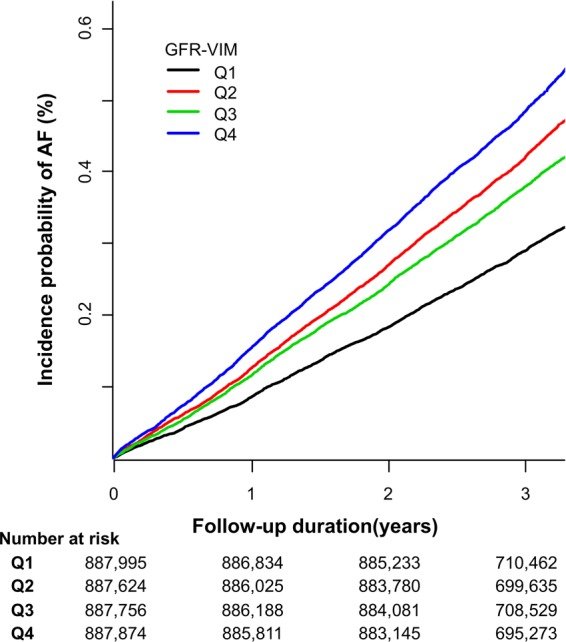
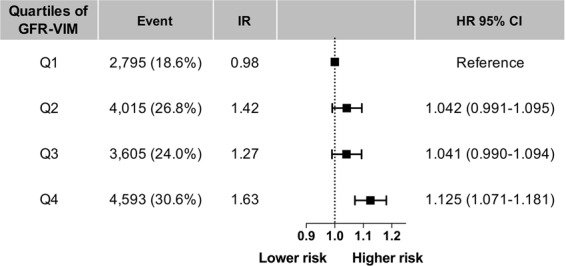
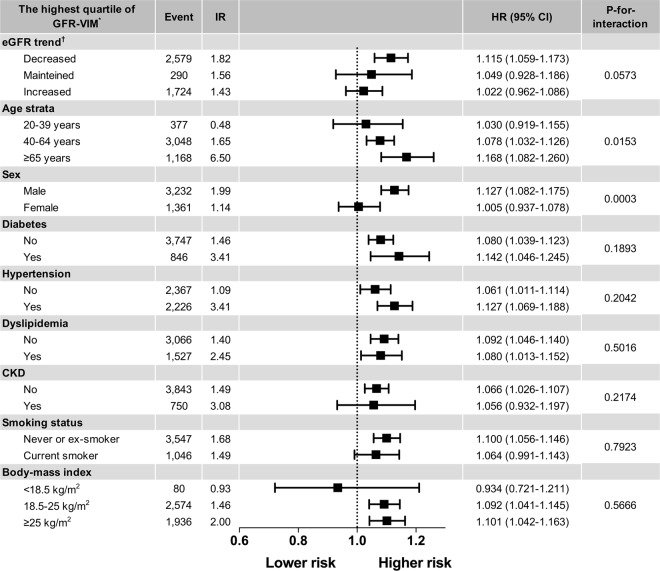
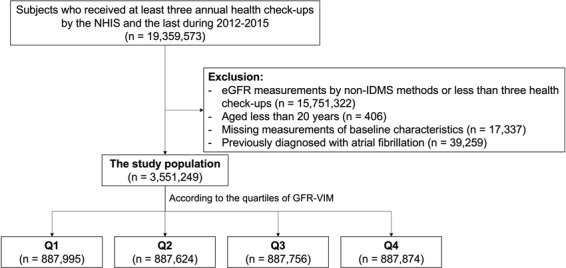
그림 출처: PubMed Central 공개 논문 (PMC6889358)
Conflict of interest statement
E.K.C. reports modest research grant from Daiichi-Sankyo, BMS/Pfizer, and Biosense Webster. G.Y.H.L. reports consultant for Bayer/Janssen, BMS/Pfizer, Medtronic, Boehringer Ingelheim, Novartis, Verseon and Daiichi-Sankyo, speaker for Bayer, BMS/Pfizer, Medtronic, Boehringer Ingelheim, and Daiichi-Sankyo. No fees are directly received personally. The remaining authors have nothing to disclose.
그 밖의 정보
- 출판 형태
- Journal Article, Research Support, Non-U.S. Gov't
- 저널
- Scientific reports · eISSN 2045-2322
- 전자 출판
- 2019-12-02
- MeSH
- Adult · Aged · Atrial Fibrillation / epidemiology / etiology · Creatinine / blood / metabolism · Female · Follow-Up Studies · Glomerular Filtration Rate / physiology · Humans · Incidence · Male · Middle Aged · Proportional Hazards Models · Renal Insufficiency, Chronic / blood / complications / physiopathology · Risk Assessment / methods · Risk Factors · Sex Factors · United Kingdom / epidemiology · Young Adult
- Substances
- Creatinine
- 참고문헌
- 31편