
Gastric Cancer. 2025;28(4):620-630.
Pairwise analysis of plasma cell-free DNA before and after palliative second-line paclitaxel plus ramucirumab treatment in patients with metastatic gastric cancer.
제1저자 김지원, 경동수 · 교신저자 이근욱
소속 (5)
- Department of Internal Medicine, Seoul National University Bundang Hospital, Seoul National University College of Medicine, 82 Gumi-Ro-173-Beon-Gil, Bundang-Gu, Seongnam, 13620, Republic of Korea.
- IMBdx, Inc., 131 Gasandigital-1-Ro, Geumcheon-Gu, Seoul, 08506, Republic of Korea.
- Biomedical Research Institute, Seoul National University Bundang Hospital, Seoul National University College of Medicine, 82 Gumi-Ro-173-Beon-Gil, Bundang-Gu, Seongnam, 13620, Republic of Korea.
- Department of Statistics, Hankuk University of Foreign Studies, 81 Oedae-Ro, Cheoin-Gu, Yongin, 17035, Republic of Korea.
- Department of Internal Medicine, Seoul National University Bundang Hospital, Seoul National University College of Medicine, 82 Gumi-Ro-173-Beon-Gil, Bundang-Gu, Seongnam, 13620, Republic of Korea. hmodoctor@snubh.org.
Abstract
BACKGROUND This study compared plasma cell-free DNA (cfDNA) and tumor tissue DNA (ttDNA) to explore the clinical applicability of cfDNA in patients with metastatic gastric cancer (mGC) receiving palliative second-line paclitaxel + ramucirumab treatment.
METHODS Targeted sequencing of 106 genes was conducted using germline DNA and cfDNA at baseline (baseline-cfDNA) and progressive disease (PD-cfDNA). The results were compared with those of ttDNA-based cancer panel data.
RESULTS Of 76 consecutive patients, 46 (27 males; median age 57.5 [range, 32-73] years) who had all three samples were included. Combined analysis of ttDNA and baseline-cfDNA revealed that TP53 (58.7%) was the most frequently mutated gene, followed by CDH1 (26.1%), KRAS (21.7%), and APC (13.0%). For these genes, the sensitivity and positive predictive value of baseline-cfDNA over ttDNA were 71.8% and 51.9%, respectively. When baseline-cfDNA and PD-cfDNA results were combined, 34 patients (73.9%) were found to have additional mutations compared with ttDNA results alone. PD-cfDNA analysis revealed 14 novel pathogenic mutations in ten patients (21.7%). At baseline, patients with a high circulating tumor DNA fraction concentration showed a significantly shorter progression-free survival (PFS) (P = 0.016) in univariable and multivariable analyses. High maximal variant allele frequency (VAF) (P = 0.022), high sum of VAF (P = 0.028), and high TP53 VAF (P = 0.022) were associated with worse PFS in univariable analysis.
CONCLUSIONS Although cfDNA alone cannot replace ttDNA entirely, cfDNA analysis revealed additional mutations. Notably, PD-cfDNA analysis revealed novel pathogenic mutations that emerged during treatment. Moreover, the baseline circulating tumor DNA fraction concentration and VAF values were associated with longer PFS.
© 2025. The Author(s).
Keywords
Anti-cancer therapyCell-free DNACirculating tumor DNAClonal evolutionGastric cancer
Figures
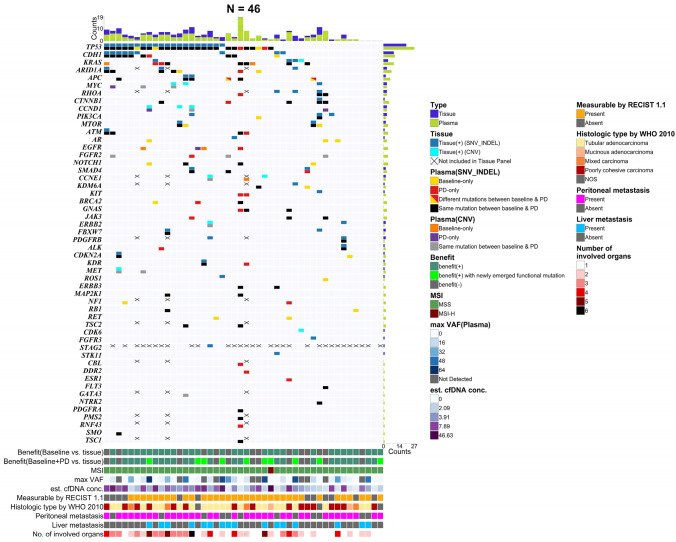
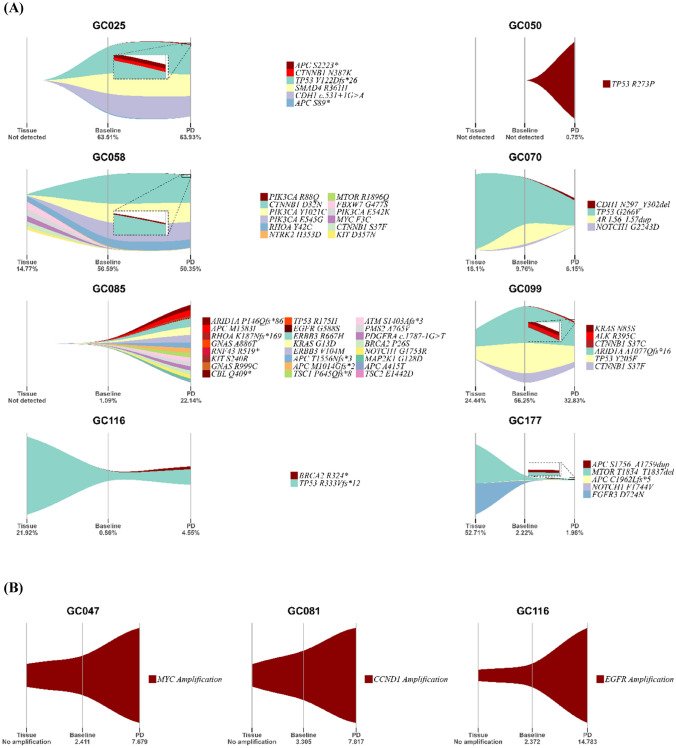
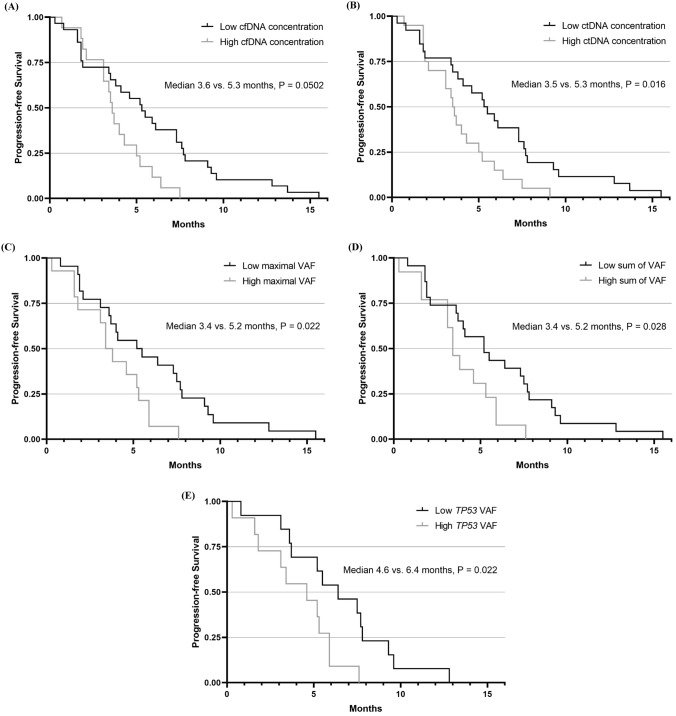
그림 출처: PubMed Central 공개 논문 (PMC12174237)
Conflict of interest statement
Declarations. Conflict of interest: Kyung DS, Ko WY, and Kim H-P are employees of IMBdx, Inc. The other authors declare no conflicts of interest.
그 밖의 정보
- 출판 형태
- Journal Article
- 저널
- Gastric cancer : official journal of the International Gastric Cancer Association and the Japanese Gastric Cancer Association · eISSN 1436-3305
- 전자 출판
- 2025-03-27
- MeSH
- Humans · Male · Stomach Neoplasms* / drug therapy / pathology / genetics / blood · Middle Aged · Female · Aged · Ramucirumab · Paclitaxel / administration & dosage · Adult · Antineoplastic Combined Chemotherapy Protocols* / therapeutic use · Antibodies, Monoclonal, Humanized / administration & dosage · Biomarkers, Tumor* / genetics / blood · Cell-Free Nucleic Acids* / blood · Circulating Tumor DNA* / blood / genetics · Palliative Care · Prognosis · Mutation · Follow-Up Studies
- Substances
- Ramucirumab · Paclitaxel · Antibodies, Monoclonal, Humanized · Biomarkers, Tumor · Cell-Free Nucleic Acids · Circulating Tumor DNA
- 연구비
- Seoul National University Bundang Hospital 14-2024-0039
- 참고문헌
- 35편