
Sci Rep. 2019;9(1):3764.
Resting hyperinflation and emphysema on the clinical course of COPD.
제1저자 김연욱 · 교신저자 이창훈
소속 (8)
- Division of Pulmonary and Critical Care Medicine, Department of Internal Medicine, Seoul National University Hospital, Seoul, Republic of Korea.
- Division of Pulmonary and Critical Care Medicine, Department of Internal Medicine, Seoul National University Hospital, Seoul, Republic of Korea. kauri670@empal.com.
- Department of Medicine, Soonchunhyang University Gumi's Hospital, North Kyungsang Province, Republic of Korea.
- Department of Internal Medicine, Chonnam National University Hospital, Gwangju, Republic of Korea.
- Division of Pulmonary and Critical Care Medicine, Department of Internal Medicine, Seoul National University College of Medicine, Seoul Metropolitan Government-Seoul National University Boramae Medical Center, Seoul, Republic of Korea.
- Department of Pulmonary and Critical Care Medicine, Asan Medical Center, University of Ulsan College of Medicine, Seoul, Republic of Korea.
- Department of Internal Medicine, The Catholic University of Korea, St. Paul's Hospital, Seoul, Republic of Korea.
- Department of Internal Medicine, Pusan National University School of Medicine, Busan, Republic of Korea.
Abstract
The aim of this study is to clarify whether the combined evaluation of resting hyperinflation and emphysema confers any additional advantages in terms of predicting clinical outcomes in chronic obstructive pulmonary disease (COPD) patients. We included COPD patients from the Korean Obstructive Lung Disease (KOLD) cohort. Patients with a residual volume/total lung capacity (RV/TLC) over the upper limit of normal were defined as having resting hyperinflation, and those with an emphysema index >10% were defined as having emphysema. We investigated the impacts of resting hyperinflation and emphysema on exacerbations and mortality. A total of 310 COPD patients were analyzed over a mean of 61.1 months. After adjustment for covariates, resting hyperinflation was an independent predictor of earlier exacerbation (HR = 1.66, CI = 1.24-2.22), more frequent exacerbation (IRR = 1.35, CI = 1.01-1.81), and higher mortality (HR = 2.45, CI = 1.16-5.17) risk. Emphysema was also significantly associated with earlier exacerbation (HR = 1.64, CI = 1.15-2.35), and higher mortality (HR = 3.13, CI = 1.06-9.27) risk. Participants with both resting hyperinflation and emphysema had an additively higher risk of earlier exacerbations (HR = 1.71, 95% CI = 1.26-2.33) and mortality (HR = 3.75, 95% CI = 1.81-7.73) compared with those in other groups. In conclusion, resting hyperinflation and emphysema had additional worse impacts on exacerbations and mortality in COPD patients.
Figures
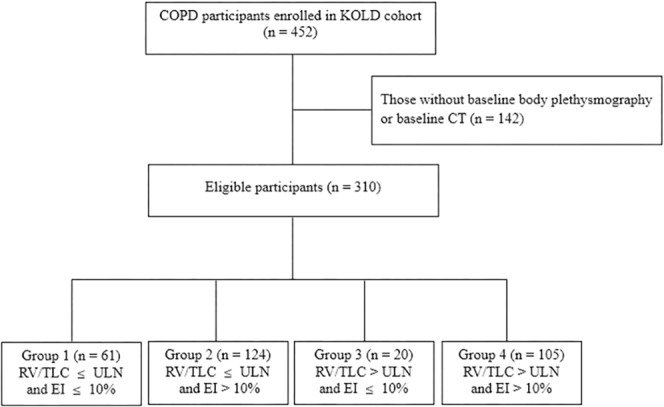
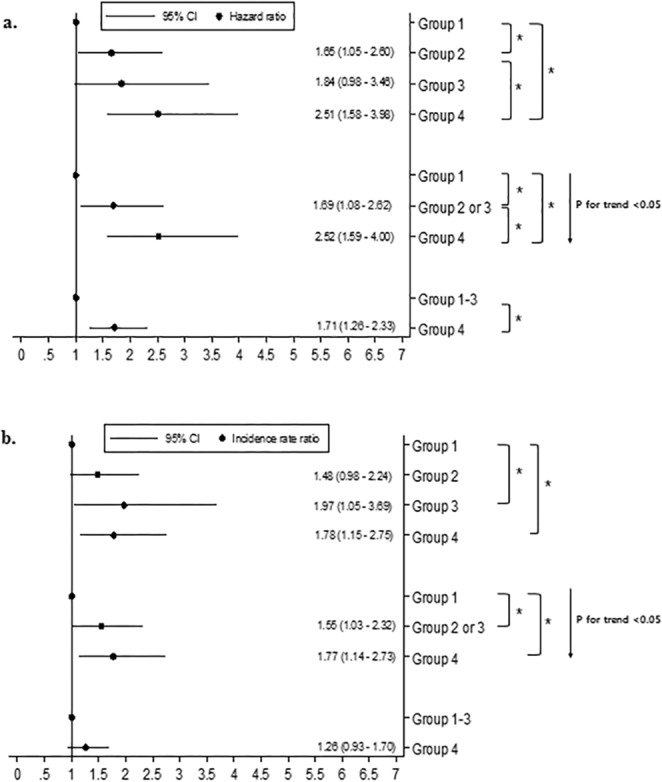
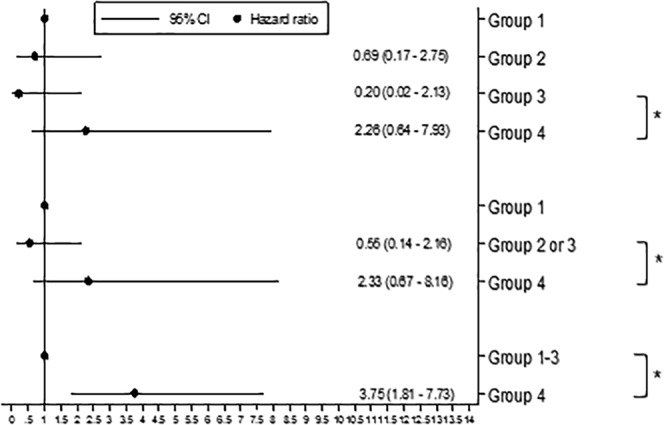
그림 출처: PubMed Central 공개 논문 (PMC6403229)
Conflict of interest statement
The authors declare no competing interests.
그 밖의 정보
- 출판 형태
- Journal Article, Multicenter Study, Research Support, Non-U.S. Gov't
- 저널
- Scientific reports · eISSN 2045-2322
- 전자 출판
- 2019-03-06
- MeSH
- Aged · Female · Humans · Longitudinal Studies · Male · Middle Aged · Multidetector Computed Tomography · Prognosis · Prospective Studies · Pulmonary Disease, Chronic Obstructive / diagnostic imaging / mortality / physiopathology · Pulmonary Emphysema / diagnostic imaging / mortality / physiopathology · Republic of Korea · Respiratory Function Tests · Rest
- 참고문헌
- 40편