
World J Gastroenterol. 2022;28(30):4182-4200.
Hepatocellular carcinoma, decompensation, and mortality based on hepatitis C treatment: A prospective cohort study.
제1저자 최광현 · 교신저자 정숙향
소속 (9)
- Department of Internal Medicine, Seoul National University Bundang Hospital, Seoul National University College of Medicine, Seongnam 13620, South Korea.
- Department of Internal Medicine, Soonchunhyang University Bucheon Hospital, Bucheon 14584, South Korea.
- Department of Internal Medicine, Inje University Busan Paik Hospital, Busan 47392, South Korea.
- Department of Internal Medicine, Chonbuk National University Hospital, Jeonju 54907, Jeonbuk, South Korea.
- Department of Internal Medicine, Chonnam National University Hwasun Hospital, Hwasun 58128, South Korea.
- Department of Gastroenterology, Asan Medical Center, University of Ulsan College of Medicine, Seoul 05505, South Korea.
- Department of Internal Medicine, The Catholic University of Korea, Seoul 06591, South Korea.
- Cancer Control and Population Health, Graduate School of Cancer Science and Policy, National Cancer Center, Goyang 10408, South Korea.
- Department of Internal Medicine, Seoul National University Bundang Hospital, Seoul National University College of Medicine, Seongnam 13620, South Korea. jsh@snubh.org.
Abstract
BACKGROUND Prospective studies of the long-term outcomes of patients with hepatitis C virus (HCV) infection after treatment with interferon-based therapy (IBT) or direct-acting antivirals (DAA) are limited in many Asian countries.
AIM To elucidate the incidences of hepatocellular carcinoma (HCC) and death/transplantation based on treatment with IBT or DAA, to compare the outcomes of the sustained virologic response (SVR) to IBT and DAA, and to investigate outcome-determining factors after SVR.
METHODS This cohort included 2054 viremic patients (mean age, 57 years; 46.5% male; 27.4% with cirrhosis) prospectively enrolled at seven hospitals between 2007 and 2019. They were classified as the untreated group (n = 619), IBT group (n = 578), and DAA group (n = 857). Outcomes included the incidences of HCC and death/transplantation. The incidences of the outcomes for each group according to treatment were calculated using an exact method based on the Poisson distribution. A multivariate Cox regression analysis was performed to determine the factors associated with HCC or death/transplantation, followed by propensity score matching to confirm the results.
RESULTS During a median of 4.1 years of follow-up, HCC and death/transplantation occurred in 113 and 206 patients, respectively, in the entire cohort. Compared with the untreated group, the incidences of HCC and death/transplantation were significantly lower in the IBT group [adjusted hazard ratio (aHR) 0.47, 95%CI: 0.28-0.80 and aHR 0.28, 95%CI: 0.18-0.43, respectively] and the DAA group (aHR 0.58, 95%CI: 0.35-0.96, and aHR 0.19, 95%CI: 0.20-0.68, respectively). Among 1268 patients who attained SVR with IBT (n = 451) or DAA (n = 816), the multivariable-adjusted analysis showed no differences in the risks of HCC (HR 2.03; 95%CI: 0.76-5.43) and death/transplantation (HR 1.38; 95%CI: 0.55-3.49) between the two groups. This was confirmed by a propensity score-matching analysis. Independent factors for HCC after SVR were age, genotype 1, and the presence of cirrhosis.
CONCLUSION Treatment and achieving SVR with either IBT or DAA significantly reduced the incidences of HCC and mortality in the Asian patients with HCV infection. The risks of HCC and mortality were not significantly different regardless of whether SVR was induced by IBT or DAA.
©The Author(s) 2022. Published by Baishideng Publishing Group Inc. All rights reserved.
Keywords
Direct-acting antiviralHepatitis C virusHepatocellular carcinomaMortalitySustained virologic response
Figures

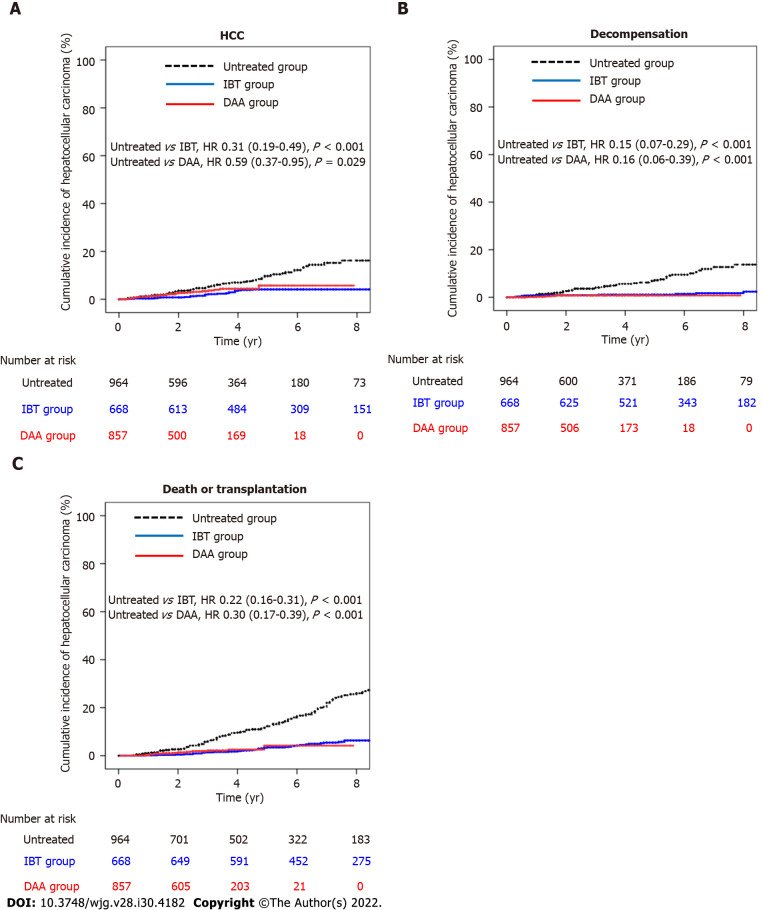
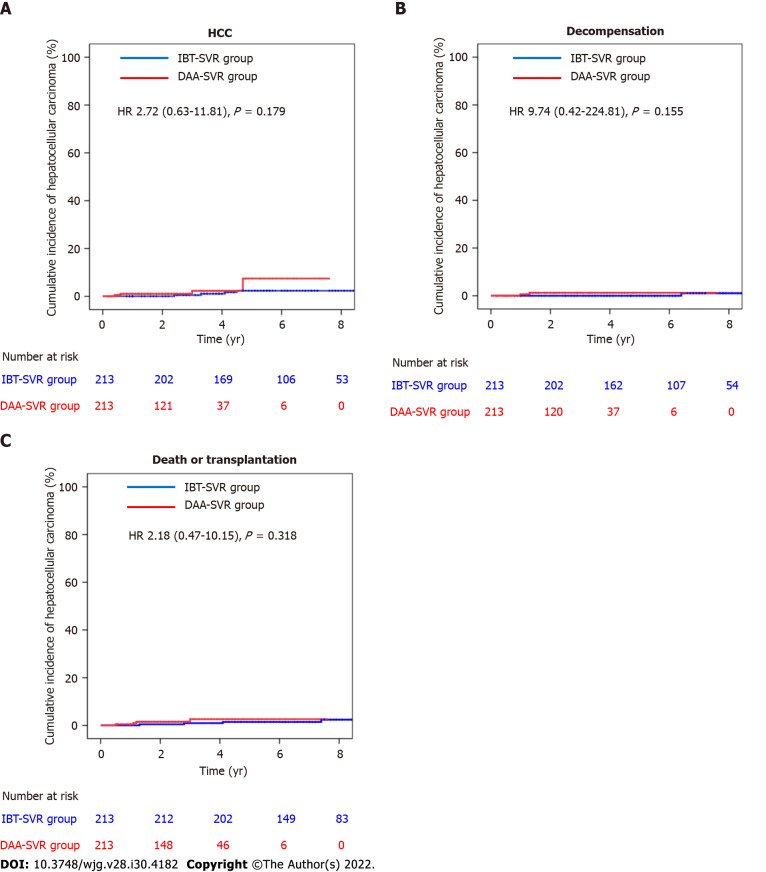
그림 출처: PubMed Central 공개 논문 (PMC9403421)
Conflict of interest statement
Conflict-of-interest statement: Nothing to declare.
그 밖의 정보
- 출판 형태
- Journal Article
- 저널
- World journal of gastroenterology · eISSN 2219-2840
- MeSH
- Antiviral Agents / therapeutic use · Carcinoma, Hepatocellular* · Cohort Studies · Female · Hepacivirus / genetics · Hepatitis C* / complications / diagnosis / drug therapy · Hepatitis C, Chronic* / complications / drug therapy / epidemiology · Humans · Interferons / therapeutic use · Liver Cirrhosis / complications · Liver Neoplasms* · Male · Middle Aged · Prospective Studies · Sustained Virologic Response
- Substances
- Antiviral Agents · Interferons
- 참고문헌
- 38편