
Clin Mol Hepatol. 2022;28(3):510-521.
Association of non-alcoholic fatty liver disease with incident dementia later in life among elder adults.
제1저자 정석송 · 교신저자 김원, 박상민
소속 (11)
- Department of Biomedical Sciences, Seoul National University College of Medicine, Seoul, Korea.
- Department of Biomedical Informatics, CHA University School of Medicine, CHA University, Seongnam, Korea.
- Department of Family Medicine, Chung-Ang University Gwangmyeong Hospital, Chung-Ang University College of Medicine, Gwangmyeong, Korea.
- Department of Internal Medicine, Seoul National University Hospital, Seoul, Korea.
- Department of Internal Medicine, Hallym University Sacred Heart Hospital, Anyang, Korea.
- Estherformula Medical Food R&D Center, Seoul, Korea.
- Division of Gastroenterology and Hepatology, Mayo Clinic, Rochester, MN, USA.
- Division of Gastroenterology and Hepatology, Department of Internal Medicine, Seoul Metropolitan Government Seoul National University Boramae Medical Center, Seoul, Korea.
- Division of Endocrinology, Department of Internal Medicine, Seoul Metropolitan Government Boramae Medical Center, Seoul National University College of Medicine, Seoul, Korea.
- Department of Internal Medicine, Seoul National University College of Medicine, Seoul, Korea.
- Department of Family Medicine, Seoul National University Hospital, Seoul, Korea.
Abstract
BACKGROUND/AIMS Accumulating evidence suggests a link between non-alcoholic fatty liver disease (NAFLD) and brain health. However, population-based evidence on the association between NAFLD and dementia remains unclear. This study was conducted to determine the association between NAFLD and incident dementia.
METHODS The study population included 608,994 adults aged ≥60 years who underwent health examinations between 2009 and 2010. Data were collected from the Korean National Health Insurance Service database. NAFLD was assessed using the fatty liver index (FLI). A Cox proportional hazards regression model was used to determine the association between NAFLD and dementia.
RESULTS During the 6,495,352 person-years of follow-up, 48,538 participants (8.0%) developed incident dementia. The participants were classified into low (FLI <30), intermediate (FLI ≥30 and <60), and high (FLI ≥60) groups. In the overall study population, the FLI groups were associated with a risk of dementia (P for trend <0.001). After propensity score matching, a low FLI was associated with a reduced risk of dementia (adjusted hazard ration [aHR], 0.96; 95% confidence interval [CI], 0.93-0.98; P=0.002), whereas a high FLI (NAFLD) was associated with an increased risk of dementia (aHR, 1.05; 95% CI, 1.02-1.08; P=0.001). A higher risk of dementia in the high FLI group than in the intermediate FLI group was attributed to Alzheimer's disease (aHR, 1.04; 95% CI, 1.01-1.07; P=0.004) rather than vascular dementia (aHR, 0.94; 95% CI, 0.75-1.18; P=0.602).
CONCLUSION NAFLD was associated with an increased risk of dementia, which was attributed to an increased risk of Alzheimer's disease.
Keywords
Alzheimer diseaseEpidemiologyNon-alcoholic fatty liver diseaseVascular dementia
Figures

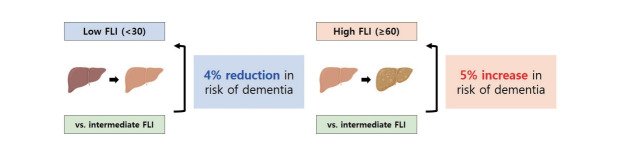
그림 출처: PubMed Central 공개 논문 (PMC9293607)
Comment · 정정
Conflict of interest statement
Conflicts of Interest . The authors have no conflicts to disclose.
그 밖의 정보
- 출판 형태
- Journal Article
- 저널
- Clinical and molecular hepatology · eISSN 2287-285X
- 전자 출판
- 2022-03-17
- MeSH
- Adult · Aged · Alzheimer Disease* / complications / diagnosis / epidemiology · Databases, Factual · Humans · Non-alcoholic Fatty Liver Disease* / complications / diagnosis / epidemiology · Proportional Hazards Models · Risk Factors
- 참고문헌
- 40편