
Clin Mol Hepatol. 2022;28(1):91-104.
A cost-effectiveness study of universal screening for hepatitis C virus infection in South Korea: A societal perspective.
제1저자 김혜린, 김경아 · 교신저자 정숙향
소속 (4)
- College of Pharmacy, Sahmyook University, Seoul, Korea.
- Department of Internal Medicine, Inje University Ilsan Paik Hospital, Goyang, Korea.
- Department of Internal Medicine, Seoul National University Bundang Hospital, Seoul National University College of Medicine, Seongnam, Korea.
- Department of Cancer Control and Policy, Graduate School of Cancer Science and Policy, National Cancer Center, Goyang, Korea.
Abstract
BACKGROUND/AIMS This study aimed to evaluate the cost-effectiveness of hepatitis C virus (HCV) screening compared to no screening in the Korean population from societal and healthcare system perspectives.
METHODS A published decision-tree plus Markov model was used to compare the expected costs and quality-adjusted life years (QALY) between one-time universal HCV screening and no screening in the population aged 40-65 years using the National Health Examination (NHE) program. Input parameters were obtained from analyses of the National Health Insurance claims data, Korean HCV cohort data, or from the literature review. The population aged 40-65 years was simulated in a model spanning a lifetime from both the healthcare system and societal perspectives, which included the cost of productivity loss due to HCV-related deaths. The incremental cost-effectiveness ratio (ICER) between universal screening and no screening was estimated.
RESULTS The HCV screening strategy had an ICER of $2,666/QALY and $431/QALY from the healthcare system and societal perspectives, respectively. Both ICERs were far less than the willingness-to-pay threshold of $25,000/QALY, showing that universal screening was highly cost-effective compared to no screening. In various sensitivity analyses, the most influential parameters on cost-effectiveness were the antibodies to HCV (anti-HCV) prevalence, screening costs, and treatment acceptance; however, all ICERs were consistently less than the threshold. If the anti-HCV prevalence was over 0.18%, screening could be cost-effective.
CONCLUSION One-time universal HCV screening in the Korean population aged 40-65 years using NHE program would be highly cost-effective from both healthcare system and societal perspectives.
Keywords
Cost effectivenessHepatitis C virusMass screeningsQuality adjusted life years
Figures

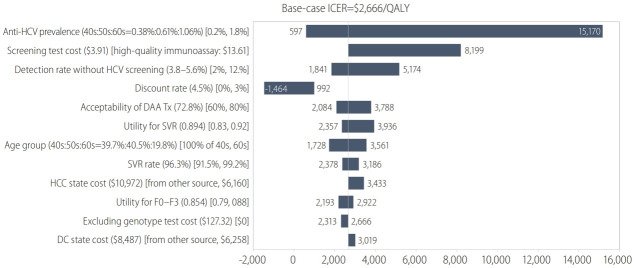
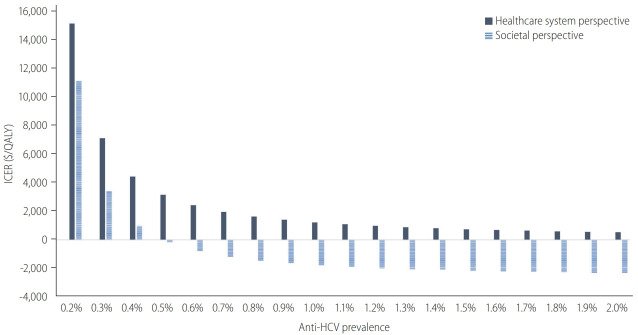


그림 출처: PubMed Central 공개 논문 (PMC8755471)
Conflict of interest statement
Conflicts of Interest . SH Jeong has served as an advisor for Gilead. The remaining authors disclose no conflicts.
그 밖의 정보
- 출판 형태
- Journal Article, Research Support, Non-U.S. Gov't
- 저널
- Clinical and molecular hepatology · eISSN 2287-285X
- 전자 출판
- 2021-11-05
- MeSH
- Cost-Benefit Analysis · Hepacivirus · Hepatitis C* / diagnosis / epidemiology · Hepatitis C, Chronic* / diagnosis · Humans · Quality-Adjusted Life Years
- 연구비
- Korean Association for the Study of the Liver · The Korean Liver Foundation · Korea Disease Control and Prevention Agency 2020-E510400
- 참고문헌
- 45편