
Antimicrob Resist Infect Control. 2020;9(1):64.
Outbreak investigation of Serratia marcescens neurosurgical site infections associated with a contaminated shaving razors.
제1저자 김은진 · 교신저자 김남중
소속 (8)
- Center for Infection Control and Prevention, Seoul National University Hospital, Seoul, South Korea.
- Department of Internal Medicine, Seoul National University College of Medicine, 101 Daehak-ro, Jongno-gu, Seoul, 03080, South Korea.
- Department of Translational Medicine, Seoul National University College of Medicine, Seoul, South Korea.
- Department of Neurosurgery, Seoul National University College of Medicine, Seoul, South Korea.
- Genomic Medicine Institute, Medical Research Center, Seoul National University, Seoul, South Korea.
- Department of Pediatrics, Seoul National University College of Medicine, Seoul, South Korea.
- Center for Infection Control and Prevention, Seoul National University Hospital, Seoul, South Korea. molder@unitel.co.kr.
- Department of Internal Medicine, Seoul National University College of Medicine, 101 Daehak-ro, Jongno-gu, Seoul, 03080, South Korea. molder@unitel.co.kr.
Abstract
BACKGROUND Surgical site infection (SSI) is the most common healthcare-associated infection. We report an outbreak of neurosurgical site infections caused by Serratia marcescens after craniotomy in a tertiary care hospital.
METHODS Between August 6 and 21, 2018, five cases of early-onset SSI caused by S. marcescens after craniotomy were recorded in a 1786-bed tertiary care hospital. Cultures were collected from potential environmental sources and healthcare workers. Whole-genome sequencing (WGS) was used to investigate the genetic relationships among S. marcescens isolates.
RESULTS The outbreak involved five patients; S. marcescens was isolated from the cerebrospinal fluid, pus, tissue, and blood samples from these patients. S. marcescens was also isolated from shaving razors and brushes. All S. marcescens isolates from the infected patients and razors showed the same resistance patterns on antibiotic-susceptibility tests. WGS revealed close clustering among four of five isolates from the patients and among three of four isolates from the razors. No additional patient developed S. marcescens infection after we stopped using the razors for scalp shaving.
CONCLUSIONS We report an outbreak of neurosurgical site infections after craniotomy, which was associated with shaving razors contaminated by S. marcescens. Shaving scalps with razors should be avoided to prevent SSI.
Keywords
Disease outbreakSerratia marcescensSurgical site infectionWhole-genome sequencing
Figures
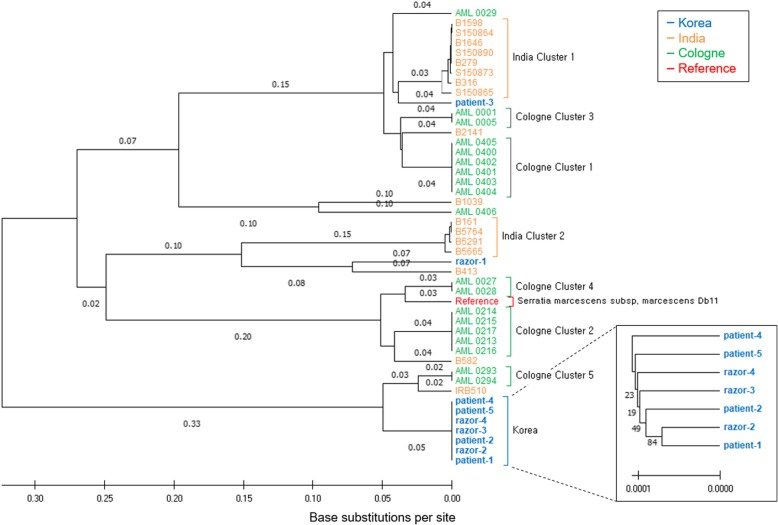
그림 출처: PubMed Central 공개 논문 (PMC7216399)
Conflict of interest statement
The authors declare that that have no competing interests.
그 밖의 정보
- 출판 형태
- Journal Article
- 저널
- Antimicrobial resistance and infection control · eISSN 2047-2994
- 전자 출판
- 2020-05-12
- MeSH
- Adolescent · Adult · Aged · Child · Craniotomy / adverse effects · Cross Infection / epidemiology / microbiology · Disease Outbreaks / classification · Equipment Contamination · Female · Genome, Bacterial · Hand / microbiology · Health Personnel · Humans · Male · Microbial Sensitivity Tests · Middle Aged · Phylogeny · Seoul / epidemiology · Serratia Infections / epidemiology / microbiology · Serratia marcescens / classification / genetics / isolation & purification · Surgical Wound Infection / epidemiology / microbiology · Tertiary Care Centers · Whole Genome Sequencing / methods
- 참고문헌
- 29편