
Europace. 2025;27(8):8243878.
Atrial fibrillation burden and symptom, quality of life, and healthcare resource utilization after cryoballoon ablation in persistent atrial fibrillation.
제1저자 여무한, 이소령 · 교신저자 최의근, 온영근
소속 (7)
- Department of Internal Medicine, Seoul National University College of Medicine, 101 Daehak-ro, Jongno-gu, Seoul 03080, Republic of Korea.
- Department of Internal Medicine, Seoul National University Hospital, Seoul, Republic of Korea.
- Department of Internal Medicine, SMG-SNU Boramae Medical Center, Seoul, Korea.
- Department of Internal Medicine, Seoul National University Bundang Hospital, Seongnam, Republic of Korea.
- Division of Cardiology, Chung-Ang University Gwangmyeong Hospital, Chung-Ang University College of Medicine, Gwangmyeong-si, Republic of Korea.
- Division of Cardiology, Asan Medical Center, University of Ulsan College of Medicine, Seoul, Republic of Korea.
- Division of Cardiology, Department of Medicine, Cardiac Arrhythmia Center, Heart Vascular and Stroke Institute, Samsung Medical Center, Sungkyunkwan University School of Medicine, 81 Irwon-ro, Gangnam-gu, Seoul 06351, Republic of Korea.
Abstract
AIMS To investigate the relationship between continuously monitored atrial fibrillation (AF) burden after cryoballoon ablation (CBA) and improvements in AF-related symptoms, quality of life (QoL), and AF-related healthcare resource utilization (HCRU) in early persistent AF.
METHODS AND RESULTS This secondary analysis of the multicentre COOL-PER trial included patients with early persistent AF who underwent CBA and continuous monitoring via an implantable loop recorder. Post-CBA AF burden was defined as the percentage of time in AF between 9- and 12-month after CBA, categorized as <0.1%, 0.1 to <10%, and ≥10%. Symptom improvement was assessed using the European Heart Rhythm Association symptom score and QoL with the SF-36 survey. AF-related HCRU was defined as rhythm control interventions after the 90-day blanking period and cardiovascular-related hospitalizations or emergency room visits. Among 130 patients (mean baseline AF burden 77 ± 34%), AF burden significantly decreased post-CBA, with 50.0% achieving <0.1%, 28.5% in 0.1 to <10%, and 21.5% ≥ 10%. Symptom improvement rate was highest in the <0.1% group (89.2%), followed by the 0.1 to <10% (78.4%) and ≥10% (46.4%) groups (P < 0.001). Significant QoL improvement was observed in the <0.1% and 0.1 to <10% groups but not in the ≥10% group. Rhythm control interventions and cardiovascular-related hospitalizations or emergency room visits were more frequent in the ≥10% group (29%, 43%) than in the 0.1 to <10% (5.4%, 22%) and <0.1% (1.5%, 7.7%) groups (both P < 0.001).
CONCLUSION In early persistent AF, lower AF burden 1-year post-CBA was associated with greater AF-related symptom improvement, significant QoL enhancement, and reduced HCRU during follow-up.
© The Author(s) 2025. Published by Oxford University Press on behalf of the European Society of Cardiology.
Keywords
Atrial fibrillationCryoablationImplantable ElectrodeQuality of Life
Figures
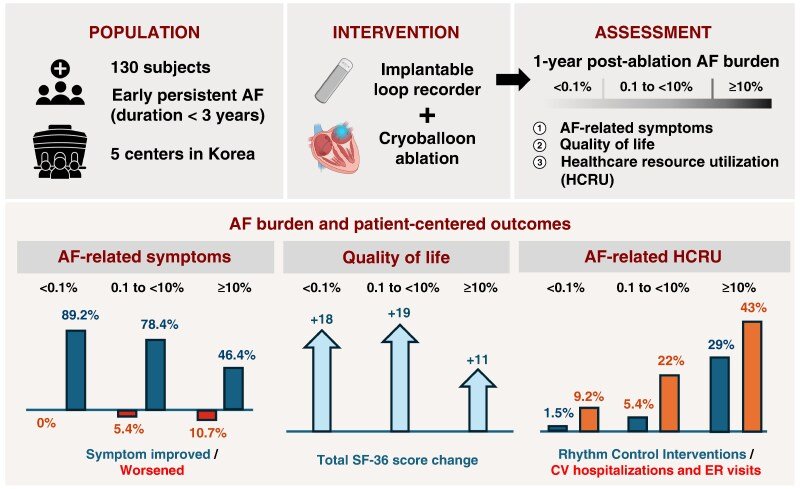
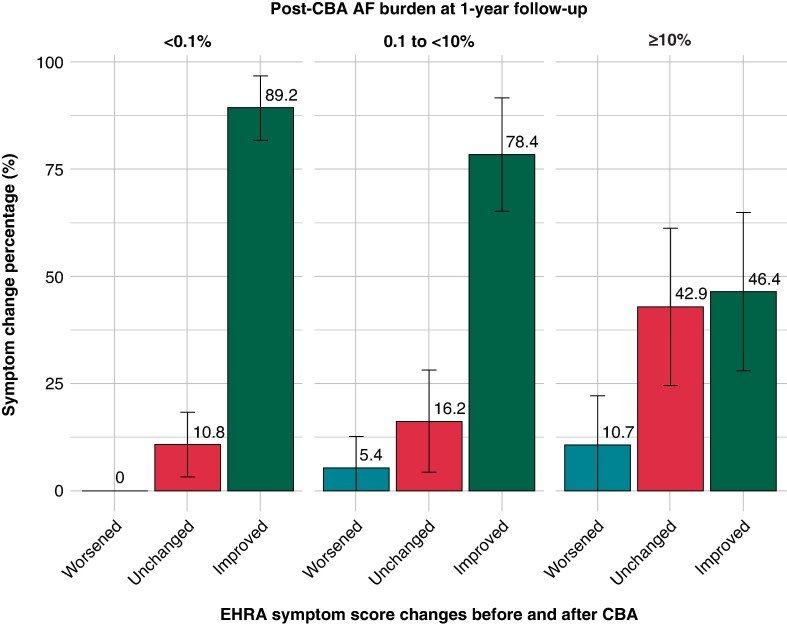
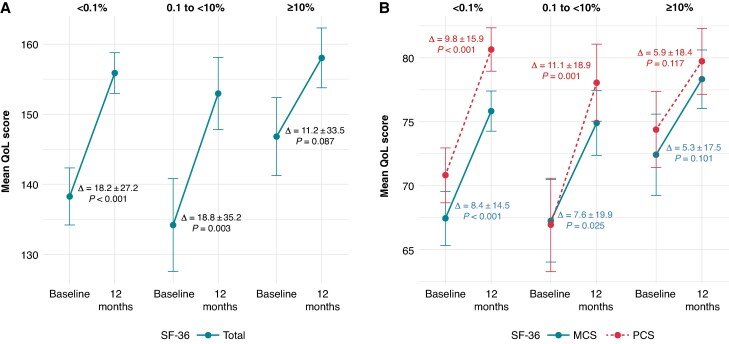
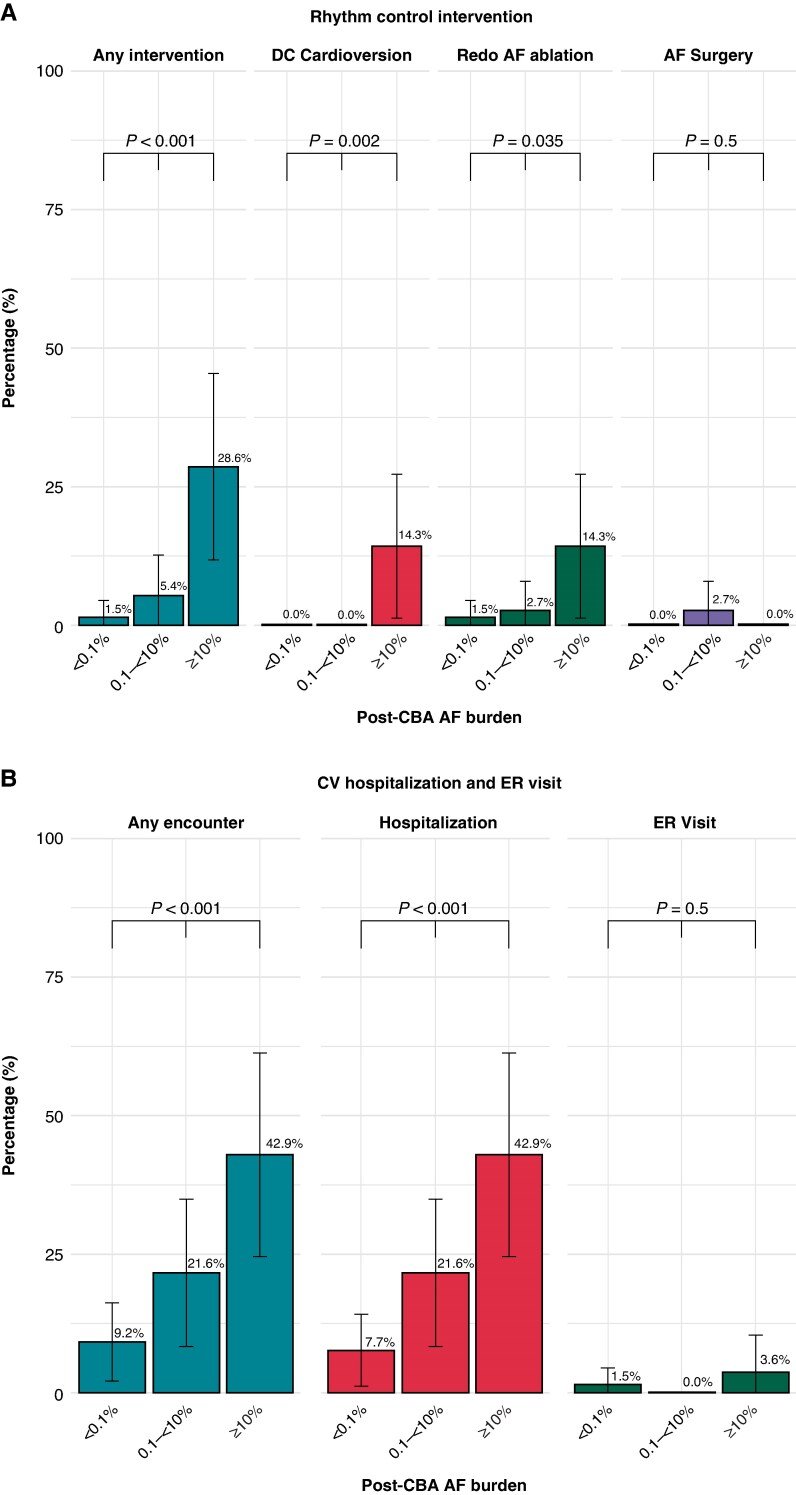
그림 출처: PubMed Central 공개 논문 (PMC12395340)
Conflict of interest statement
Conflict of interest: E.K.C.: Research grants or speaking fees from Abbott, Bayer, BMS/Pfizer, Biosense Webster, Chong Kun Dang, Daewoong Pharmaceutical Co., Daiichi-Sankyo, DeepQure, Dreamtech Co., Ltd., Jeil Pharmaceutical Co., Ltd, Medtronic, Samjinpharm, Samsung Electronics Co., Ltd., Seers Technology, and Skylabs. All other authors have reported that they have no relationships relevant to the contents of this paper to disclose.
그 밖의 정보
- 출판 형태
- Journal Article, Multicenter Study
- 저널
- Europace : European pacing, arrhythmias, and cardiac electrophysiology : journal of the working groups on cardiac pacing, arrhythmias, and cardiac cellular electrophysiology of the European Society of Cardiology · eISSN 1532-2092
- MeSH
- Aged · Female · Humans · Male · Middle Aged · Atrial Fibrillation* / surgery / physiopathology / diagnosis / psychology / economics · Cost of Illness · Cryosurgery* / adverse effects / methods · Health Resources* / statistics & numerical data · Heart Rate · Patient Acceptance of Health Care* / statistics & numerical data · Quality of Life* · Time Factors · Treatment Outcome
- 연구비
- Medtronic IIS ERP-2020-12253
- 참고문헌
- 42편