
J Korean Med Sci. 2012;27(1):64-71.
Lower residual renal function is a risk factor for depression and impaired health-related quality of life in Korean peritoneal dialysis patients.
제1저자 박혜인조 · 교신저자 오윤규
소속 (1)
- Department of Internal Medicine, Seoul National University College of Medicine, Seoul, Korea.
Abstract
We retrospectively evaluated demographic and biochemical parameters associated with depression and health-related quality of life (HRQOL) in maintenance peritoneal dialysis (PD) patients. This study included 105 patients maintaining PD at Seoul National University Hospital. Data were collected from electronic medical record. Korean Beck's Depression Inventory and Korean version of Kidney Disease Quality of Life short form, version 1.3 were used to evaluate depression and HRQOL, respectively. Moderate to severe depression was found in 24.8% of patients. Patients with lower normalized protein equivalent of nitrogen appearance (nPNA) (< 1.2 g/kg/day), lower weekly renal Kt/V(urea) (< 0.2), and lower serum albumin level (≤ 4.0 g/dL) were associated with depression (P < 0.05). Among them, lower weekly renal Kt/V(urea) was the only independent risk factor associated with depression (OR = 3.1, P = 0.007). Depressed patients showed significantly lower scores in every dimension of HRQOL (P < 0.001). Lower weekly renal Kt/V(urea) (β = 0.24, P = 0.005) and lower nPNA (β = 0.15, P = 0.03) were the independent risk factors associated with lower kidney dialysis component summary, whereas lower plasma hemoglobin level was the consistent risk factor for lower physical component summary (β = 0.22, P = 0.03) and mental component summary (β = 0.22, P = 0.01). Depression is a prevalent psychological problem in PD population. Residual renal function is the most important factor associated with depression and impaired HRQOL in PD patients.
Keywords
Beck's Depression InventoryDepressionHealth-Related Quality of LifeKDQOL-SFPeritoneal DialysisResidual Renal Function
Figures

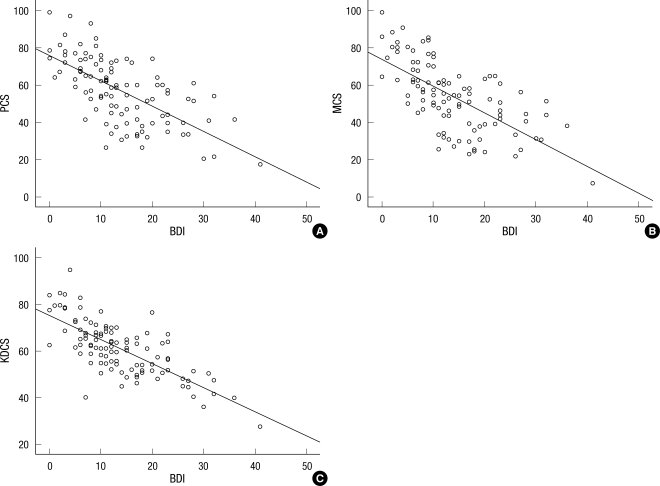
그림 출처: PubMed Central 공개 논문 (PMC3247777)
그 밖의 정보
- 출판 형태
- Journal Article, Research Support, Non-U.S. Gov't
- 저널
- Journal of Korean medical science · eISSN 1598-6357
- 전자 출판
- 2011-12-19
- MeSH
- Adult · Aged · Demography · Depression / etiology · Female · Health Status · Hemoglobins / analysis · Humans · Kidney Diseases / complications / physiopathology / psychology · Male · Middle Aged · Peritoneal Dialysis · Quality of Life* · Republic of Korea · Retrospective Studies · Risk Factors · Serum Albumin / analysis · Software
- Substances
- Hemoglobins · Serum Albumin
- 참고문헌
- 30편