
Crit Care. 2023;27(1):346.
Prospective, multicenter validation of the deep learning-based cardiac arrest risk management system for predicting in-hospital cardiac arrest or unplanned intensive care unit transfer in patients admitted to general wards.
제1저자 조경재, 김정수 · 교신저자 이연주
소속 (8)
- VUNO, Seoul, Republic of Korea.
- Division of Critical Care Medicine, Department of Hospital Medicine, Inha College of Medicine, Incheon, Republic of Korea.
- Department of Intensive Care Medicine, Dong-A University Hospital, College of Medicine, Busan, Republic of Korea.
- Department of Critical Care Medicine, Seoul National University Hospital, Seoul, Republic of Korea.
- Division of Pulmonary and Critical Care Medicine, Department of Internal Medicine, Seoul National University Hospital, Seoul National University College of Medicine, Seoul, Republic of Korea.
- Division of Pulmonary and Critical Care Medicine, Department of Internal Medicine, Seoul National University College of Medicine, Seoul National University Bundang Hospital, Seongnam, Republic of Korea.
- Department of Emergency Medicine, Seoul National University College of Medicine, Seoul National University Bundang Hospital, Seongnam, Republic of Korea.
- Division of Pulmonary and Critical Care Medicine, Department of Internal Medicine, Seoul National University College of Medicine, Seoul National University Bundang Hospital, Seongnam, Republic of Korea. yjlee1117@snubh.org.
Abstract
BACKGROUND Retrospective studies have demonstrated that the deep learning-based cardiac arrest risk management system (DeepCARS™) is superior to the conventional methods in predicting in-hospital cardiac arrest (IHCA). This prospective study aimed to investigate the predictive accuracy of the DeepCARS™ for IHCA or unplanned intensive care unit transfer (UIT) among general ward patients, compared with that of conventional methods in real-world practice.
METHODS This prospective, multicenter cohort study was conducted at four teaching hospitals in South Korea. All adult patients admitted to general wards during the 3-month study period were included. The primary outcome was predictive accuracy for the occurrence of IHCA or UIT within 24 h of the alarm being triggered. Area under the receiver operating characteristic curve (AUROC) values were used to compare the DeepCARS™ with the modified early warning score (MEWS), national early warning Score (NEWS), and single-parameter track-and-trigger systems.
RESULTS Among 55,083 patients, the incidence rates of IHCA and UIT were 0.90 and 6.44 per 1,000 admissions, respectively. In terms of the composite outcome, the AUROC for the DeepCARS™ was superior to those for the MEWS and NEWS (0.869 vs. 0.756/0.767). At the same sensitivity level of the cutoff values, the mean alarm counts per day per 1,000 beds were significantly reduced for the DeepCARS™, and the rate of appropriate alarms was higher when using the DeepCARS™ than when using conventional systems.
CONCLUSION The DeepCARS™ predicts IHCA and UIT more accurately and efficiently than conventional methods. Thus, the DeepCARS™ may be an effective screening tool for detecting clinical deterioration in real-world clinical practice. Trial registration This study was registered at ClinicalTrials.gov ( NCT04951973 ) on June 30, 2021.
© 2023. BioMed Central Ltd., part of Springer Nature.
Keywords
Artificial intelligenceCardiac arrestDeep learningEarly warning scoreIntensive care unitRapid response system
Figures
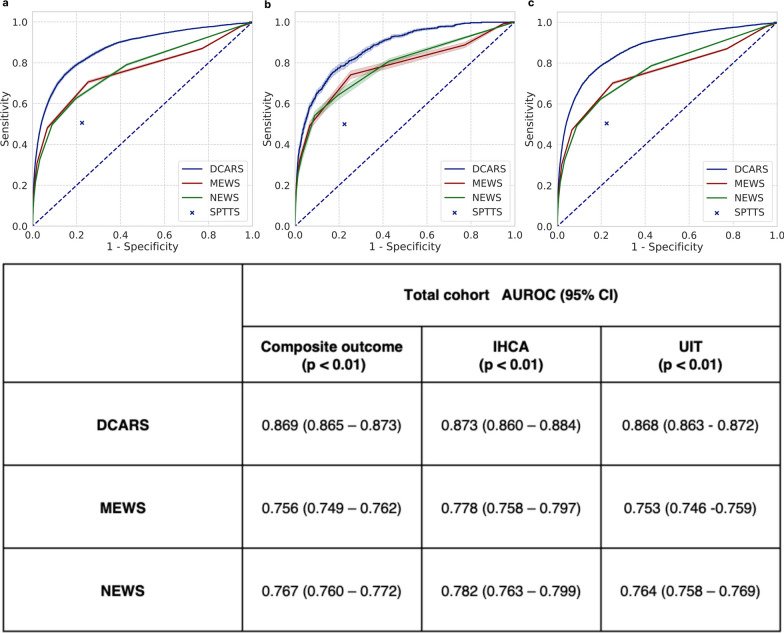
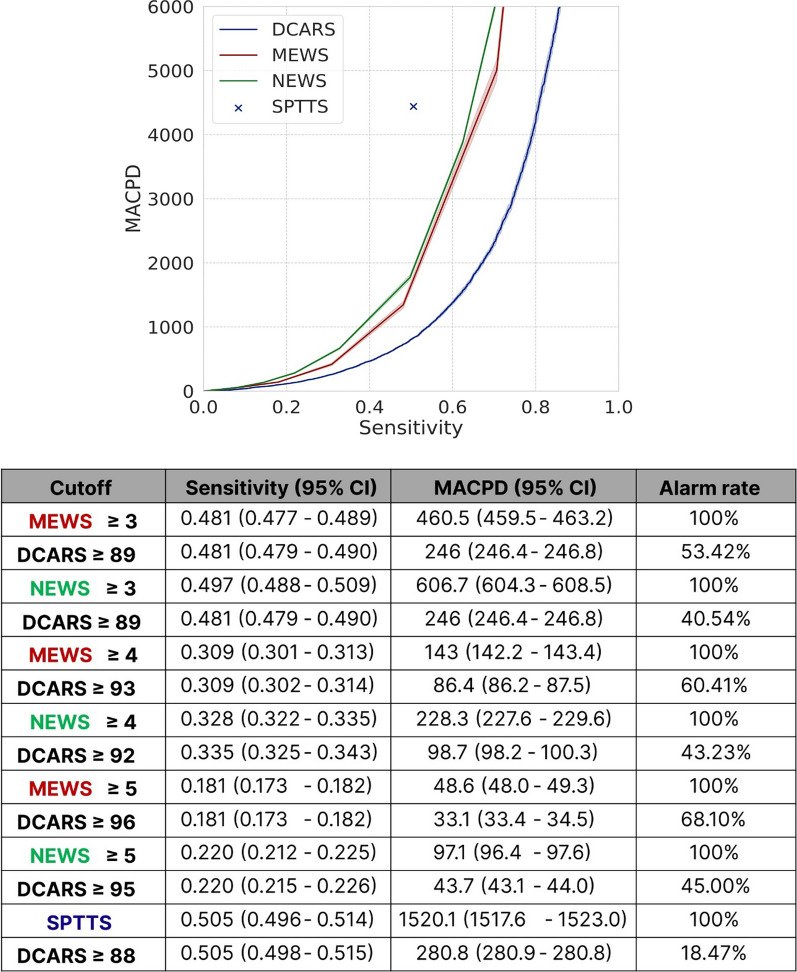
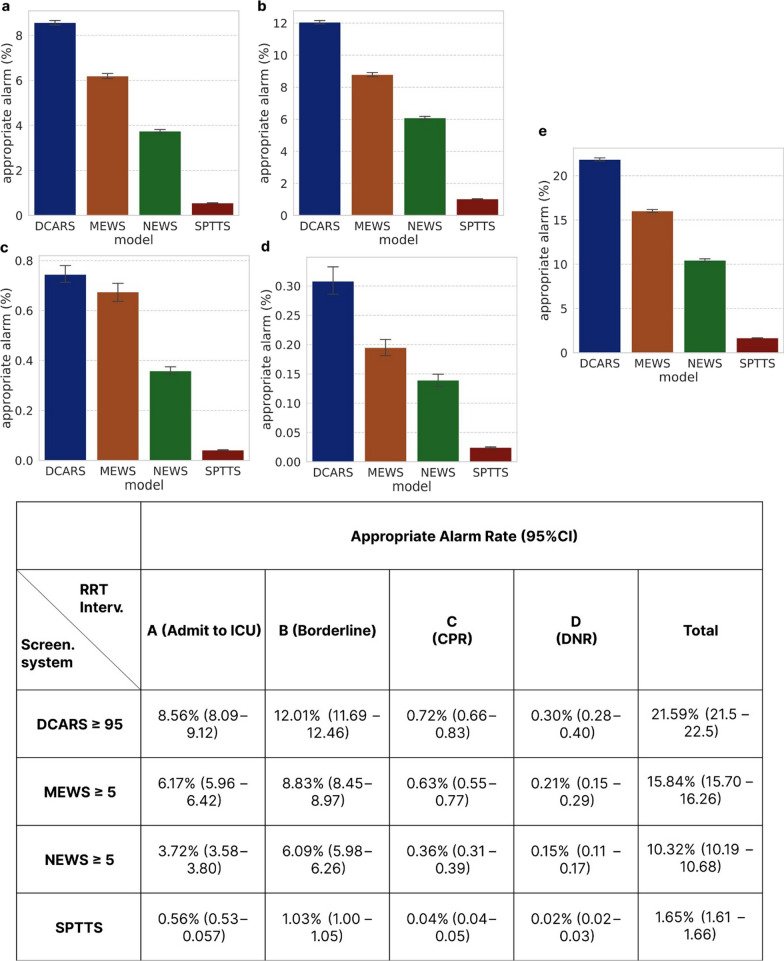
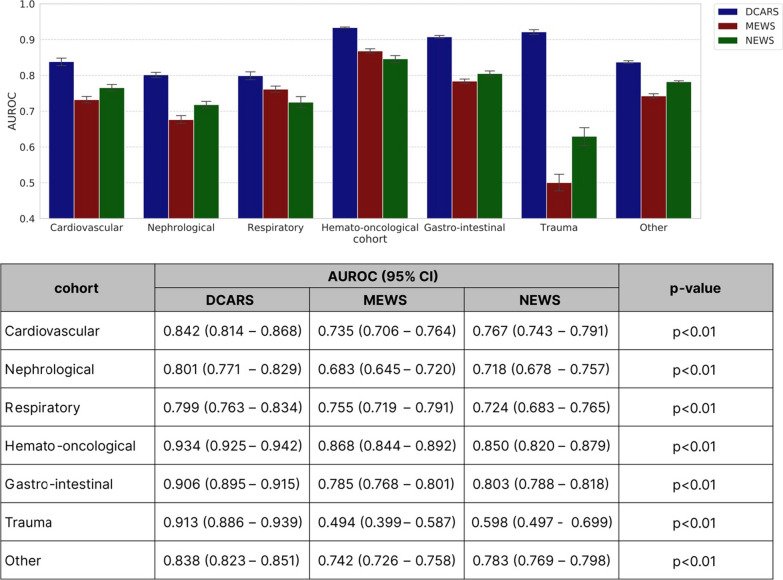
그림 출처: PubMed Central 공개 논문 (PMC10481524)
Conflict of interest statement
All authors have disclosed that they have no potential conflicts interest with any companies or organizations.
그 밖의 정보
- 출판 형태
- Multicenter Study, Journal Article
- 저널
- Critical care (London, England) · eISSN 1466-609X
- 전자 출판
- 2023-09-05
- MeSH
- Adult · Humans · Patients' Rooms · Prospective Studies · Cohort Studies · Deep Learning* · Retrospective Studies · Hospitals, Teaching · Heart Arrest* · Intensive Care Units · Risk Management
- 연구비
- Korea Medical Device Development Fund 202015X02 · Seoul National University Bundang Hospital, South Korea 14-2017-0021
- 데이터
- ClinicalTrials.gov: NCT04951973
- 참고문헌
- 28편