
Europace. 2024;26(5):7646273.
Association between body mass index and results of cryoballoon ablation in Korean patients with atrial fibrillation: an analysis from the Korean Heart Rhythm Society Cryoablation registry.
제1저자 안현진, 오일영 · 교신저자 이소령
소속 (13)
- Department of Internal Medicine, Seoul National University Hospital, 101 Daehak-ro, Jongno-gu, Seoul 03080, Korea.
- Cardiovascular Center, Seoul National University Bundang Hospital, Seoul National University College of Medicine, Seongnam, Korea.
- Department of Internal Medicine, Seoul National University College of Medicine, 101 Daehak-ro, Jongno-gu, Seoul 03080, Korea.
- Department of Internal Medicine, Heart Vascular and Stroke Institute, Samsung Medical Center, Sungkyunkwan University School of Medicine, Seoul, Korea.
- Division of Cardiology, Department of Internal Medicine, Asan Medical Center, University of Ulsan College of Medicine, Seoul, Korea.
- Division of Cardiology, Department of Internal Medicine, Konkuk University Medical Center, Konkuk University School of Medicine, Seoul, Korea.
- Division of Cardiology, Department of Internal Medicine, Kangbuk Samsung Hospital, Sungkyunkwan University School of Medicine, Seoul, Korea.
- Department of Cardiology, School of Medicine, Ewha Womans University, Seoul, Korea.
- Department of Internal Medicine, Haeundae Paik Hospital, Inje University College of Medicine, Busan, Korea.
- Department of Cardiology, CHA Bundang Medical Center, CHA University, Seongnam, Korea.
- Department of Internal Medicine, Chungnam National University Hospital, Chungnam National University College of Medicine, Daejeon, Korea.
- Division of Cardiology, Department of Internal Medicine, Korea University College of Medicine and Korea University Anam Hospital, Seoul, Korea.
- Division of Cardiology, Hallym University Sacred Heart Hospital, Hallym University College of Medicine, Anyang, Korea.
Abstract
AIMS Pulmonary vein isolation using cryoablation is effective and safe in patients with atrial fibrillation (AF). Although both obesity and underweight are associated with a higher risk for incident AF, there is limited data on the efficacy and safety following cryoablation according to body mass index (BMI) especially in Asians.
METHODS AND RESULTS Using the Korean Heart Rhythm Society Cryoablation registry, a multicentre registry of 12 tertiary hospitals, we analysed AF recurrence and procedure-related complications after cryoablation by BMI (kg/m2) groups (BMI < 18.5, underweight, UW; 18.5-23, normal, NW; 23-25, overweight, OW; 25-30, obese Ⅰ, OⅠ; ≥30, obese Ⅱ, OⅡ). A total of 2648 patients were included (median age 62.0 years; 76.7% men; 55.6% non-paroxysmal AF). Patients were categorized by BMI groups: 0.9% UW, 18.7% NW, 24.8% OW, 46.1% OI, and 9.4% OII. Underweight patients were the oldest and had least percentage of non-paroxysmal AF (33.3%). During a median follow-up of 1.7 years, atrial arrhythmia recurred in 874 (33.0%) patients (incidence rate, 18.9 per 100 person-years). After multivariable adjustment, the risk of AF recurrence was higher in UW group compared with NW group (adjusted hazard ratio, 95% confidence interval; 2.55, 1.18-5.50, P = 0.02). Procedure-related complications occurred in 123 (4.7%) patients, and the risk was higher for UW patients (odds ratio, 95% confidence interval; 2.90, 0.94-8.99, P = 0.07), mainly due to transient phrenic nerve palsy.
CONCLUSION Underweight patients showed a higher risk of AF recurrence after cryoablation compared with NW patients. Also, careful attention is needed on the occurrence of phrenic nerve palsy in UW patients.
© The Author(s) 2024. Published by Oxford University Press on behalf of the European Society of Cardiology.
Keywords
Atrial fibrillationBody mass indexCryoablationUnderweight
Figures
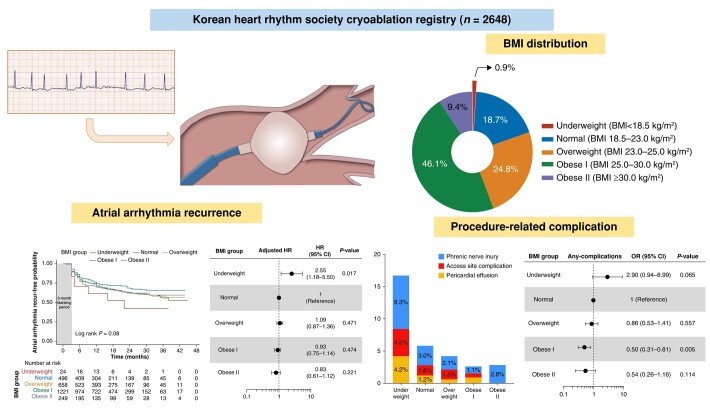
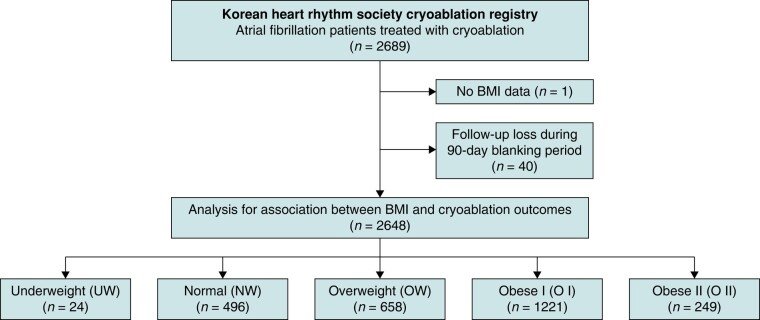
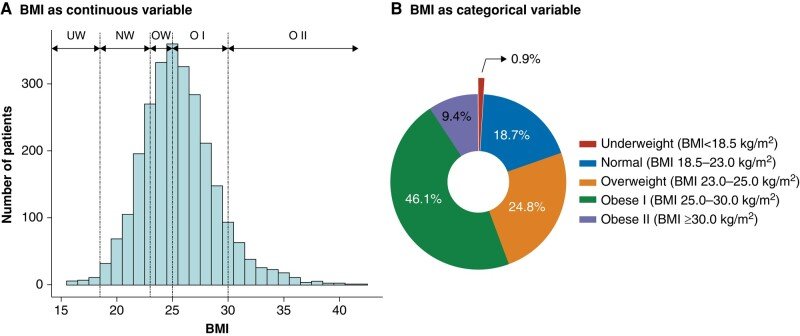
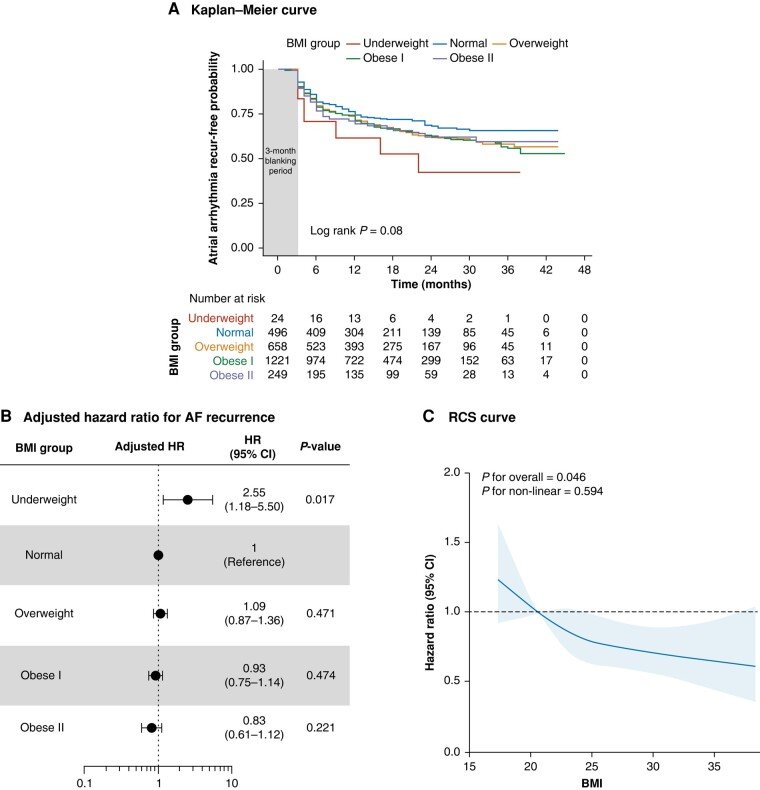
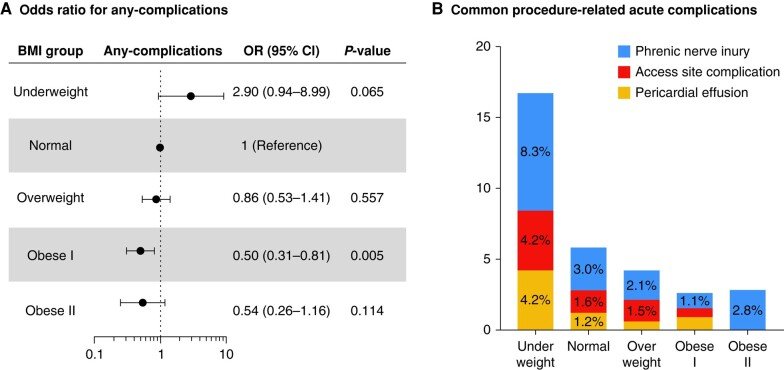
그림 출처: PubMed Central 공개 논문 (PMC11077609)
Conflict of interest statement
Conflict of interest: H.J.A., I.-Y.O., J.C., K.-Y.L., H.-J.A., S.K., S.O., J.Y.K., M.-J.C., C.H.K., S.H.L., J.P., K.-H.K., P.-S.Y., J.-H.K., J.S., and H.E.L.: these authors have reported that they have no relationships relevant to the contents of this paper to disclose. S.-R.L. reports speaking fees from Bayer, BMS/Pfizer, Biosense Webster, Daiichi-Sankyo, Sanofi-Aventis, Daewoong Pharmaceutical Co., Samjin Pharm, Seers Technology, Biotronik, Boston Scientific, and Medtronic and is a consultant for Biosense Webster. No fees are received personally and no fees are related to this work. E.-K.C. reports research grants or speaking fees from Abbott, Bayer, BMS/Pfizer, Biosense Webster, Chong Kun Dang, Daewoong Pharmaceutical Co., Daiichi-Sankyo, DeepQure, Dreamtech Co., Ltd, Jeil Pharmaceutical Co. Ltd, Medtronic, Samjin Pharm, Seers Technology, and SkyLabs. No fees are received personally and no fees are related to this work.
그 밖의 정보
- 출판 형태
- Journal Article, Multicenter Study
- 저널
- Europace : European pacing, arrhythmias, and cardiac electrophysiology : journal of the working groups on cardiac pacing, arrhythmias, and cardiac cellular electrophysiology of the European Society of Cardiology · eISSN 1532-2092
- MeSH
- Humans · Atrial Fibrillation* / surgery · Cryosurgery* / adverse effects · Male · Female · Middle Aged · Registries* · Body Mass Index* · Republic of Korea / epidemiology · Aged · Treatment Outcome · Recurrence* · Risk Factors · Pulmonary Veins* / surgery · Obesity* / complications · Thinness / complications · Time Factors · Postoperative Complications / epidemiology / etiology
- 연구비
- Heart Rhythm Society KHRS 2021-3 · Korean Cardiac Research Foundation 202103-01
- 참고문헌
- 31편