
Clin Mol Hepatol. 2020;26(3):328-339.
Effectiveness of nivolumab versus regorafenib in hepatocellular carcinoma patients who failed sorafenib treatment.
제1저자 이철형, 이윤빈 · 교신저자 김윤준
소속 (3)
- Department of Internal Medicine and Liver Research Institute, Seoul National University College of Medicine, Seoul, Korea.
- Department of Internal Medicine, Seoul National University Hospital, Seoul, Korea.
- Cancer Research Institute, Seoul National University, Seoul, Korea.
Abstract
BACKGROUND/AIMS Several treatment options are currently available for patients with hepatocellular carcinoma (HCC) failing previous sorafenib treatment. We aimed to compare the effectiveness of regorafenib and nivolumab in these patients.
METHODS Consecutive HCC patients who received regorafenib or nivolumab after failure of sorafenib treatment were included. Primary endpoint was overall survival (OS) and secondary endpoints were time to progression, tumor response rate, and adverse events. Inverse probability of treatment weighting (IPTW) using the propensity score was conducted to reduce treatment selection bias.
RESULTS Among 150 study patients, 102 patients received regorafenib and 48 patients received nivolumab. Median OS was 6.9 (95% confidence interval [CI], 3.0-10.8) months for regorafenib and 5.9 (95% CI, 3.7-8.1) months for nivolumab (P=0.77 by log-rank test). In multivariable analysis, nivolumab was associated with prolonged OS (vs. regorafenib: adjusted hazard ratio [aHR], 0.54; 95% CI, 0.30-0.96; P=0.04). Time to progression was not significantly different between groups (nivolumab vs. regorafenib: aHR, 0.82; 95% CI, 0.51-1.30; P=0.48). HRs were maintained after IPTW. Objective response rates were 5.9% and 16.7% in patients treated with regorafenib and nivolumab, respectively (P=0.04).
CONCLUSION After sorafenib failure, the use of nivolumab may be associated with improved OS and better objective response rate as compared to using regorafenib.
Keywords
Liver cancerNivolumabRegorafenibSurvival
Figures

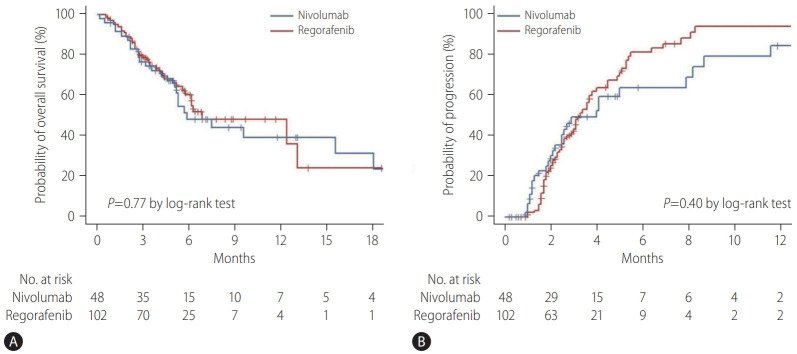

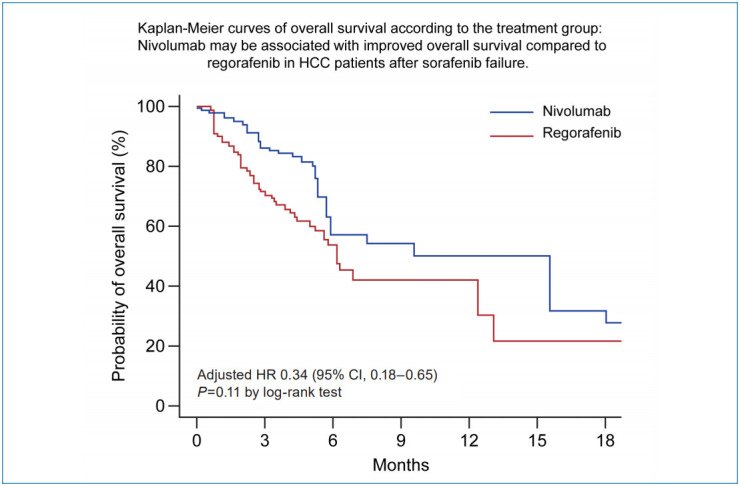
그림 출처: PubMed Central 공개 논문 (PMC7364358)
Comment · 정정
Conflict of interest statement
Conflicts of Interest: Dr. Lee YB reports receiving research grant from Samjin Pharmaceuticals; Dr. Lee KH reports honoraria from Roche and AstraZeneca, and serves an advisory role for AstraZeneca, Samsung Bioepis, BAYER, Roche, Eisai, and Ono Pharmaceutical; Dr. Lee JH reports receiving lecture fee from GreenCross Cell, Daewoong Pharmaceuticals, and Gilead Korea; Dr. Yu SJ reports lecture fee from Bayer HealthCare Pharmaceuticals; Dr. Kim YJ, research grants from Bristol-Myers Squibb, Roche, JW Creagene, Bukwang Pharmaceuticals, Handok Pharmaceuticals, Hanmi Pharmaceuticals, Yuhan Pharmaceuticals, Samjin Pharmaceuticals, AstraZeneca, and Pharmaking, and lecture fees from Bayer HealthCare Pharmaceuticals, Gilead Science, MSD Korea, Yuhan Pharmaceuticals, Samil Pharmaceuticals, CJ Pharmaceuticals, Bukwang Pharmaceuticals, and Handok Pharmaceuticals; Dr. Yoon JH, research grants from AstraZeneca, Bayer HealthCare Pharmaceuticals, Daewoong Pharmaceuticals, and Bukwang Pharmaceuticals. No other potential conflict of interest relevant to this article was reported.
그 밖의 정보
- 출판 형태
- Comparative Study, Journal Article, Research Support, Non-U.S. Gov't
- 저널
- Clinical and molecular hepatology · eISSN 2287-285X
- 전자 출판
- 2020-05-28
- MeSH
- Aged · Antineoplastic Agents, Immunological / therapeutic use · Carcinoma, Hepatocellular / drug therapy / mortality / pathology · Female · Humans · Kaplan-Meier Estimate · Liver Neoplasms / drug therapy / mortality / pathology · Male · Middle Aged · Nivolumab / therapeutic use · Phenylurea Compounds / therapeutic use · Proportional Hazards Models · Pyridines / therapeutic use · Retrospective Studies · Sorafenib / therapeutic use · Treatment Outcome
- Substances
- Antineoplastic Agents, Immunological · Phenylurea Compounds · Pyridines · regorafenib · Nivolumab · Sorafenib
- 참고문헌
- 35편