
Clin Mol Hepatol. 2019;25(1):52-64.
Association between hepatic steatosis and the development of hepatocellular carcinoma in patients with chronic hepatitis B.
제1저자 이윤빈 · 교신저자 황성규
소속 (5)
- Division of Hepatology, Department of Internal Medicine, CHA Bundang Medical Center, CHA University, Seongnam, Korea.
- Department of Internal Medicine and Liver Research Institute, Seoul National University College of Medicine, Seoul, Korea.
- Department of Pathology, CHA Bundang Medical Center, CHA University, Seongnam, Korea.
- Bio-Age, Medical Research Institute, Seoul, Korea.
- Department of Statistics, LSK Global Pharma Services Co., Ltd., Seoul, Korea.
Abstract
BACKGROUND/AIMS Nonalcoholic fatty liver disease (NAFLD) is becoming a worldwide epidemic, and is frequently found in patients with chronic hepatitis B (CHB). We investigated the impact of histologically proven hepatic steatosis on the risk for hepatocellular carcinoma (HCC) in CHB patients without excessive alcohol intake.
METHODS Consecutive CHB patients who underwent liver biopsy from January 2007 to December 2015 were included. The association between hepatic steatosis (≥ 5%) and subsequent HCC risk was analyzed. Inverse probability weighting (IPW) using the propensity score was applied to adjust for differences in patient characteristics, including metabolic factors.
RESULTS Fatty liver was histologically proven in 70 patients (21.8%) among a total of 321 patients. During the median (interquartile range) follow-up of 5.3 (2.9-8.3) years, 17 of 321 patients (5.3%) developed HCC: 8 of 70 patients (11.4%) with fatty liver and 9 of 251 patients (3.6%) without fatty liver. The five-year cumulative incidences of HCC among patients without and with fatty liver were 1.9% and 8.2%, respectively (P=0.004). Coexisting fatty liver was associated with a higher risk for HCC (adjusted hazards ratio [HR], 3.005; 95% confidence interval [CI], 1.122-8.051; P=0.03). After balancing with IPW, HCC incidences were not significantly different between the groups (P=0.19), and the association between fatty liver and HCC was not significant (adjusted HR, 1.709; 95% CI, 0.404-7.228; P=0.47).
CONCLUSION Superimposed NAFLD was associated with a higher HCC risk in CHB patients. However, the association between steatosis per se and HCC risk was not evident after adjustment for metabolic factors.
Keywords
Fatty liverHepatitis B virusLiver cancerMetabolic syndromeNonalcoholic fatty liver disease (NAFLD)
Figures
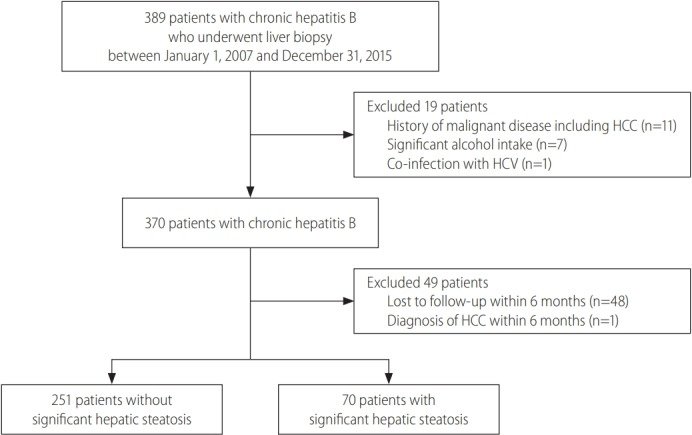
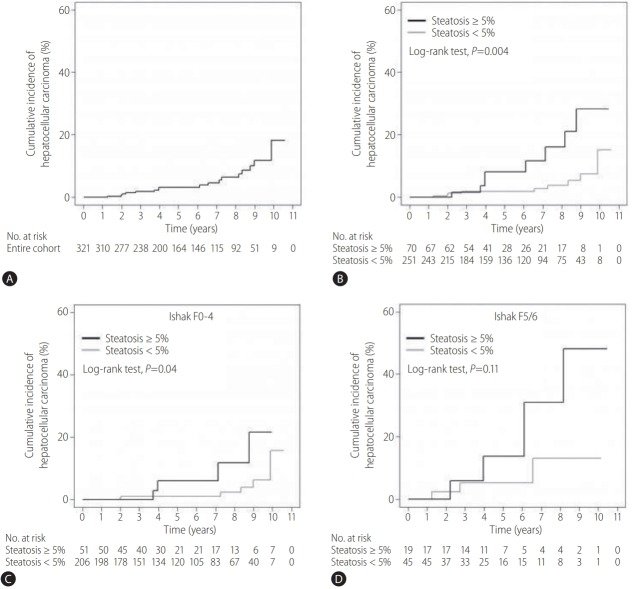
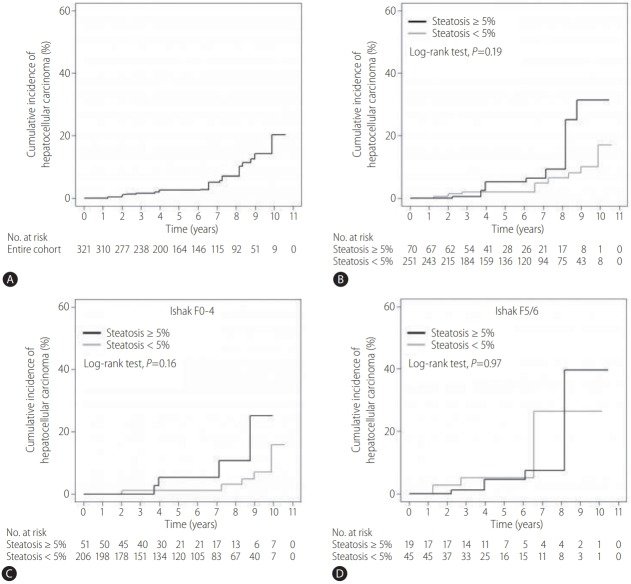
그림 출처: PubMed Central 공개 논문 (PMC6435969)
Comment · 정정
Conflict of interest statement
Conflicts of Interest The authors declare that they have no competing interests.
그 밖의 정보
- 출판 형태
- Journal Article
- 저널
- Clinical and molecular hepatology · eISSN 2287-285X
- 전자 출판
- 2018-10-23
- MeSH
- Adult · Carcinoma, Hepatocellular / diagnosis / epidemiology / etiology · Female · Follow-Up Studies · Hepatitis B, Chronic / complications / diagnosis · Humans · Incidence · Liver / pathology · Liver Neoplasms / diagnosis / epidemiology / etiology · Male · Middle Aged · Non-alcoholic Fatty Liver Disease / diagnosis / etiology / pathology · Proportional Hazards Models · Retrospective Studies · Risk Factors
- 참고문헌
- 26편