
Arthritis Res Ther. 2023;25(1):33.
Interplay between chronic inflammation and clonal haematopoiesis of indeterminate potential in Behçet's disease.
제1저자 박지혜, 안홍율 · 교신저자 이은영, 천재희
소속 (10)
- Department of Internal Medicine, Severance Hospital, Yonsei University College of Medicine, 50-1 Yonsei-Ro, Seodaemun-Gu, Seoul, 03722, South Korea.
- Institute of Gastroenterology, Severance Hospital, Yonsei University College of Medicine, Seoul, South Korea.
- Genome Opinion Inc, Seoul, South Korea.
- Brain Korea 21 PLUS Project for Medical Science, Yonsei University College of Medicine, Seoul, South Korea.
- Division of Rheumatology, Department of Internal Medicine, Seoul National University College of Medicine, Seoul, South Korea.
- Division of Hematology and Oncology, Department of Internal Medicine, Seoul National University Hospital, Seoul, South Korea.
- Division of Rheumatology, Department of Internal Medicine, Seoul National University Hospital, 101 Daehak-Ro, Jongno-Gu, Seoul, 03080, South Korea. elee@snu.ac.kr.
- Department of Internal Medicine, Severance Hospital, Yonsei University College of Medicine, 50-1 Yonsei-Ro, Seodaemun-Gu, Seoul, 03722, South Korea. geniushee@yuhs.ac.
- Institute of Gastroenterology, Severance Hospital, Yonsei University College of Medicine, Seoul, South Korea. geniushee@yuhs.ac.
- Brain Korea 21 PLUS Project for Medical Science, Yonsei University College of Medicine, Seoul, South Korea. geniushee@yuhs.ac.
Abstract
BACKGROUND Clonal haematopoiesis of indeterminate potential (CHIP) is a predisposition to haematological malignancy whose relationship with chronic inflammatory diseases, such as cardiovascular diseases, has been highlighted. Here, we aimed to investigate the CHIP emergence rate and its association with inflammatory markers in Behçet's disease (BD).
METHODS We performed targeted next-generation sequencing to detect the presence of CHIP using peripheral blood cells from 117 BD patients and 5004 healthy controls between March 2009 and September 2021 and analysed the association between CHIP and inflammatory markers.
RESULTS CHIP was detected in 13.9% of patients in the control group and 11.1% of patients in the BD group, indicating no significant intergroup difference. Among the BD patients of our cohort, five variants (DNMT3A, TET2, ASXL1, STAG2, and IDH2) were detected. DNMT3A mutations were the most common, followed by TET2 mutations. CHIP carriers with BD had a higher serum platelet count, erythrocyte sedimentation rate, and C-reactive protein level; older age; and lower serum albumin level at diagnosis than non-CHIP carriers with BD. However, the significant association between inflammatory markers and CHIP disappeared after the adjustment for various variables, including age. Moreover, CHIP was not an independent risk factor for poor clinical outcomes in patients with BD.
CONCLUSIONS Although BD patients did not have higher CHIP emergence rates than the general population, older age and degree of inflammation in BD were associated with CHIP emergence.
© 2023. The Author(s).
Keywords
Behçet’s diseaseClonal haematopoiesis of indeterminate potentialInflammation
Figures
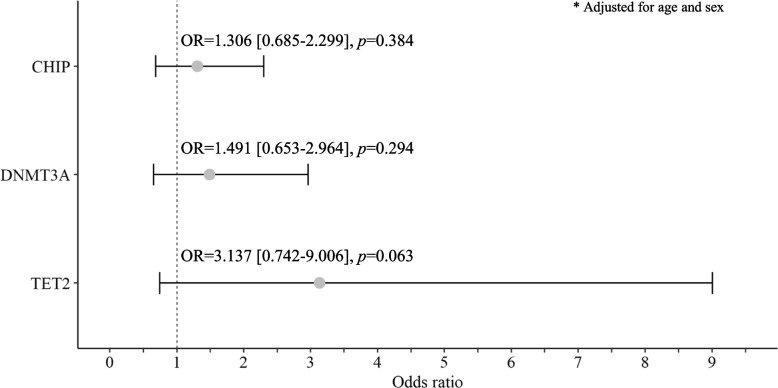
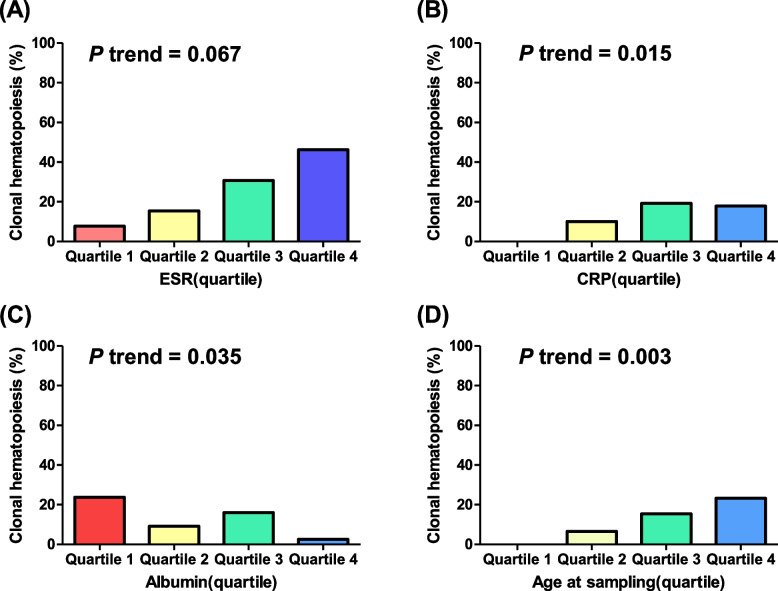
그림 출처: PubMed Central 공개 논문 (PMC9979406)
Conflict of interest statement
The authors declare that they have no competing interests.
그 밖의 정보
- 출판 형태
- Journal Article
- 저널
- Arthritis research & therapy · eISSN 1478-6362
- 전자 출판
- 2023-03-02
- MeSH
- Humans · Behcet Syndrome* / diagnosis / genetics · Clonal Hematopoiesis · Inflammation / genetics · Risk Factors · Blood Sedimentation
- 참고문헌
- 21편