
Sci Rep. 2019;9(1):6690.
Comparison of Once-Daily Administration of Edoxaban and Rivaroxaban in Asian Patients with Atrial Fibrillation.
제1저자 이소령 · 교신저자 최의근
소속 (5)
- Division of Cardiology, Department of Internal Medicine, Seoul National University Hospital, Seoul, Republic of Korea.
- Division of Cardiology, Department of Internal Medicine, Seoul National University Hospital, Seoul, Republic of Korea. choiek17@snu.ac.kr.
- Department of Medical Statistics, College of Medicine, Catholic University of Korea, Seoul, Republic of Korea.
- Liverpool Centre for Cardiovascular Science, University of Liverpool and Liverpool Chest & Heart Hospital, Liverpool, United Kingdom.
- Department of Clinical Medicine, Aalborg University, Aalborg, Denmark.
Abstract
It is unclear whether the two once-daily dosing non-vitamin K antagonist oral anticoagulants (NOACs), edoxaban and rivaroxaban, have similar effectiveness and safety in Asian patients with non-valvular atrial fibrillation (AF). This study aimed to compare the effectiveness and safety of edoxaban and rivaroxaban in a Korean population with non-valvular AF. Using the Korean National Health Insurance Service database from January 2014 to December 2016, we compared the risk of ischemic stroke, intracranial hemorrhage (ICH), hospitalization for gastrointestinal (GI) bleeding, hospitalization for major bleeding, all-cause death, and composite outcome in a 3:1 propensity score matched cohort in patients with AF who were naïve to rivaroxaban (n = 12,369) and edoxaban (n = 4,123). Hazard ratios for the six clinical outcomes were analyzed using Cox regression analysis with rivaroxaban as the reference. Baseline characteristics were balanced between the two groups (median age, 71 years; median CHA2DS2-VASc score, 3; 56% of patients received a reduced dose). Edoxaban users showed comparable results in all six clinical outcomes (all p = nonsignificant) when compared to rivaroxaban users for total, standard, and reduced doses. We provide for the first time the comparison of effectiveness and safety between the two once-daily NOACs in a large-scale Asian AF population. In both standard and reduced dose regimens, edoxaban showed comparable effectiveness and safety compared to rivaroxaban.
Figures
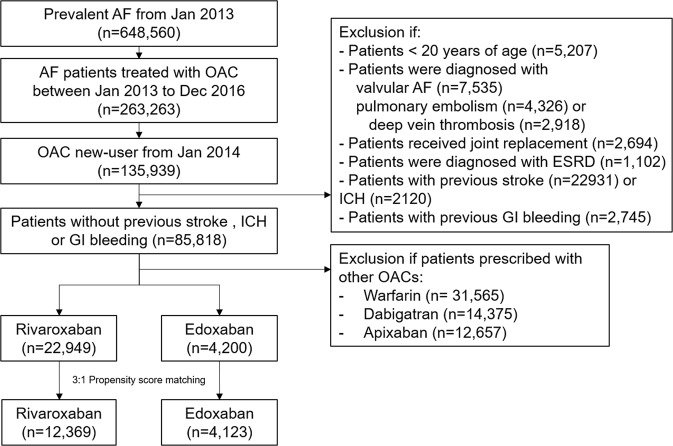
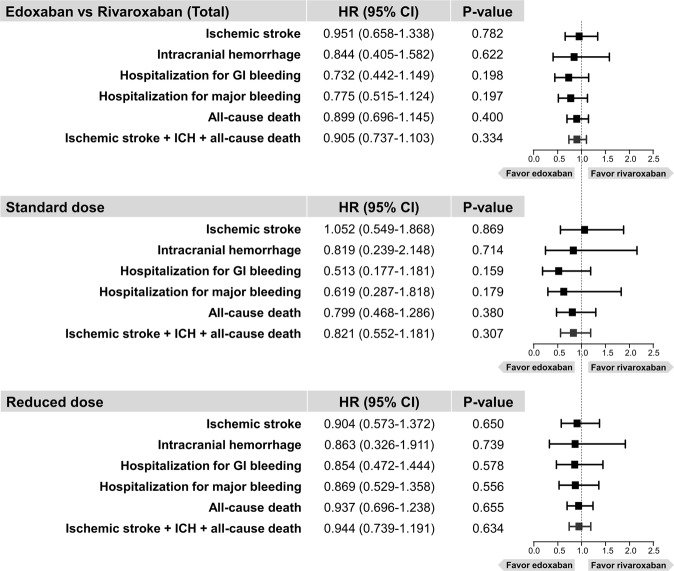
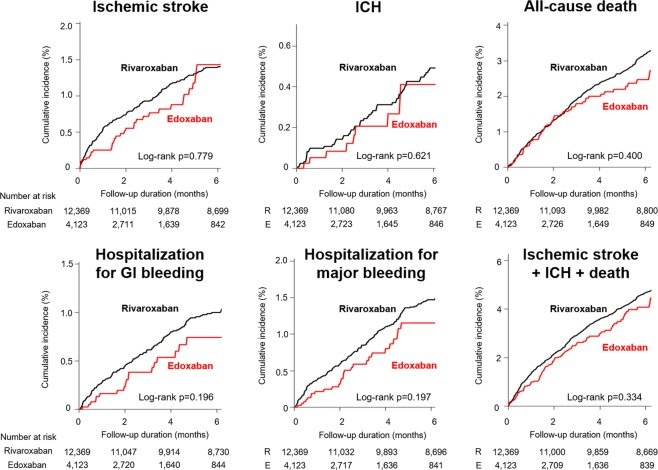
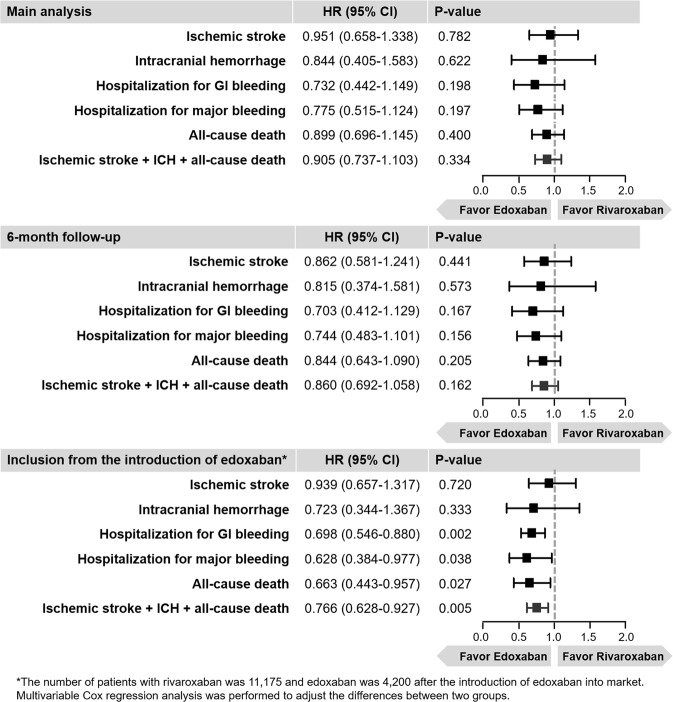
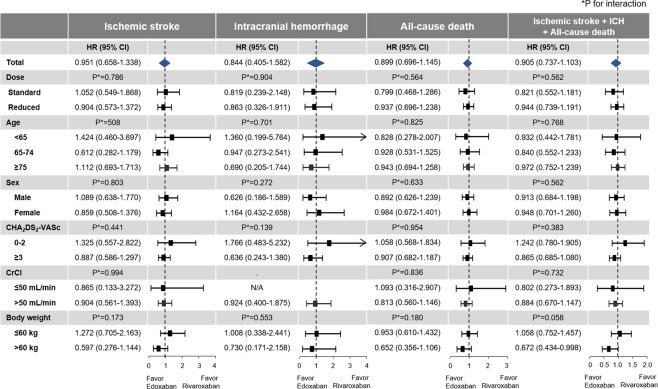
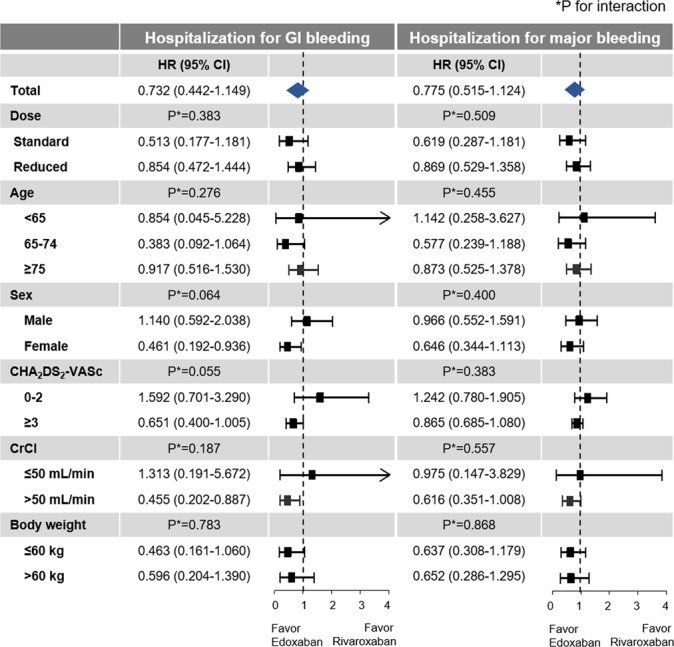
그림 출처: PubMed Central 공개 논문 (PMC6491445)
Conflict of interest statement
S.R.L., K.D.H., J.H.J., S.O.: None. E.K.C.: Research grant from Daiichi-Sankyo and Biosense Webster. G.Y.H.L. Consultant for Bayer/Janssen, BMS/Pfizer, Biotronik, Medtronic, Boehringer Ingelheim, Microlife and Daiichi-Sankyo. Speaker for Bayer, BMS/Pfizer, Medtronic, Boehringer Ingelheim, Microlife, Roche and Daiichi-Sankyo. No fees are received personally.
그 밖의 정보
- 출판 형태
- Journal Article, Research Support, Non-U.S. Gov't
- 저널
- Scientific reports · eISSN 2045-2322
- 전자 출판
- 2019-04-30
- MeSH
- Administration, Oral · Aged · Aged, 80 and over · Asian People* · Atrial Fibrillation / epidemiology / etiology · Cause of Death · Disease Susceptibility · Drug Administration Schedule · Factor Xa Inhibitors / administration & dosage / adverse effects · Female · Flow Cytometry · Follow-Up Studies · Hemorrhage / epidemiology / etiology · Humans · Incidence · Infant · Male · Middle Aged · Patient Outcome Assessment · Population Surveillance · Pyridines / administration & dosage / adverse effects · Rivaroxaban / administration & dosage / adverse effects · Thiazoles / administration & dosage / adverse effects
- Substances
- Factor Xa Inhibitors · Pyridines · Thiazoles · Rivaroxaban · edoxaban
- 참고문헌
- 39편