
Sci Rep. 2019;9(1):7536.
Circulating Microbiota-Based Metagenomic Signature for Detection of Hepatocellular Carcinoma.
제1저자 조은주/임상섭 · 교신저자 윤정환/박태성
소속 (8)
- Department of Internal Medicine and Liver Research Institute, Seoul National University College of Medicine, Seoul, Korea.
- Department of Statistics, Seoul National University, Seoul, Korea.
- Department of Health and Safety Convergence Science, Korea University, Seoul, Korea.
- Department of Gastroenterology, Ajou University School of Medicine, Suwon, Korea.
- Department of Internal Medicine, Seoul National University Boramae Hospital, Seoul National University College of Medicine, Seoul, Korea.
- Department of Internal Medicine, Inje University Haeundae Paik Hospital, Busan, Korea.
- Department of Internal Medicine and Liver Research Institute, Seoul National University College of Medicine, Seoul, Korea. yoonjh@snu.ac.kr.
- Department of Statistics, Seoul National University, Seoul, Korea. tspark@stats.snu.ac.kr.
Abstract
Circulating microbial dysbiosis is associated with chronic liver disease including nonalcoholic steatohepatitis and alcoholic liver disease. In this study, we evaluated whether disease-specific alterations of circulating microbiome are present in patients with cirrhosis and hepatocellular carcinoma (HCC), and their potential as diagnostic biomarkers for HCC. We performed cross-sectional metagenomic analyses of serum samples from 79 patients with HCC, 83 with cirrhosis, and 201 matching healthy controls, and validated the results in the same number of subjects. Serum bacterial DNA was analyzed using high-throughput pyrosequencing after amplification of the V3-V4 hypervariable regions of 16S rDNA. Blood microbial diversity was significantly reduced in HCC, compared with cirrhosis and control. There were significant differences in the relative abundances of several bacterial taxa that correlate with the presence of HCC, thus defining a specific blood microbiome-derived metagenomic signature of HCC. We identified 5 microbial gene markers-based model which distinguished HCC from controls with an area under the receiver-operating curve (AUC) of 0.879 and a balanced accuracy of 81.6%. In the validation, this model accurately distinguished HCC with an AUC of 0.875 and an accuracy of 79.8%. In conclusion, circulating microbiome-based signatures may be potential biomarkers for the detection HCC.
Figures
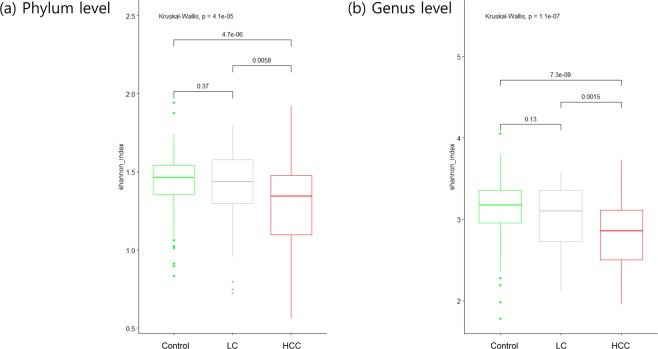
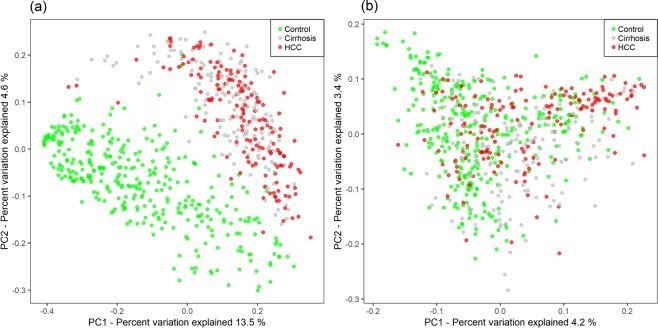
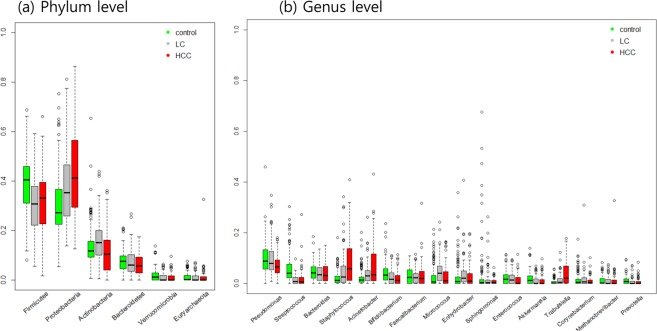
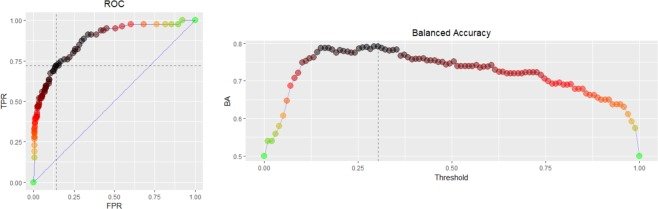
그림 출처: PubMed Central 공개 논문 (PMC6525191)
Conflict of interest statement
The authors declare no competing interests.
그 밖의 정보
- 출판 형태
- Journal Article, Research Support, Non-U.S. Gov't
- 저널
- Scientific reports · eISSN 2045-2322
- 전자 출판
- 2019-05-17
- MeSH
- Biomarkers, Tumor / genetics · Carcinoma, Hepatocellular / blood / diagnosis / microbiology · Cross-Sectional Studies · DNA, Bacterial / blood · DNA, Ribosomal / blood / genetics · Dysbiosis / blood / microbiology · Female · Humans · Liver Cirrhosis / blood / microbiology · Liver Neoplasms / blood / diagnosis / microbiology · Male · Metagenome / genetics · Microbiota / genetics · Middle Aged · RNA, Ribosomal, 16S / genetics · Republic of Korea
- Substances
- Biomarkers, Tumor · DNA, Bacterial · DNA, Ribosomal · RNA, Ribosomal, 16S
- 참고문헌
- 28편