
Front Cardiovasc Med. 2022;9:832023.
Non-alcoholic Fatty Liver Disease and the Risk of Incident Atrial Fibrillation in Young Adults: A Nationwide Population-Based Cohort Study.
제1저자 최정민, 이소령 · 교신저자 최의근
소속 (6)
- Department of Internal Medicine, Seoul National University Hospital, Seoul, South Korea.
- Department of Internal Medicine, Seoul National University College of Medicine, Seoul, South Korea.
- Department of Medical Statistics, College of Medicine, Catholic University of Korea, Seoul, South Korea.
- Department of Statistics and Actuarial Science, Soongsil University, Seoul, South Korea.
- Liverpool Center for Cardiovascular Science, University of Liverpool and Liverpool Chest and Heart Hospital, Liverpool, United Kingdom.
- Department of Clinical Medicine, Aalborg University, Aalborg, Denmark.
Abstract
BACKGROUND Non-alcoholic fatty liver disease (NAFLD) is a multisystem disease including cardiovascular. However, the association between NAFLD and the risk of incident atrial fibrillation (AF), especially in young adults, remains unclear. We aimed to evaluate the association between NAFLD as assessed by the fatty liver index (FLI) and the risk of AF in young adults.
METHODS We identified individuals aged 20-39 years who underwent health examinations conducted by the Korean National Health Insurance Corporation between January 2009 and December 2012. Individuals with significant liver disease, heavy alcohol consumption, or prevalent AF were excluded. We categorized based on FLI: <30, 30 to <60, and ≥60. Incident AF was evaluated as the primary outcome.
RESULTS We included 5,333,907 subjects (mean age, 31 ± 5 years; men, 57%). During a mean follow-up of 7.4 ± 1.1 years, 12,096 patients had newly diagnosed AF (incidence rate 0.31 per 1,000 person-years). After adjustment, subjects with FLI 30 to <60 and FLI ≥60 showed a higher risk of AF compared to those with FLI <30 (hazard ratio [HR] 1.21, 95% confidence interval [CI, 1.15-1.27] and HR 1.47, 95% CI [1.39-1.55], p < 0.001, respectively). In women, the increased AF risk was accentuated in the higher FLI group than in the individuals with FLI <30, compared with men (p-for-interaction = 0.023). A higher incident AF risk in the higher FLI groups was consistently observed in various subgroups.
CONCLUSION Among young adults, NAFLD assessed using FLI was positively correlated with the AF risk. These findings support the evidence of AF screening in young adults with high FLI scores.
Copyright © 2022 Choi, Lee, Choi, Ahn, Kwon, Park, Lee, Chung, Han, Lee, Han, Oh and Lip.
Keywords
adultatrial fibrillationfatty liver indexnon-alcoholic fatty liver diseaseyoung
Figures


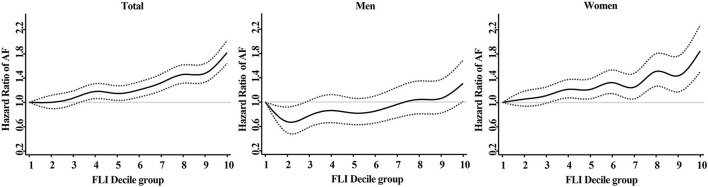

그림 출처: PubMed Central 공개 논문 (PMC8984026)
Conflict of interest statement
E-KC, Research grants or speaking fees from Bayer, BMS/Pfizer, Biosense Webster, Chong Kun Dang, Daiichi-Sankyo, Dreamtech Co., Ltd., Medtronic, Samjinpharm, Sanofi-Aventis, Seers Technology, and Skylabs. GL, Consultant and speaker for BMS/Pfizer, Boehringer Ingelheim, and Daiichi-Sankyo. The remaining authors declare that the research was conducted in the absence of any commercial or financial relationships that could be construed as a potential conflict of interest.
그 밖의 정보
- 출판 형태
- Journal Article
- 저널
- Frontiers in cardiovascular medicine · ISSN 2297-055X
- 전자 출판
- 2022-03-23
- 참고문헌
- 66편