
Crit Care. 2020;24(1):42.
Machine learning algorithm to predict mortality in patients undergoing continuous renal replacement therapy.
제1저자 강민우 · 교신저자 한승석
소속 (3)
- Department of Internal Medicine, Seoul National University College of Medicine, 103 Daehak-ro, Jongno-gu, Seoul, 03080, Korea.
- Medical Research Collaborating Center, Seoul National University Hospital, Seoul, Korea.
- Department of Internal Medicine, Seoul National University College of Medicine, 103 Daehak-ro, Jongno-gu, Seoul, 03080, Korea. hansway80@gmail.com.
Abstract
BACKGROUND Previous scoring models such as the Acute Physiologic Assessment and Chronic Health Evaluation II (APACHE II) and the Sequential Organ Failure Assessment (SOFA) scoring systems do not adequately predict mortality of patients undergoing continuous renal replacement therapy (CRRT) for severe acute kidney injury. Accordingly, the present study applies machine learning algorithms to improve prediction accuracy for this patient subset.
METHODS We randomly divided a total of 1571 adult patients who started CRRT for acute kidney injury into training (70%, n = 1094) and test (30%, n = 477) sets. The primary output consisted of the probability of mortality during admission to the intensive care unit (ICU) or hospital. We compared the area under the receiver operating characteristic curves (AUCs) of several machine learning algorithms with that of the APACHE II, SOFA, and the new abbreviated mortality scoring system for acute kidney injury with CRRT (MOSAIC model) results.
RESULTS For the ICU mortality, the random forest model showed the highest AUC (0.784 [0.744-0.825]), and the artificial neural network and extreme gradient boost models demonstrated the next best results (0.776 [0.735-0.818]). The AUC of the random forest model was higher than 0.611 (0.583-0.640), 0.677 (0.651-0.703), and 0.722 (0.677-0.767), as achieved by APACHE II, SOFA, and MOSAIC, respectively. The machine learning models also predicted in-hospital mortality better than APACHE II, SOFA, and MOSAIC.
CONCLUSION Machine learning algorithms increase the accuracy of mortality prediction for patients undergoing CRRT for acute kidney injury compared with previous scoring models.
Keywords
Acute kidney injuryContinuous renal replacement therapyIntensive care unitMachine learningMortality
Figures
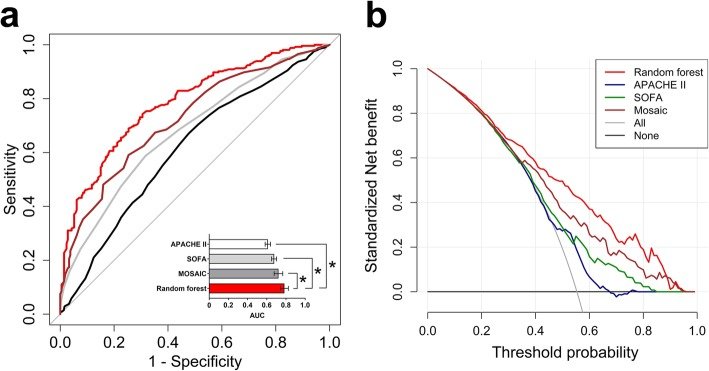
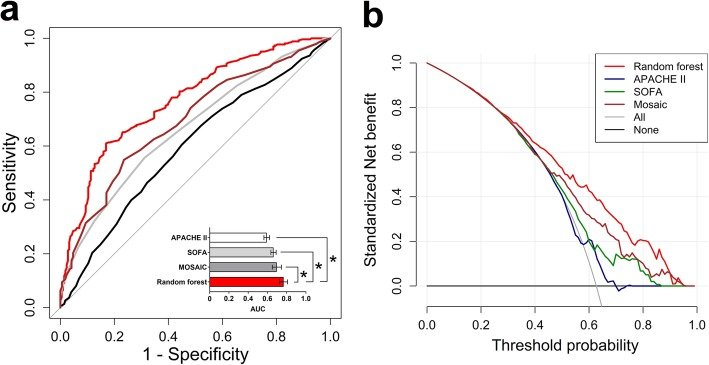
그림 출처: PubMed Central 공개 논문 (PMC7006166)
Conflict of interest statement
The authors declare that they have no competing interests.
그 밖의 정보
- 출판 형태
- Journal Article, Research Support, Non-U.S. Gov't
- 저널
- Critical care (London, England) · eISSN 1466-609X
- 전자 출판
- 2020-02-06
- MeSH
- APACHE · Acute Kidney Injury / therapy · Aged · Aged, 80 and over · Algorithms* · Area Under Curve · Continuous Renal Replacement Therapy / adverse effects / methods / statistics & numerical data · Female · Humans · Machine Learning / trends · Male · Middle Aged · Mortality / trends · Organ Dysfunction Scores · ROC Curve · Republic of Korea · Risk Factors · Severity of Illness Index
- 연구비
- National Research Foundation of Korea NRF-2017R1D1A1B03031642
- 참고문헌
- 34편