
Arthritis Res Ther. 2022;24(1):180.
Incident and recurrent herpes zoster for first-line bDMARD and tsDMARD users in seropositive rheumatoid arthritis patients: a nationwide cohort study.
제1저자 정석송, 최슬기 · 교신저자 강병주, 이은영
소속 (8)
- Department of Biomedical Sciences, Seoul National University College of Medicine, Seoul, South Korea.
- Department of Biomedical Informatics, CHA University School of Medicine, CHA University, Seongnam, South Korea.
- Department of Internal Medicine, Seoul National University Hospital, Seoul, South Korea.
- Department of Family Medicine, Seoul National University Hospital, Seoul, South Korea.
- Division of Rheumatology, Department of Internal Medicine, Jeju National University School of Medicine, Jeju National University Hospital, Jeju, South Korea.
- Division of Rheumatology, Department of Internal Medicine, Jeju National University School of Medicine, Jeju National University Hospital, Jeju, South Korea. indream81@naver.com.
- Division of Rheumatology, Department of Internal Medicine, Seoul National University College of Medicine, 101 Daehak-ro, Jongno-gu, Seoul, South Korea. elee@snu.ac.kr.
- Integrated Major in Innovative Medical Science, Seoul National University Graduate School, Seoul, South Korea. elee@snu.ac.kr.
Abstract
BACKGROUND There is limited information regarding disease-modifying antirheumatic drug (DMARD)-dependent risks of overall, incident, and recurrent herpes zoster (HZ) during first-line biologic DMARD (bDMARD) or targeted synthetic DMARD (tsDMARD) treatment among patients with seropositive rheumatoid arthritis (RA) in terms of HZ risk.
METHODS A total of 11,720 patients with seropositive RA who were prescribed bDMARD or tofacitinib between January 2011 and January 2019 from the Korean Health Insurance Review & Assessment Service database were studied. A multivariate Cox proportional hazards regression model was adopted to evaluate the adjusted hazard ratio (aHR) with 95% confidence interval (CI) for the risk of HZ dependent on the choice of first-line bDMARDs or tsDMARD, including etanercept, infliximab, adalimumab, golimumab, tocilizumab, rituximab, tofacitinib, and abatacept.
RESULTS During the 34,702 person-years of follow-up, 1686 cases (14.4%) of HZ were identified, including 1372 (11.7%) incident and 314 (2.7%) recurrent HZs. Compared with that of the abatacept group, tofacitinib increased the overall risk (aHR, 2.46; 95% CI, 1.61-3.76; P<0.001), incidence (aHR, 1.99; 95% CI, 1.18-3.37; P=0.011), and recurrence (aHR, 3.69; 95% CI, 1.77-7.69; P<0.001) of HZ. Infliximab (aHR, 1.36; 95% CI, 1.06-1.74; P=0.017) and adalimumab (aHR, 1.29; 95% CI, 1.02-1.64; P=0.032) also increased the overall HZ risk. Moreover, a history of HZ was found to be an independent risk factor for HZ (aHR, 1.54; 95% CI, 1.33-1.78; P<0.001).
CONCLUSIONS HZ risk is significantly increased in RA patients with a history of HZ after the initiation of bDMARDs or tsDMARD. The risk of incident and recurrent HZ was higher after tofacitinib treatment in patients with RA than that after treatment with bDMARDs. Individualized characteristics and history of HZ should be considered when selecting bDMARDs or tsDMARD for RA patients considering HZ risks.
© 2022. The Author(s).
Keywords
Biologic disease-modifying antirheumatic drugsHerpes zosterRheumatoid arthritisTargeted synthetic disease-modifying antirheumatic drugs
Figures
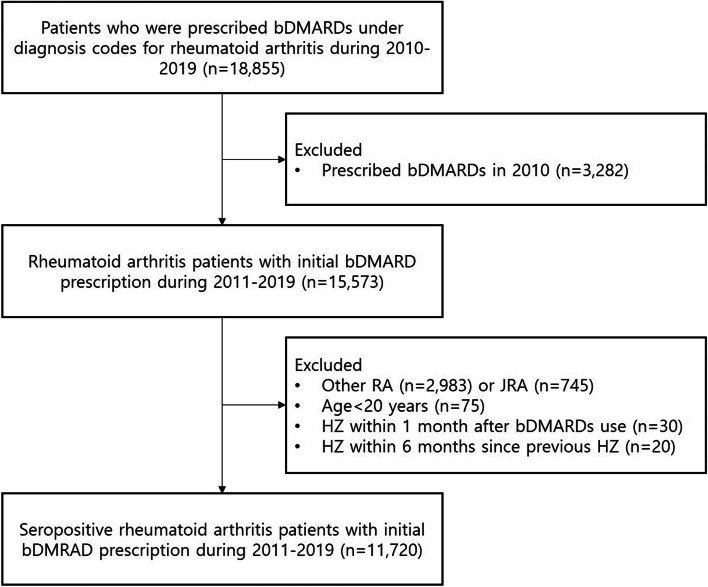
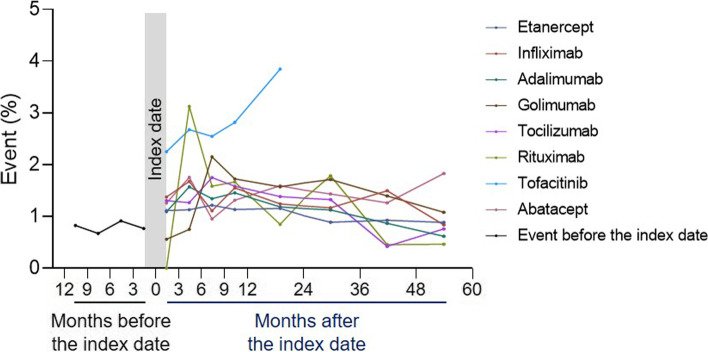
그림 출처: PubMed Central 공개 논문 (PMC9330646)
Conflict of interest statement
The authors declare that they have no competing interests.
그 밖의 정보
- 출판 형태
- Journal Article, Research Support, Non-U.S. Gov't
- 저널
- Arthritis research & therapy · eISSN 1478-6362
- 전자 출판
- 2022-07-28
- MeSH
- Abatacept / therapeutic use · Adalimumab / therapeutic use · Antirheumatic Agents* / adverse effects · Arthritis, Rheumatoid* / drug therapy / epidemiology · Biological Products* / therapeutic use · Cohort Studies · Herpes Zoster* / chemically induced / epidemiology · Humans · Infliximab / therapeutic use
- Substances
- Antirheumatic Agents · Biological Products · Abatacept · Infliximab · Adalimumab
- 참고문헌
- 34편