
Front Cardiovasc Med. 2022;9:1008340.
The impact of socioeconomic deprivation on the risk of atrial fibrillation in patients with diabetes mellitus: A nationwide population-based study.
제1저자 한민주, 이소령 · 교신저자 최의근
소속 (5)
- Department of Internal Medicine, Seoul National University Hospital, Seoul, South Korea.
- Department of Internal Medicine, Seoul National University College of Medicine, Seoul, South Korea.
- Statistics and Actuarial Science, Soongsil University, Seoul, South Korea.
- Liverpool Centre for Cardiovascular Science, Liverpool Heart and Chest Hospital, University of Liverpool, Liverpool, United Kingdom.
- Department of Clinical Medicine, Aalborg University, Aalborg, Denmark.
Abstract
OBJECTIVE To evaluate the relationship between socioeconomic status and the risk of atrial fibrillation (AF) in patients with diabetes mellitus (DM).
RESEARCH DESIGN AND METHODS From the National Health Insurance Service (NHIS) database, we identified 2,429,610 diabetic patients who underwent national health check-ups between 2009 and 2012. Tracing back the subjects for 5 years from the date of health check-up, we determined the subjects' income and whether they received medical aid (MA) during the past 5 years. Subjects were divided into six groups according to the number of years of receiving (MA groups 0 through 5) and into four groups according to socioeconomic status change during the past 5 years. We estimated the risk of AF for each group using the Cox proportional-hazards model.
RESULTS During a median follow-up of 7.2 ± 1.7 years, 80,257 were newly identified as AF. The MA groups showed a higher risk of AF than the non-MA group with the hazard ratios (HRs) and 95% confidence interval (CI) 1.32 (1.2-1.44), 1.33 (1.22-1.45), 1.23 (1.13-1.34), 1.28 (1.16-1.4), and 1.50 (1.39-1.63) for MA groups 1 through 5, respectively. Dividing subjects according to socioeconomic condition change, those who experienced worsening socioeconomic status (non-MA to MA) showed higher risk compared to the persistent non-MA group (HR 1.54; 95% CI 1.38-1.73).
CONCLUSION Low socioeconomic status was associated with the risk of AF in patients with diabetes. More attention should be directed at alleviating health inequalities, targeting individuals with socioeconomic deprivation to provide timely management for AF.
Copyright © 2022 Han, Lee, Choi, Park, Lee, Chung, Choi, Han, Oh and Lip.
Keywords
atrial fibrillationdiabetes mellitusmedical aid beneficiariessocial medicinesocioeconomic status
Figures

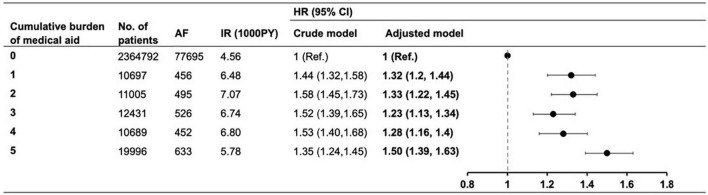
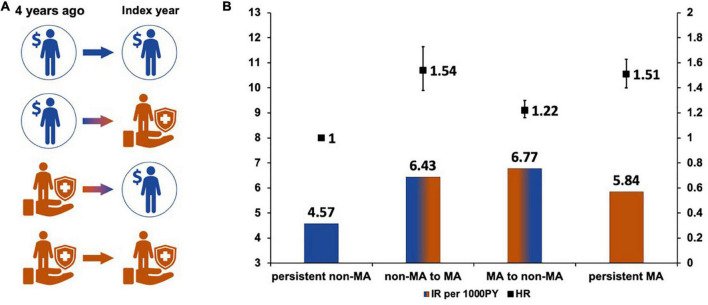
그림 출처: PubMed Central 공개 논문 (PMC9708742)
Conflict of interest statement
Author E-KC research grants or speaking fees from Bayer, BMS/Pfizer, Biosense Webster, Chong Kun Dang, Daiichi-Sankyo, Dreamtech Co., Ltd., Medtronic, Samjinpharm, Sanofi-Aventis, Seers Technology, and Skylabs. Author GL consultant and speaker for BMS/Pfizer, Boehringer Ingelheim, and Daiichi-Sankyo. No fees are received personally. The remaining authors declare that the research was conducted in the absence of any commercial or financial relationships that could be construed as a potential conflict of interest.
그 밖의 정보
- 출판 형태
- Journal Article
- 저널
- Frontiers in cardiovascular medicine · ISSN 2297-055X
- 전자 출판
- 2022-11-16
- 참고문헌
- 44편