
J Med Internet Res. 2021;23(7):e29979.
A Smart Diaper System Using Bluetooth and Smartphones to Automatically Detect Urination and Volume of Voiding: Prospective Observational Pilot Study in an Acute Care Hospital.
제1저자 조재호 · 교신저자 김선욱
소속 (2)
- Department of Internal Medicine, Seoul National University Bundang Hospital, Gyeonggi-do, Republic of Korea.
- Panoptics Corp, Gyeonggi-do, Republic of Korea.
Abstract
BACKGROUND Caregivers of patients who wear conventional diapers are required to check for voiding every hour because prolonged wearing of wet diapers causes health problems including diaper dermatitis and urinary tract infections. However, frequent checking is labor intensive and disturbs patients' and caregivers' sleep. Furthermore, assessing patients' urine output with diapers in an acute care setting is difficult. Recently, a smart diaper system with wetness detection technology was developed to solve these issues.
OBJECTIVE We aimed to evaluate the applicability of the smart diaper system for urinary detection, its accuracy in measuring voiding volume, and its effect on incontinence-associated dermatitis (IAD) occurrence in an acute care hospital.
METHODS This prospective, observational, single-arm pilot study was conducted at a single tertiary hospital. We recruited 35 participants aged ≥50 years who were wearing diapers due to incontinence between August and November 2020. When the smart diaper becomes wet, the smart diaper system notifies the caregiver to change the diaper and measures voiding volume automatically. Caregivers were instructed to record the weight of wet diapers on frequency volume charts (FVCs). We determined the voiding detection rate of the smart diaper system and compared the urine volume as automatically calculated by the smart diaper system with the volume recorded on FVCs. Agreement between the two measurements was estimated using a Bland-Altman plot. We also checked for the occurrence or aggravation of IAD and bed sores.
RESULTS A total of 30 participants completed the protocol and 390 episodes of urination were recorded. There were 108 records (27.7%) on both the FVCs and the smart diaper system, 258 (66.2%) on the FVCs alone, 18 (4.6%) on the smart diaper system alone, and 6 (1.5%) on the FVCs with sensing device lost. The detection rate of the smart diaper system was 32.8% (126/384). When analyzing records concurrently listed in both the FVCs and the smart diaper system, linear regression showed a strong correlation between the two measurements (R2=0.88, P<.001). The Bland-Altman assessment showed good agreement between the two measurements, with a mean difference of -4.2 mL and 95% limits of agreement of -96.7 mL and 88.3 mL. New occurrence and aggravation of IAD and bed sores were not observed. Bed sores improved in one participant.
CONCLUSIONS The smart diaper system showed acceptable accuracy for measuring urine volume and it could replace conventional FVCs in acute setting hospitals. Furthermore, the smart diaper system has the potential advantage of preventing IAD development and bed sore worsening. However, the detection rate of the smart diaper system was lower than expected. Detection rate polarization among participants was observed, and improvements in the user interface and convenience are needed for older individuals who are unfamiliar with the smart diaper system.
©Jae Ho Cho, Jung-Yeon Choi, Nak-Hyun Kim, Yejee Lim, Jung Hun Ohn, Eun Sun Kim, Jiwon Ryu, Jangsun Kim, Yiseob Kim, Sun-wook Kim, Kwang-Il Kim. Originally published in the Journal of Medical Internet Research (https://www.jmir.org), 30.07.2021.
Keywords
appdiaper rasheHealthenuresismHealthmedical devicemobile phoneobservationalpilot studyprospectivesensorsmart diapersmartphoneurinary incontinenceurinevoided volume
Figures
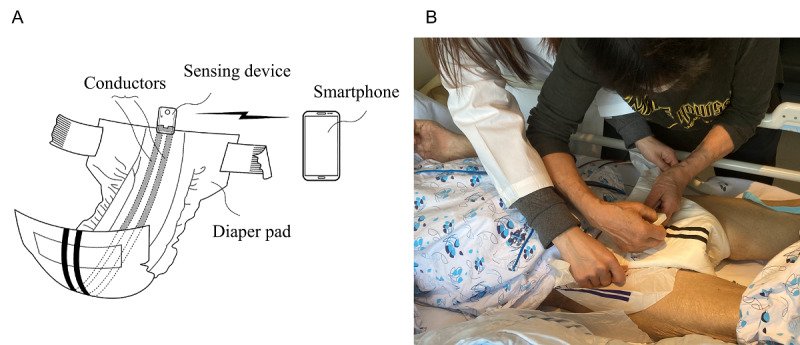

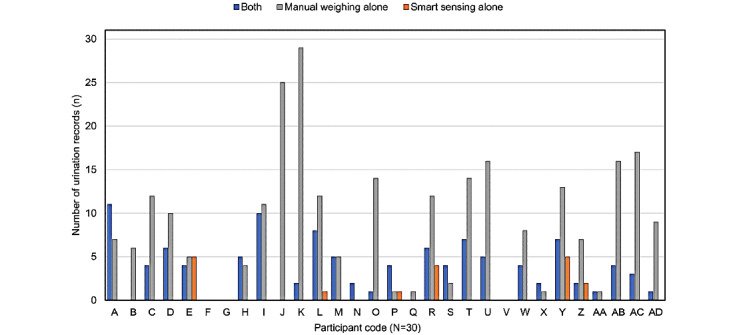
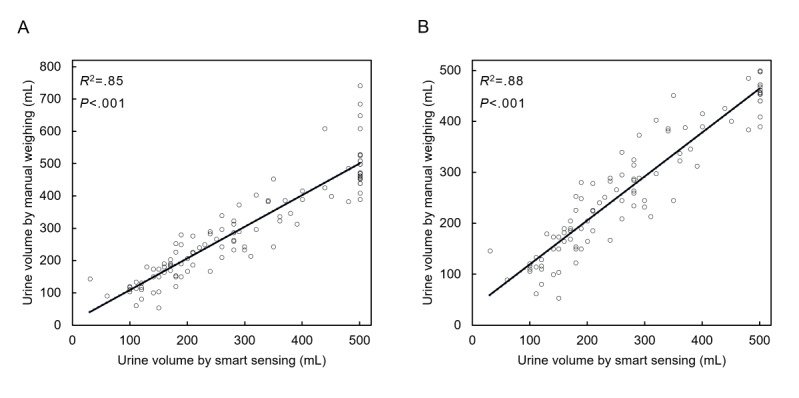
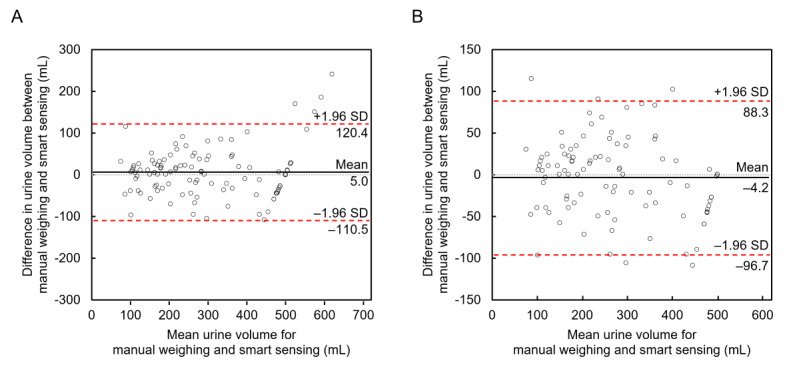
그림 출처: PubMed Central 공개 논문 (PMC8367151)
Conflict of interest statement
Conflicts of Interest: None declared.
그 밖의 정보
- 출판 형태
- Journal Article, Observational Study, Research Support, Non-U.S. Gov't
- 저널
- Journal of medical Internet research · eISSN 1438-8871
- 전자 출판
- 2021-07-30
- MeSH
- Hospitals · Humans · Pilot Projects · Prospective Studies · Smartphone* · Urination*
- 참고문헌
- 36편