
Immune Netw. 2023;23(5):e39.
COVID-19 Vaccination Alters NK Cell Dynamics and Transiently Reduces HBsAg Titers Among Patients With Chronic Hepatitis B.
제1저자 신현재, 이하석 · 교신저자 신의철, 이정훈
소속 (5)
- Department of Internal Medicine and Liver Research Institute, Seoul National University College of Medicine, Seoul 03080, Korea.
- Graduate School of Medical Science and Engineering, Korea Advanced Institute of Science and Technology (KAIST), Daejeon 34141, Korea.
- Division of Infectious Diseases, Department of Internal Medicine, Korea University Guro Hospital, Korea University College of Medicine, Seoul 08308, Korea.
- Division of Infectious Diseases, Department of Medicine, Samsung Medical Center, Sungkyunkwan University School of Medicine, Seoul 16419, Korea.
- The Center for Viral Immunology, Korea Virus Research Institute, Institute for Basic Science, Daejeon 34126, Korea.
Abstract
Coronavirus disease 2019 (COVID-19) vaccination may non-specifically alter the host immune system. This study aimed to evaluate the effect of COVID-19 vaccination on hepatitis B surface Ag (HBsAg) titer and host immunity in chronic hepatitis B (CHB) patients. Consecutive 2,797 CHB patients who had serial HBsAg measurements during antiviral treatment were included in this study. Changes in the HBsAg levels after COVID-19 vaccination were analyzed. The dynamics of NK cells following COVID-19 vaccination were also examined using serial blood samples collected prospectively from 25 healthy volunteers. Vaccinated CHB patients (n=2,329) had significantly lower HBsAg levels 1-30 days post-vaccination compared to baseline (median, -21.4 IU/ml from baseline), but the levels reverted to baseline by 91-180 days (median, -3.8 IU/ml). The velocity of the HBsAg decline was transiently accelerated within 30 days after vaccination (median velocity: -0.06, -0.39, and -0.04 log10 IU/ml/year in pre-vaccination period, days 1-30, and days 31-90, respectively). In contrast, unvaccinated patients (n=468) had no change in HBsAg levels. Flow cytometric analysis showed that the frequency of NK cells expressing NKG2A, an NK inhibitory receptor, significantly decreased within 7 days after the first dose of COVID-19 vaccine (median, -13.1% from baseline; p<0.001). The decrease in the frequency of NKG2A+ NK cells was observed in the CD56dimCD16+ NK cell population regardless of type of COVID-19 vaccine. COVID-19 vaccination leads to a rapid, transient decline in HBsAg titer and a decrease in the frequency of NKG2A+ NK cells.
Copyright © 2023. The Korean Association of Immunologists.
Keywords
COVID-19 vaccinesChronic hepatitis BHBsAgNK cellsNKG2A
Figures
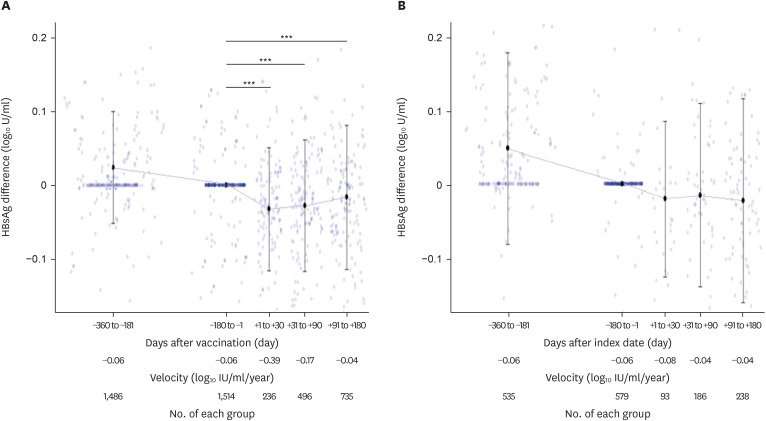
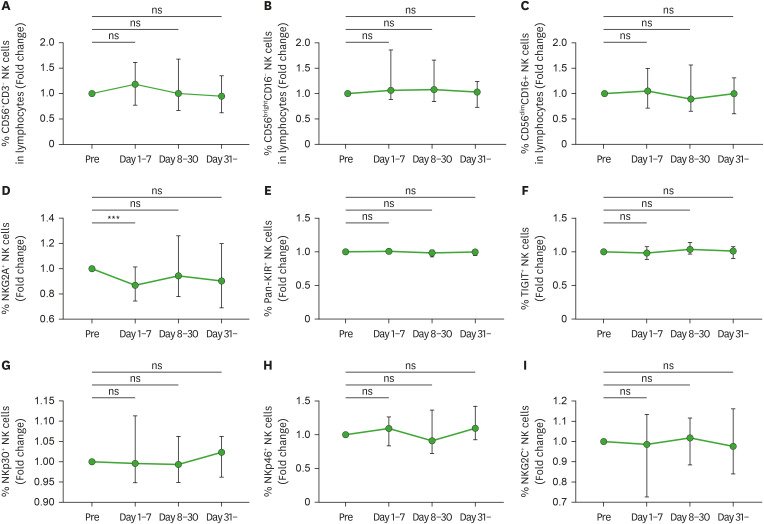
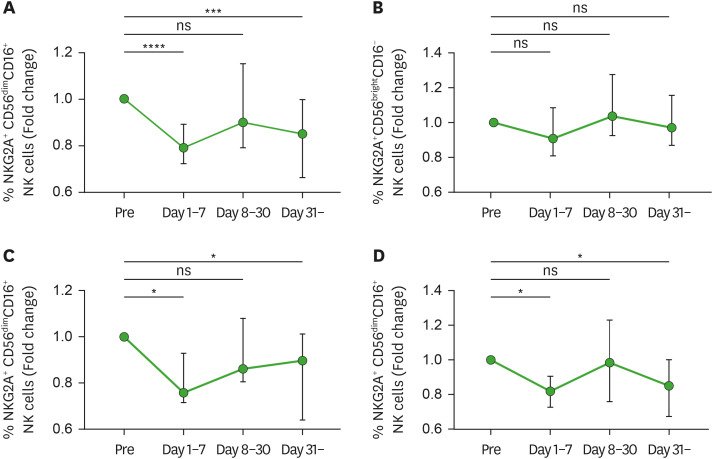
그림 출처: PubMed Central 공개 논문 (PMC10643334)
Conflict of interest statement
Conflict of Interest: Yun Bin Lee reports receiving research grants from Samjin Pharmaceuticals and Yuhan Pharmaceuticals. Yoon Jun Kim reports receiving research grants from Bristol-Myers Squibb, Roche, JW Creagene, Bukwang Pharmaceuticals, Handok Pharmaceuticals, Hanmi Pharmaceuticals, Yuhan Pharmaceuticals, and Pharmaking, and lecture fees from Bayer HealthCare Pharmaceuticals, Gilead Science, MSD Korea, Yuhan Pharmaceuticals, Samil Pharmaceuticals, CJ Pharmaceuticals, Bukwang Pharmaceuticals, and Handok Pharmaceuticals. Jung-Hwan Yoon reports receiving research grants from Bayer HealthCare Pharmaceuticals, Daewoong Pharmaceuticals, and Bukwang Pharmaceuticals. Jeong-Hoon Lee reports receiving research grants from Yuhan Pharmaceuticals, and lecture fee from GreenCross Cell, Daewoong Pharmaceuticals, and Gilead Korea. All other authors have declared that no conflict of interest exists.
그 밖의 정보
- 출판 형태
- Journal Article
- 저널
- Immune network · ISSN 1598-2629
- 전자 출판
- 2023-10-17
- 참고문헌
- 40편