
J Med Internet Res. 2021;23(4):e24120.
Real-Time Clinical Decision Support Based on Recurrent Neural Networks for In-Hospital Acute Kidney Injury: External Validation and Model Interpretation.
제1저자 김기표, 양현식 · 교신저자 김세중
소속 (6)
- Division of Nephrology and Hypertension, Department of Internal Medicine, Inha University College of Medicine, Incheon, Republic of Korea.
- Department of Computer Science and Engineering, Seoul National University, Seoul, Republic of Korea.
- Department of Health Science and Technology, Graduate School of Convergence Science and Technology, Seoul National University, Seoul, Republic of Korea.
- Department of Internal Medicine, Seoul National University Bundang Hospital, Seongnam, Republic of Korea.
- Department of Internal Medicine, Seoul National University Hospital, Seoul, Republic of Korea.
- Center for Artificial Intelligence in Healthcare, Seoul National University Bundang Hospital, Seongnam, Republic of Korea.
Abstract
BACKGROUND Acute kidney injury (AKI) is commonly encountered in clinical practice and is associated with poor patient outcomes and increased health care costs. Despite it posing significant challenges for clinicians, effective measures for AKI prediction and prevention are lacking. Previously published AKI prediction models mostly have a simple design without external validation. Furthermore, little is known about the process of linking model output and clinical decisions due to the black-box nature of neural network models.
OBJECTIVE We aimed to present an externally validated recurrent neural network (RNN)-based continuous prediction model for in-hospital AKI and show applicable model interpretations in relation to clinical decision support.
METHODS Study populations were all patients aged 18 years or older who were hospitalized for more than 48 hours between 2013 and 2017 in 2 tertiary hospitals in Korea (Seoul National University Bundang Hospital and Seoul National University Hospital). All demographic data, laboratory values, vital signs, and clinical conditions of patients were obtained from electronic health records of each hospital. We developed 2-stage hierarchical prediction models (model 1 and model 2) using RNN algorithms. The outcome variable for model 1 was the occurrence of AKI within 7 days from the present. Model 2 predicted the future trajectory of creatinine values up to 72 hours. The performance of each developed model was evaluated using the internal and external validation data sets. For the explainability of our models, different model-agnostic interpretation methods were used, including Shapley Additive Explanations, partial dependence plots, individual conditional expectation, and accumulated local effects plots.
RESULTS We included 69,081 patients in the training, 7675 in the internal validation, and 72,352 in the external validation cohorts for model development after excluding cases with missing data and those with an estimated glomerular filtration rate less than 15 mL/min/1.73 m2 or end-stage kidney disease. Model 1 predicted any AKI development with an area under the receiver operating characteristic curve (AUC) of 0.88 (internal validation) and 0.84 (external validation), and stage 2 or higher AKI development with an AUC of 0.93 (internal validation) and 0.90 (external validation). Model 2 predicted the future creatinine values within 3 days with mean-squared errors of 0.04-0.09 for patients with higher risks of AKI and 0.03-0.08 for those with lower risks. Based on the developed models, we showed AKI probability according to feature values in total patients and each individual with partial dependence, accumulated local effects, and individual conditional expectation plots. We also estimated the effects of feature modifications such as nephrotoxic drug discontinuation on future creatinine levels.
CONCLUSIONS We developed and externally validated a continuous AKI prediction model using RNN algorithms. Our model could provide real-time assessment of future AKI occurrences and individualized risk factors for AKI in general inpatient cohorts; thus, we suggest approaches to support clinical decisions based on prediction models for in-hospital AKI.
©Kipyo Kim, Hyeonsik Yang, Jinyeong Yi, Hyung-Eun Son, Ji-Young Ryu, Yong Chul Kim, Jong Cheol Jeong, Ho Jun Chin, Ki Young Na, Dong-Wan Chae, Seung Seok Han, Sejoong Kim. Originally published in the Journal of Medical Internet Research (http://www.jmir.org), 16.04.2021.
Keywords
acute kidney injuryexternal validationinternal validationkidneyneural networksprediction modelrecurrent neural network
Figures
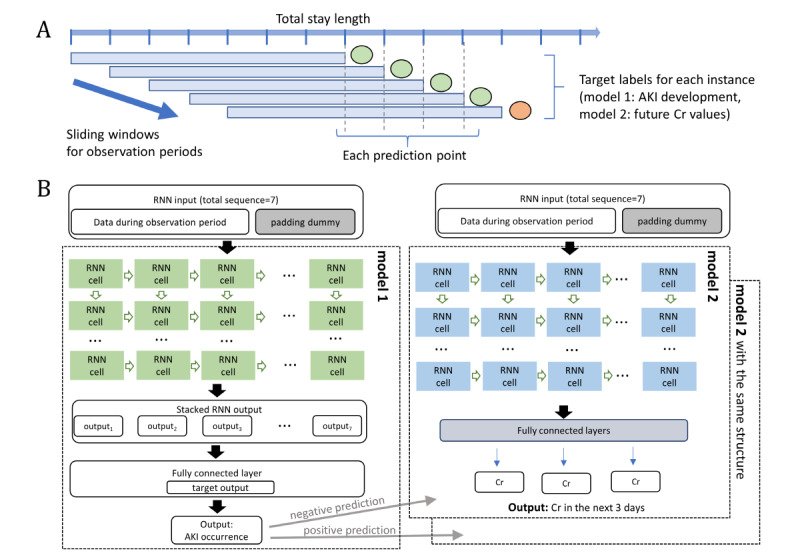
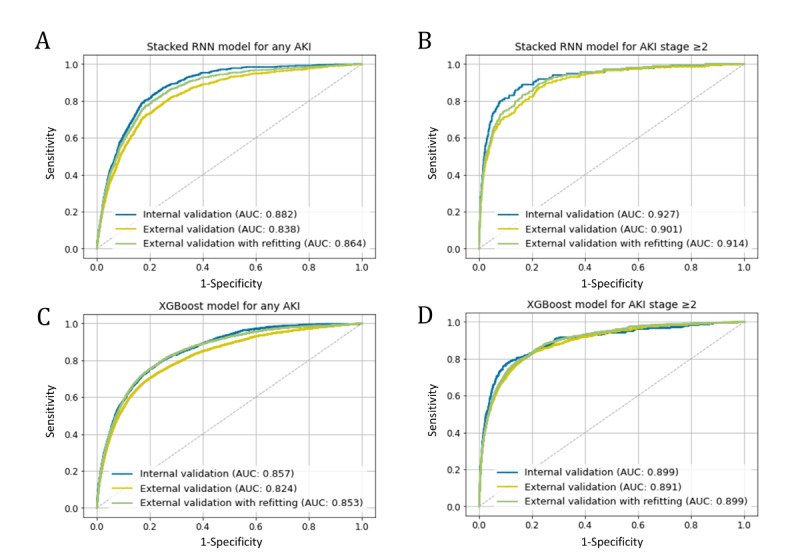
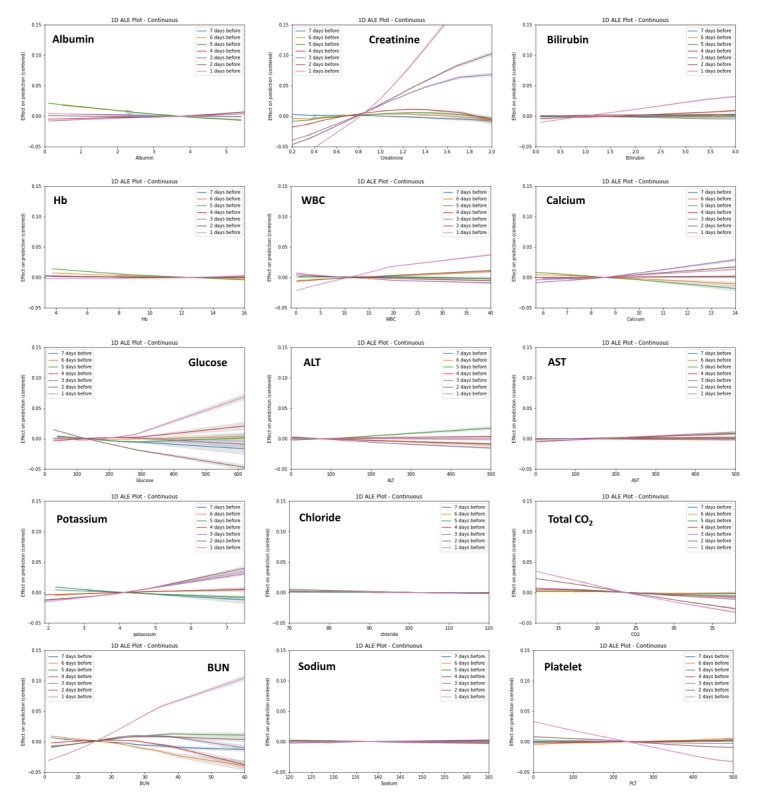
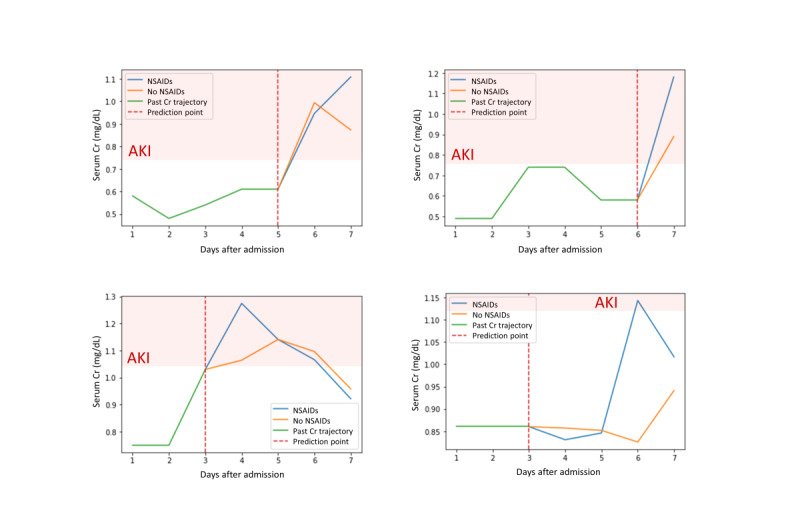
그림 출처: PubMed Central 공개 논문 (PMC8087972)
Conflict of interest statement
Conflicts of Interest: None declared.
그 밖의 정보
- 출판 형태
- Journal Article, Research Support, Non-U.S. Gov't
- 저널
- Journal of medical Internet research · eISSN 1438-8871
- 전자 출판
- 2021-04-16
- MeSH
- Acute Kidney Injury* / diagnosis / therapy · Decision Support Systems, Clinical* · Hospitals, University · Humans · Neural Networks, Computer · Risk Assessment · Risk Factors
- 참고문헌
- 50편