
J Korean Med Sci. 2008;23(2):232-5.
Korean ginseng-induced occupational asthma and determination of IgE binding components.
제1저자 김경묵 · 교신저자 김유영
소속 (1)
- Department of Internal Medicine, Seoul National University College of Medicine, 28 Yeongeon-dong, Jongno-gu, Seoul, Korea.
Abstract
A number of case reports on occupational asthma caused by herbal medicines have been issued, for example, on Sanyak, Chunkung, Banha, and Brazilian ginseng. Recently, cases of occupational asthma induced by Sanyak and Korean ginseng have been reported, but the pathogenic mechanisms involved are unknown. This study was carried out to evaluate the immunologic mechanism underlying Korean ginseng-induced occupational asthma. A patient engaged in Korean ginseng wholesale was referred for recurrent dyspnea, wheezing, and nasal symptoms, which were aggravated at work. Allergen bronchial provocation testing to Korean ginseng extract showed a typical immediate response, and skin prick testing to Korean ginseng extract also showed a strong positive response. Moreover, serum-specific IgE levels to Korean ginseng extract were significantly higher than in controls. Enzyme-linked immunosorbent assay (ELISA) inhibition tests showed a dose-dependent inhibition by Korean ginseng, but not by Dermatophagoides farinae, wheat flour, or Chinese balloon flower. Sodium dodecylsulfate-poly-acrylamide gel electrophoresis (SDS-PAGE) and immunoblotting revealed four specific Immunoglobulin E (IgE) binding components at 26, 30, 47, and 60 kDa, which were not bound by control sera. These results strongly suggest that occupation asthma induced by Korean ginseng is induced via an IgE-mediated mechanism.
Figures

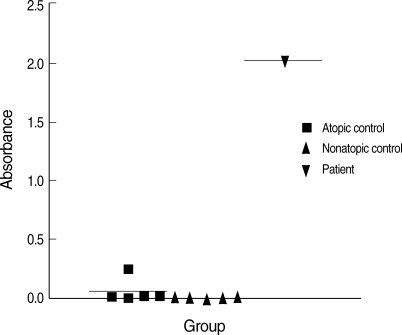


그림 출처: PubMed Central 공개 논문 (PMC2526437)
그 밖의 정보
- 출판 형태
- Journal Article, Research Support, Non-U.S. Gov't
- 저널
- Journal of Korean medical science · ISSN 1011-8934
- MeSH
- Animals · Asthma / diagnosis / etiology / immunology · Bronchi / metabolism · Electrophoresis, Polyacrylamide Gel · Enzyme-Linked Immunosorbent Assay / methods · Flour · Flowers · Humans · Hypersensitivity / diagnosis · Immunoglobulin E / analysis / chemistry · Korea · Occupational Diseases / diagnosis / etiology / immunology · Panax / adverse effects · Pyroglyphidae / metabolism · Skin Tests*
- Substances
- Immunoglobulin E
- 참고문헌
- 7편