
Respir Res. 2022;23(1):144.
Association between oxygen saturation level during bronchoscopy and post-bronchoscopy adverse events: a retrospective cohort study.
제1저자 김소연 · 교신저자 이현우
소속 (2)
- Division of Pulmonary and Critical Care Medicine, Department of Internal Medicine, Seoul Metropolitan Government-Seoul National University Boramae Medical Center, 20, Boramae-ro 5-gil, Dongjak-gu, Seoul, 07061, Republic of Korea.
- Division of Pulmonary and Critical Care Medicine, Department of Internal Medicine, Seoul Metropolitan Government-Seoul National University Boramae Medical Center, 20, Boramae-ro 5-gil, Dongjak-gu, Seoul, 07061, Republic of Korea. athrunzara86@snu.ac.kr.
Abstract
BACKGROUND Flexible bronchoscopy is widely used to diagnose and treat various respiratory diseases. However, caution is warranted for post-bronchoscopy adverse events. Although desaturation frequently occurs during bronchoscopy, its clinical impact and the optimal oxygen saturation level during the procedure remain unclear. This study aimed to investigate whether the percutaneous oxygen saturation (SpO2) level during bronchoscopy is associated with the development of post-bronchoscopy respiratory adverse events.
METHODS In this single-center retrospective cohort study conducted from March 2020 to February 2021, 569 patients were classified into high or low oxygen saturation groups based on the SpO2 level during bronchoscopy. The primary outcome was post-bronchoscopy respiratory adverse events, and secondary outcomes were other post-bronchoscopy adverse events and clinical outcomes.
RESULTS Among 569 patients, 458 and 111 patients were classified into the high oxygen saturation (SpO2 > 96%) and low oxygen saturation (SpO2 ≤ 94%) groups, respectively. After propensity score matching, the low oxygen saturation group had more post-bronchoscopy respiratory and febrile adverse events than the high oxygen saturation group. In the multivariable regression analysis, low SpO2 level during bronchoscopy was an independent risk factor for post-bronchoscopy respiratory adverse events (odds ratio = 3.16 [95% confidence interval 1.37-7.30]). In the low oxygen saturation group, the high-risk subgroups for post-bronchoscopy respiratory adverse events were the elderly, women, current smokers, and patients with chronic obstructive pulmonary disease or acute decompensated heart failure before bronchoscopy. There was no significant difference in the length of hospital stay, intensive care unit admission, or mortality between the high and low oxygen saturation groups.
CONCLUSIONS Close monitoring is recommended for patients with SpO2 ≤ 94% during bronchoscopy due to the increased risk of respiratory adverse events after the procedure.
© 2022. The Author(s).
Keywords
BronchoscopyComplicationsOxygen saturationSafety
Figures
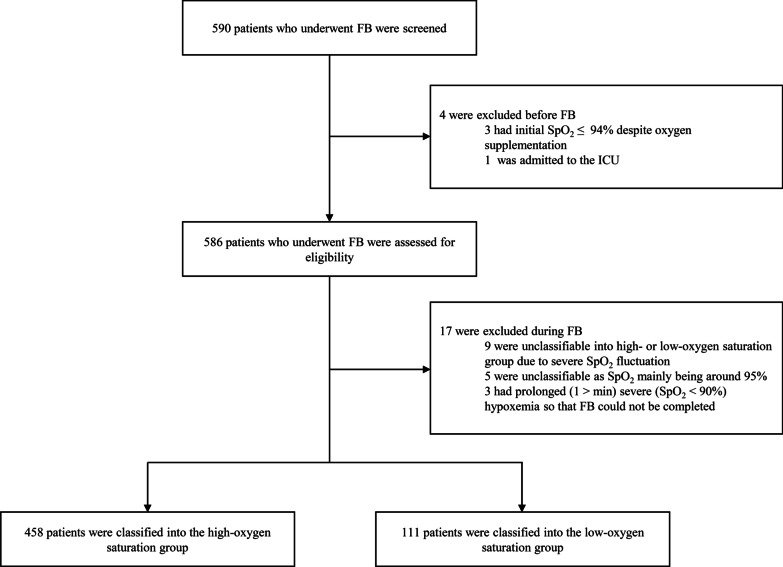
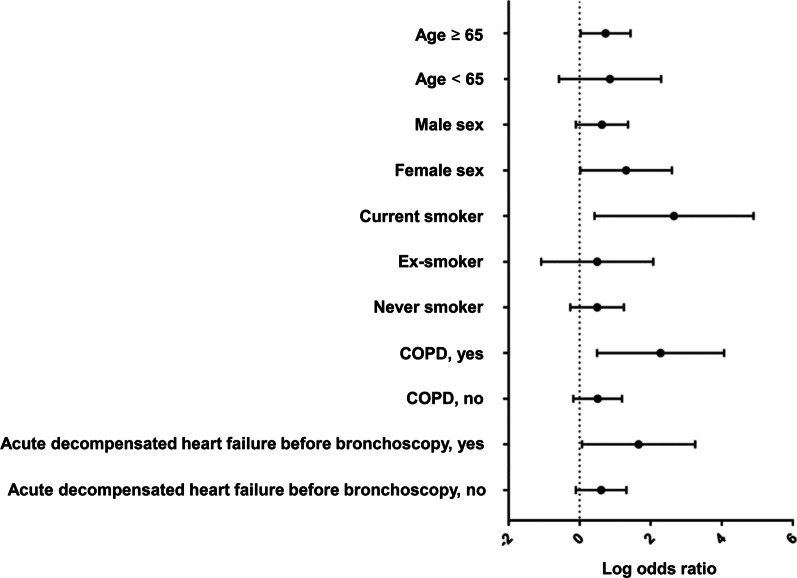
그림 출처: PubMed Central 공개 논문 (PMC9161191)
Conflict of interest statement
The authors declare that they have no competing interests.
그 밖의 정보
- 출판 형태
- Journal Article
- 저널
- Respiratory research · eISSN 1465-993X
- 전자 출판
- 2022-06-02
- MeSH
- Aged · Bronchoscopy* / adverse effects · Female · Humans · Length of Stay · Oxygen Saturation · Pulmonary Disease, Chronic Obstructive* / etiology · Retrospective Studies
- 참고문헌
- 43편