Division of Rheumatology, Department of Internal Medicine, Seoul National University College of Medicine, Seoul, South Korea.
Department of Molecular Medicine and Biopharmaceutical Sciences, Graduate School of Convergence Science and Technology, Seoul National University, Seoul, South Korea.
Department of Pharmacology and Toxicology, CKD Research Institute, CKD Pharmaceutical Company, Seoul, South Korea.
Department of Biomedical Science and Research Institute for Bioscience & Biotechnology, Hallym University, Chuncheon, South Korea.
Division of Rheumatology, Department of Internal Medicine, Seoul National University College of Medicine, Seoul, South Korea. ysong@snu.ac.kr.
Department of Molecular Medicine and Biopharmaceutical Sciences, Graduate School of Convergence Science and Technology, Seoul National University, Seoul, South Korea. ysong@snu.ac.kr.
Abstract
OBJECTIVES Histone deacetylase (HDAC) 6 promotes inflammation. We investigated the anti-arthritic effects of CKD-506, a novel HDAC6 inhibitor, in vitro and in a murine model of arthritis as a novel treatment option for rheumatoid arthritis (RA).
METHODS HDAC6 was overexpressed in mouse peritoneal macrophages and RAW 264.7 cells, and the effects of a HDAC6 inhibitor CKD-506 on cytokine production and activity of NF-κB and AP-1 signaling were examined. Peripheral blood mononuclear cells (PBMCs) from RA patients and fibroblast-like synoviocytes (FLS) were activated in the presence of CKD-506. Next, regulatory T cells (Tregs) were induced from RA patients and co-cultured with healthy effector T cells (Teffs) and cell proliferation was analyzed by flow cytometry. Finally, the effects of the inhibitor on the severity of arthritis were assessed in a murine model of adjuvant-induced arthritis (AIA).
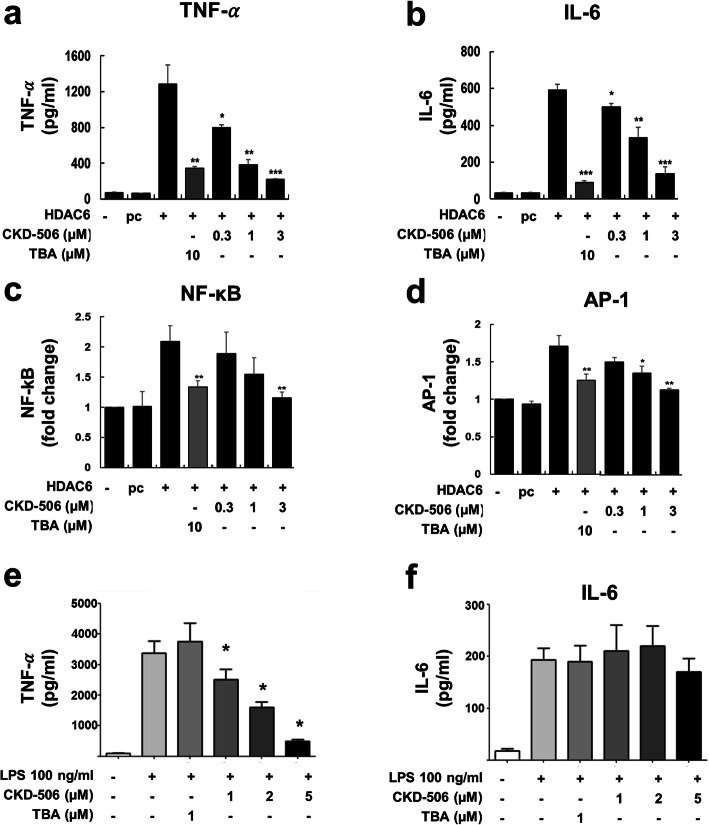
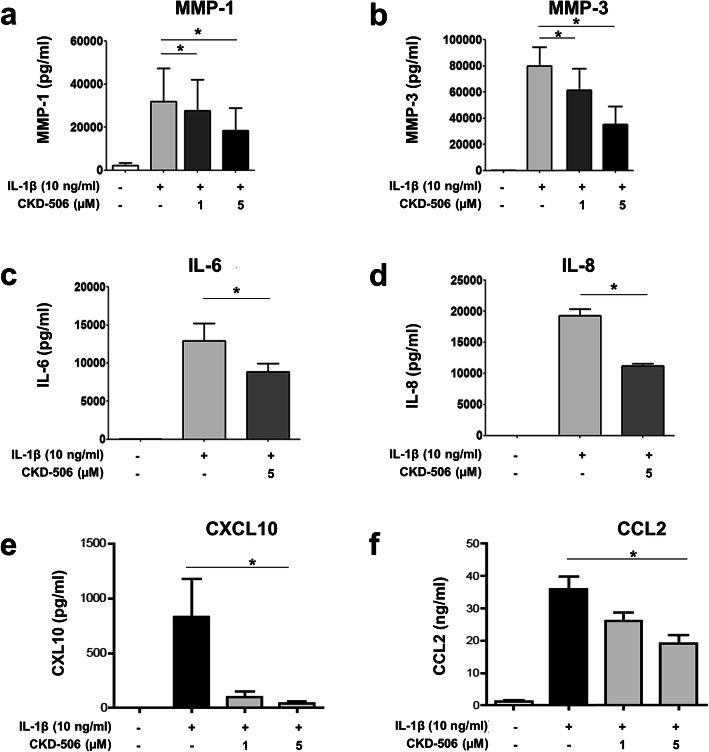
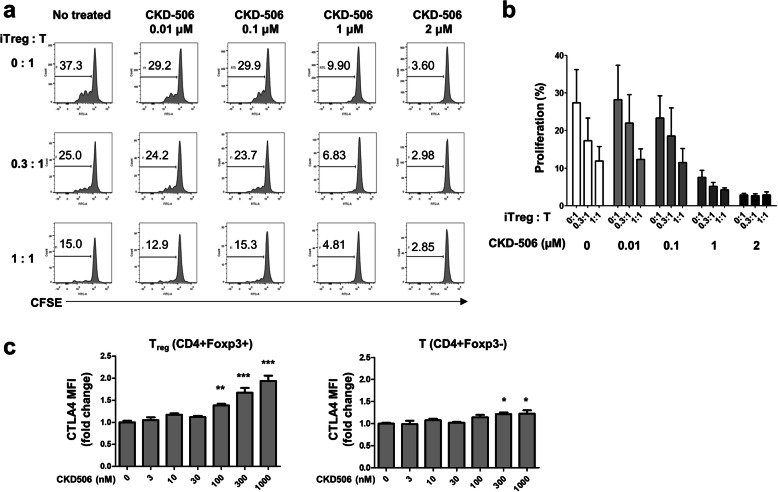
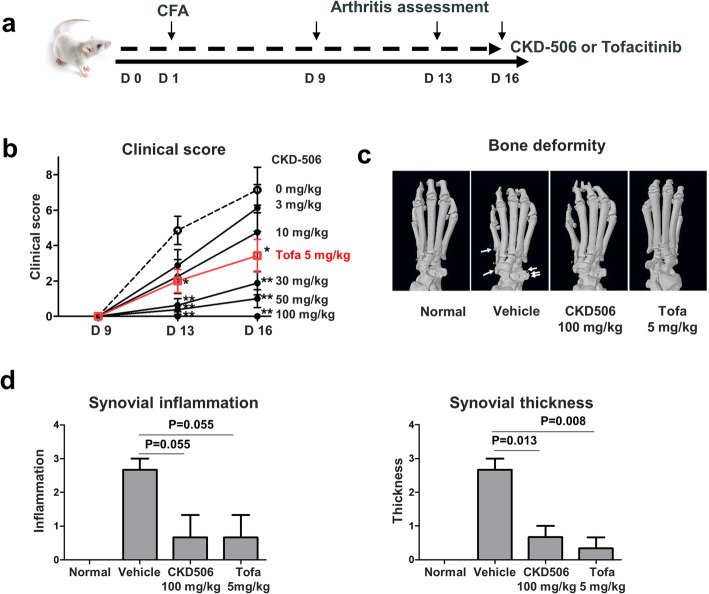
RESULTS Overexpression of HDAC6 induced macrophages to produce TNF-α and IL-6. The inhibitory effect of CKD-506 was mediated via blockade of NF-κB and AP-1 activation. HDAC6 inhibition reduced TNF-α and IL-6 production by activated RA PBMCs. CKD-506 inhibited production of MMP-1, MMP-3, IL-6, and IL-8 by activated FLS. In addition, CKD-506 inhibited proliferation of Teffs directly and indirectly by improving iTreg function. In AIA rats, oral CKD-506 improved clinical arthritis in a dose-dependent manner. A combination of sub-therapeutic CKD-506 and methotrexate exerted a synergistic effect.
CONCLUSION The novel HDAC6 inhibitor CKD-506 suppresses inflammatory responses by monocytes/macrophages, improves Treg function, and ameliorates arthritis severity in a murine model of RA. Thus, CKD-506 might be a novel and effective treatment option for RA.
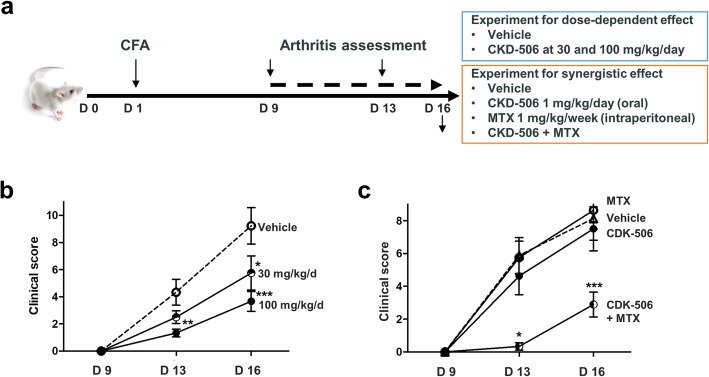
Fig. 1HDAC6 inhibitors suppress HDAC6-induced inflammatory responses. a, b Primary peritoneal macrophages (n = 3) were pretreated for 1 h with the indicated concentrations with CKD-506 or tubastatin (TBA) and then transfected with a control (pcDNA3.1 [pc]) or HDAC6 expression vector (1 μg/ml). At 48 h post-transfection, the levels of TNF-α (a) and IL-6 (b) in the culture medium were measured by ELISA. c, d RAW 264.7 cells (n = 3) were pretreated for 1 h with CKD-506 and then transiently co-transfected with an NF-κB (c) or AP-1 (d) promoter-luciferase expression vector, a β-galactosidase plasmid (pCMV-lacZ), and a control or HDAC6 expression vector. After 48 h, the luciferase activity in transfected cells was determined. Luciferase activity was normalized to that of β-galactosidase and expressed as -fold change over the control level. Data are expressed as the mean ± SEM of three independent experiments. *p < 0.05, **p < 0.01, and ***p < 0.001, compared with HDAC6-transfected cells. e, f PBMCs from RA patients (n = 5) were pretreated for 1 h with increasing concentrations of CKD-506 and then stimulated with LPS (100 ng/ml). Production TNF-α and IL-6 in the supernatant was measured using an ELISA. All data represent the mean value ± SEM. *p < 0.05, **p < 0.01 compared with no CKD-506 treatment. pc, plasmid control; TNF, tumor necrosis factor; IL, interleukin; TBA, tubastatinFig. 2CKD-506 suppresses production of tissue-degradative enzymes, inflammatory cytokines, and chemokines by fibroblast-like synoviocytes (FLS). RA FLS (n = 3) were pretreated for 1 h with CKD-506 and then activated for 24 h with IL-1β (10 ng/ml). Then, the amounts of MMP-1 (a), MMP-3 (b), IL-6 (c), IL-8 (d), CXCL10 (e), and CCL2 (f) in the supernatant were measured in an ELISA. Data represent the mean value ± SEM. *p < 0.05Fig. 3CKD-506 augments Treg-mediated suppression of T cell proliferation. Induced Treg cells (iTreg) from RA patients (n = 3) were co-cultured for 72 h at different ratios with CFSE-labeled T cells from healthy controls in the presence of an HDAC6 inhibitor and CD3/28 Dynabeads, and the proliferation of T cells was examined by FACS. a Representative FACS data from three independent experiments are shown. b T cell proliferation under different ratio of iTreg to T cells. c Changes in expression of CTLA4 by iTreg and T cells after treatment with CKD-506. *p < 0.05, **p < 0.01, ***p < 0.001 vs. no treatmentFig. 4CKD-506 prevents experimental arthritis in an AIA rat model. a Experimental design. Rats with experimentally induced arthritis were treated with daily oral CKD-506. Severity of arthritis was assessed on days 9, 13, and 16 after CFA injection. Rats were sacrificed thereafter. b Clinical scores over the treatment period are shown according to CKD-506 treatment dose. Groups were compared using repeated measure ANOVA, followed by post hoc analysis with Bonferroni corrections. c Representative 3D reconstructed image of the hind foot. White arrows indicate bone erosions. d The efficacy of CKD-506 at 100 mg/kg QD vs. tofacitinib 5 mg/kg (with respect to the effects on synovial inflammation and thickness) was compared. Data represent the mean value ± SEM. *p < 0.05, **p < 0.01 vs. CKD-506 at 0 mg/kg. CFA, complete Freund’s adjuvant; Tofa, tofacitinibFig. 5CKD-506 ameliorates experimental arthritis and shows a synergistic effect with MTX in an AIA rat model. a After induction of arthritis, rats were treated with CKD-506 with or without MTX starting 9 days after CFA injection. b Anti-arthritic effects by CKD-506 at 0 (vehicle treatment), 30, and 100 mg/kg/day were depicted. c Anti-arthritic effects of low dose MTX 1 mg/kg/week, low dose CKD 1 mg/kg/day, and their combination treatment were shown. Data represent the mean value ± SEM. *p < 0.05, **p < 0.01, ***p < 0.001 vs. vehicle treatment. Groups were compared using repeated measure ANOVA, followed by post hoc analysis with Bonferroni corrections