
BMC Nephrol. 2021;22(1):2.
Genetic identification of inherited cystic kidney diseases for implementing precision medicine: a study protocol for a 3-year prospective multicenter cohort study.
제1저자 박혜인조 · 교신저자 오윤규
소속 (12)
- Department of Internal Medicine, Hallym University College of Medicine, Seoul, South Korea.
- Department of Internal Medicine, Seoul National University College of Medicine, Seoul, South Korea.
- Department of Internal Medicine, National Medical Center, Seoul, South Korea.
- Department of Internal Medicine, Kangbuk Samsung Hospital, Seoul, South Korea.
- Department of Internal Medicine, Busan Paik Hospital, Busan, South Korea.
- Department of Internal Medicine, Keimyung University School of Medicine, Daegu, South Korea.
- Department of Internal Medicine, Chonnam National University Medical School, Gwangju, South Korea.
- Department of Pediatrics, Seoul National University Children's Hospital, Seoul, South Korea.
- Department of Pediatrics, Hallym University College of Medicine, Seoul, South Korea.
- Department of Biomedical Sciences, Korea University College of Medicine, Seoul, South Korea.
- Department of Internal Medicine, Seoul National University College of Medicine, Seoul, South Korea. yoonkyuoh@gmail.com.
- Department of Internal Medicine, Seoul Metropolitan Government Seoul National University Boramae Medical Center, Seoul, South Korea. yoonkyuoh@gmail.com.
Abstract
BACKGROUND Inherited cystic kidney disease is a spectrum of disorders in which clusters of renal cysts develop as the result of genetic mutation. The exact methods and pipelines for defining genetic mutations of inherited cystic kidney disease are not clear at this point. This 3-year, prospective, multicenter, cohort study was designed to set up a cohort of Korean patients with inherited cystic kidney disease, establish a customized genetic analysis pipeline for each disease subtype, and identify modifying genes associated with the severity of the disease phenotype.
METHODS/DESIGN From May 2020 to May 2022, we aim to recruit 800 patients and their family members to identify pathogenic mutations. Patients with more than 3 renal cysts in both kidneys are eligible to be enrolled. Cases of simple renal cysts and acquired cystic kidney disease that involve cyst formation as the result of renal failure will be excluded from this study. Demographic, laboratory, and imaging data as well as family pedigree will be collected at baseline. Renal function and changes in total kidney volume will be monitored during the follow-up period. Genetic identification of each case of inherited cystic kidney disease will be performed using a targeted gene panel of cystogenesis-related genes, whole exome sequencing (WES) and/or family segregation studies. Genotype-phenotype correlation analysis will be performed to elucidate the genetic effect on the severity of the disease phenotype.
DISCUSSION This is the first nationwide cohort study on patients with inherited cystic kidney disease in Korea. We will build a multicenter cohort to describe the clinical characteristics of Korean patients with inherited cystic kidney disease, elucidate the genotype of each disease, and demonstrate the genetic effects on the severity of the disease phenotype.
TRIAL REGISTRATION This cohort study was retrospectively registered at the Clinical Research Information Service ( KCT0005580 ) operated by the Korean Center for Disease Control and Prevention on November 5th, 2020.
Keywords
Cohort studyCystic kidney diseaseGenetic association studiesGenotypeGlomerular filtration rateHigh-throughput nucleotide sequencingPhenotype
Figures
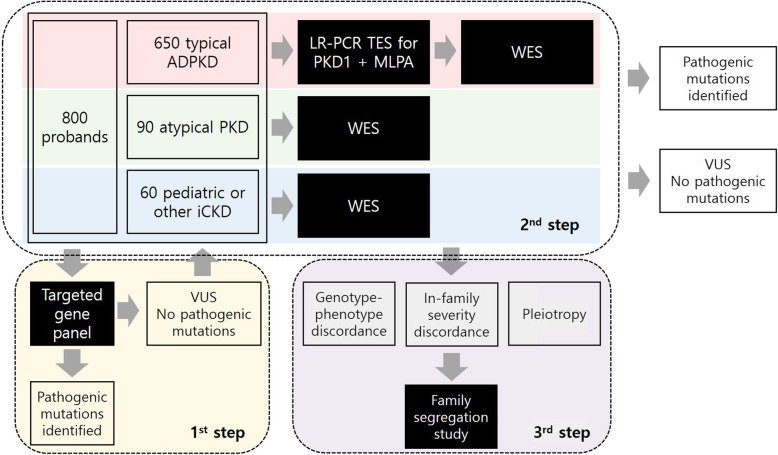
그림 출처: PubMed Central 공개 논문 (PMC7786983)
Conflict of interest statement
The authors declare that they have no competing interests.
그 밖의 정보
- 출판 형태
- Journal Article, Research Support, Non-U.S. Gov't
- 저널
- BMC nephrology · eISSN 1471-2369
- 전자 출판
- 2021-01-06
- MeSH
- Cohort Studies · Humans · Kidney Diseases, Cystic / genetics · Multicenter Studies as Topic / methods · Precision Medicine* · Prospective Studies · Research Design* · Time Factors
- 연구비
- Korea Centers for Disease Control and Prevention 2019-ER-7304-00 · Korea Centers for Disease Control and Prevention 2019-ER-7304-01
- 데이터
- CRiS: KCT0005580
- 참고문헌
- 32편