
Respir Res. 2021;22(1):60.
The association between hospital length of stay before rapid response system activation and clinical outcomes: a retrospective multicenter cohort study.
제1저자 박지명, 이연주 · 교신저자 이상민
소속 (12)
- Division of Pulmonary and Critical Care Medicine, Department of Internal Medicine, Seoul National University College of Medicine, 101, Daehak-ro, Jongno-gu, Seoul, 03080, Republic of Korea.
- Division of Pulmonary and Critical Care Medicine, Department of Internal Medicine, Seoul National University Bundang Hospital, Seongnam-si, Republic of Korea.
- Department of Pulmonary and Critical Care Medicine, Asan Medical Center, University of Ulsan College of Medicine, Seoul, Republic of Korea.
- Department of Critical Care Medicine, Samsung Medical Center, Sungkyunkwan University School of Medicine, Seoul, Republic of Korea.
- Division of Pulmonary and Critical Care Medicine, Department of Medicine, Samsung Medical Center, Sungkyunkwan University School of Medicine, Seoul, Republic of Korea.
- Division of Pulmonary and Critical Care Medicine, Department of Internal Medicine, Chungnam National University Sejong Hospital, Chungnam National University College of Medicine, Sejong-si, Republic of Korea.
- Division of Pulmonary and Critical Care Medicine, Department of Internal Medicine, Inha University Hospital, Inha University School of Medicine, Incheon, Republic of Korea.
- Department of Internal Medicine, Ulsan University Hospital, University of Ulsan College of Medicine, Ulsan, Korea.
- Division of Pulmonary and Critical Care Medicine, Department of Internal Medicine, Dong-A University College of Medicine, Busan, Korea.
- Division of Pulmonology, Department of Internal Medicine, CHA Bundang Medical Center, CHA University, Seongnam-si, Korea.
- Division of Pulmonology, Department of Internal Medicine, Gangnam Severance Hospital, Yonsei University College of Medicine, Seoul, Korea.
- Division of Pulmonary and Critical Care Medicine, Department of Internal Medicine, Seoul National University College of Medicine, 101, Daehak-ro, Jongno-gu, Seoul, 03080, Republic of Korea. sangmin2@snu.ac.kr.
Abstract
BACKGROUND Rapid response system (RRS) is being increasingly adopted to improve patient safety in hospitals worldwide. However, predictors of survival outcome after RRS activation because of unexpected clinical deterioration are not well defined. We investigated whether hospital length of stay (LOS) before RRS activation can predict the clinical outcomes.
METHODS Using a nationwide multicenter RRS database, we identified patients for whom RRS was activated during hospitalization at 9 tertiary referral hospitals in South Korea between January 1, 2016, and December 31, 2017. All information on patient characteristics, RRS activation, and clinical outcomes were retrospectively collected by reviewing patient medical records at each center. Patients were categorized into two groups according to their hospital LOS before RRS activation: early deterioration (LOS < 5 days) and late deterioration (LOS ≥ 5 days). The primary outcome was 28-day mortality and multivariable logistic regression was used to compare the two groups. In addition, propensity score-matched analysis was used to minimize the effects of confounding factors.
RESULTS Among 11,612 patients, 5779 and 5883 patients belonged to the early and late deterioration groups, respectively. Patients in the late deterioration group were more likely to have malignant disease and to be more severely ill at the time of RRS activation. After adjusting for confounding factors, the late deterioration group had higher 28-day mortality (aOR 1.60, 95% CI 1.44-1.77). Other clinical outcomes (in-hospital mortality and hospital LOS after RRS activation) were worse in the late deterioration group as well, and similar results were found in the propensity score-matched analysis (aOR for 28-day mortality 1.66, 95% CI 1.45-1.91).
CONCLUSIONS Patients who stayed longer in the hospital before RRS activation had worse clinical outcomes. During the RRS team review of patients, hospital LOS before RRS activation should be considered as a predictor of future outcome.
Keywords
Clinical deteriorationGeneral wardHospital rapid response teamIntensive care unitsLength of stayMortality
Figures
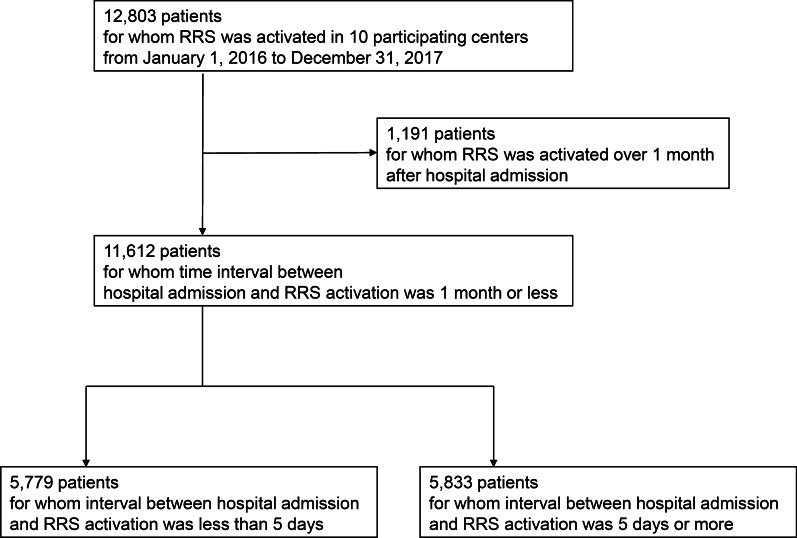
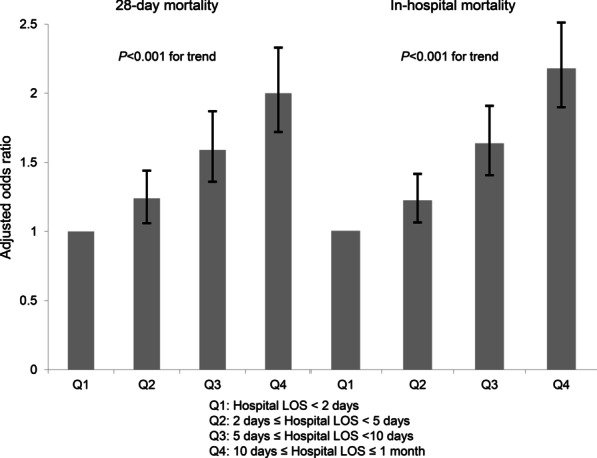
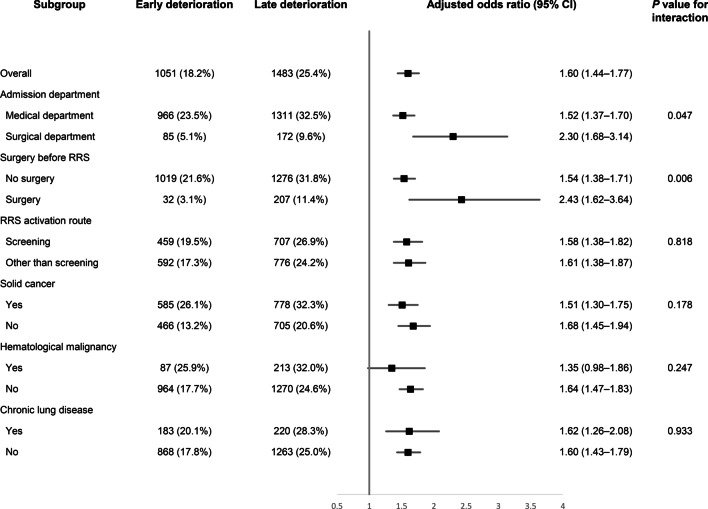
그림 출처: PubMed Central 공개 논문 (PMC7891162)
Conflict of interest statement
The authors declare that they have no competing interests.
그 밖의 정보
- 출판 형태
- Journal Article, Multicenter Study
- 저널
- Respiratory research · eISSN 1465-993X
- 전자 출판
- 2021-02-18
- MeSH
- Aged · Clinical Deterioration · Critical Illness / epidemiology / therapy · Female · Hospital Mortality / trends · Hospital Rapid Response Team · Humans · Intensive Care Units / statistics & numerical data · Length of Stay / trends · Male · Middle Aged · Republic of Korea / epidemiology · Retrospective Studies
- 연구비
- Korea Health Industry Development Institute HI18C0599
- 참고문헌
- 25편