
BMC Nephrol. 2021;22(1):247.
Serum uric acid is associated with coronary artery calcification in early chronic kidney disease: a cross-sectional study.
제1저자 한미연 · 교신저자 오국환
소속 (9)
- Department of Internal Medicine, Hallym University Hangang Sacred Heart Hospital, Seoul, Korea.
- Department of Internal Medicine, Hallym University Chuncheon Sacred Heart Hospital, Chuncheon, Korea.
- Department of Internal Medicine, Pusan National University Hospital, Busan, Korea.
- Department of Internal Medicine, Ewha Womans University Seoul Hospital, Ewha Womans University College of Medicine, Seoul, Korea.
- Department of Internal Medicine, The Catholic University of Korea, Seoul St. Mary's Hospital, Seoul, Korea.
- Department of Internal Medicine, College of Medicine, Institute of Kidney Disease Research, Yonsei University, Seoul, Republic of Korea.
- Department of Internal Medicine, Chonnam National University Medical School, Gwangju, Korea.
- Division of Nephrology, Department of Internal Medicine, Seoul National University College of Medicine, 101 Daehak-ro, Chong No Gu, 03080, Seoul, Korea.
- Division of Nephrology, Department of Internal Medicine, Seoul National University College of Medicine, 101 Daehak-ro, Chong No Gu, 03080, Seoul, Korea. khoh@snu.ac.kr.
Abstract
BACKGROUND Although uric acid (UA) is regarded as a risk factor for cardiovascular disease, whether UA is an independent risk factor contributing to coronary artery calcification in chronic kidney disease (CKD) is not well known. We evaluated whether UA level is associated with coronary artery calcium (CAC) score in a predialysis CKD cohort.
METHODS A total of 1,350 subjects who underwent coronary computed tomography as part of the KoreaN Cohort Study for Outcome in Patients With Chronic Kidney Disease were analysed. We conducted a logistic regression analysis to evaluate the association between UA and the presence of CAC.
RESULTS CAC was detected in 705 (52.2 %) patients, and the level of UA was significantly higher in CAC > 0 patients. UA showed a positive relationship with CAC > 0 in age- and sex-adjusted logistic regression analysis (Odds ratio (OR) 1.11, 95 % confidence interval (CI) 1.04-1.19, P = 0.003). However, UA showed no association with CAC > 0 in multivariate analysis. Further analysis showed that UA showed a positive association with CAC > 0 only in estimated glomerual filtration rate (eGFR) > 60 ml/min/1.73 m2 (OR 1.23, 95 % CI 1.02-1.49, P = 0.036) but not in eGFR 30-59 ml/min/1.73 m2 (OR 0.92, 95 % CI 0.78-1.08, P = 0.309) or < 30 ml/min/1.73 m2 (OR 0.92, 95 % CI 0.79-1.08, P = 0.426).
CONCLUSIONS UA level was significantly associated with CAC in early CKD, but not in advanced CKD.
Keywords
Chronic kidney diseaseCoronary artery calcificationCoronary computed tomographyUric acid
Figures
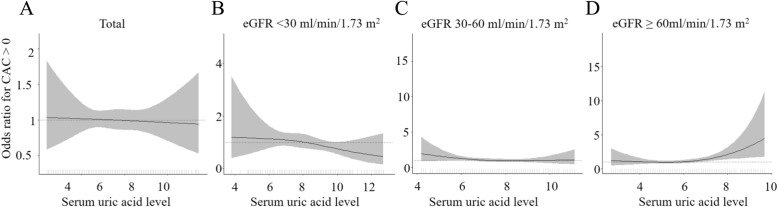
그림 출처: PubMed Central 공개 논문 (PMC8255010)
Conflict of interest statement
The authors have nothing to disclose.
그 밖의 정보
- 출판 형태
- Journal Article, Research Support, Non-U.S. Gov't
- 저널
- BMC nephrology · eISSN 1471-2369
- 전자 출판
- 2021-07-04
- MeSH
- Adult · Aged · Coronary Angiography · Coronary Artery Disease / blood / complications / diagnostic imaging · Cross-Sectional Studies · Disease Progression · Female · Glomerular Filtration Rate · Humans · Male · Middle Aged · Renal Insufficiency, Chronic / blood / complications / physiopathology · Risk Factors · Tomography, X-Ray Computed · Uric Acid / blood · Vascular Calcification / blood / complications / diagnostic imaging
- Substances
- Uric Acid
- 참고문헌
- 30편