
BMC Gastroenterol. 2022;22(1):91.
Total polyp number may be more important than size and histology of polyps for prediction of metachronous high-risk colorectal neoplasms.
제1저자 윤혁 · 교신저자 이동호
소속 (4)
- Department of Internal Medicine, Seoul National University Bundang Hospital, 300 Gumi-dong, Bundang-gu, Seongnam, Gyeonggi-do, 463-707, South Korea.
- Department of Internal Medicine and Liver Research Institute, Seoul National University College of Medicine, Seoul, South Korea.
- Department of Internal Medicine, Seoul National University Bundang Hospital, 300 Gumi-dong, Bundang-gu, Seongnam, Gyeonggi-do, 463-707, South Korea. dhljohn@yahoo.co.kr.
- Department of Internal Medicine and Liver Research Institute, Seoul National University College of Medicine, Seoul, South Korea. dhljohn@yahoo.co.kr.
Abstract
BACKGROUND To evaluate whether the risk of metachronous high-risk colorectal neoplasm (HR-CRN) differs according to the indication for surveillance colonoscopy.
METHODS Patients who underwent polypectomy or endoscopic resection of colorectal neoplasms were enrolled and classified into three groups according to the indication for surveillance colonoscopy: advanced colorectal neoplasm (ACRN: adenoma ≥ 10 mm, adenoma with high-degree dysplasia and/or villous component), advanced serrated polyps (ASP: hyperplastic polyp or sessile serrated lesion ≥ 10 mm, traditional serrated polyp), and high-risk polyps (HRP: 3 or more adenomas or serrated polyps). The primary outcome was the development of metachronous HR-CRN, defined as ACRN, ASP, or HRP at the first follow-up colonoscopy.
RESULTS In total, 367 patients were enrolled (ACRN group: N = 264; ASP group: N = 33; HRP group: N = 70). Among the 160 patients who underwent follow-up colonoscopy, 28 (18%) had HR-CRN. In univariable analysis, indication for surveillance colonoscopy was not found to be associated with the development of metachronous HR-CRN. Instead, the total polyp number at index colonoscopy showed a positive association with the risk of metachronous HR-CRN in trend analysis (p = 0.001). In multivariable analysis, the presence of 5 or more polyps at index colonoscopy was found to be associated with the risk of metachronous HR-CRN (OR, 2.575, p = 0.049) after adjusting for risk factors, such as obesity, diabetes, and smoking.
CONCLUSIONS The risk of metachronous HR-CRN did not differ according to the main indications for surveillance colonoscopy. The presence of 5 or more polyps at index colonoscopy was the only risk factor for metachronous HR-CRN.
© 2022. The Author(s).
Keywords
Colorectal neoplasmMetachronousRisk factors
Figures
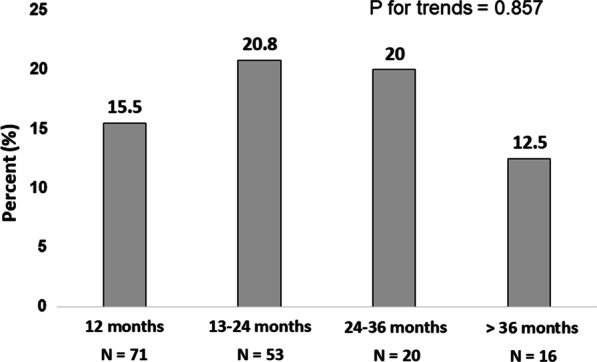
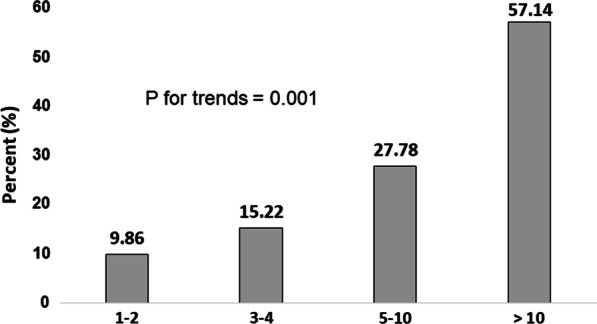
그림 출처: PubMed Central 공개 논문 (PMC8889722)
Conflict of interest statement
The authors declare that they have no competing interests.
그 밖의 정보
- 출판 형태
- Journal Article
- 저널
- BMC gastroenterology · eISSN 1471-230X
- 전자 출판
- 2022-03-02
- MeSH
- Adenoma* / pathology · Colonic Polyps* / pathology · Colonoscopy / adverse effects · Colorectal Neoplasms* / pathology · Humans · Neoplasms, Second Primary* / epidemiology / pathology · Risk Factors
- 연구비
- the Ministry of Science, ICT and Future Planning 2011-0030001
- 참고문헌
- 19편