
BMC Gastroenterol. 2022;22(1):271.
The effect of nafamostat mesilate infusion after ERCP for post-ERCP pancreatitis.
제1저자 김주성 · 교신저자 이상협
소속 (6)
- Division of Gastroenterology, Department of Internal Medicine, Liver Research Institute, Seoul National University Hospital, Seoul National University College of Medicine, 101, Daehak-ro, Jongno-gu, Seoul, 03080, Republic of Korea.
- Department of Internal Medicine, Dongguk University College of Medicine, Dongguk University Ilsan Hospital, Goyang-si, 10326, Republic of Korea.
- Division of Gastroenterology, Department of Internal Medicine, Liver Research Institute, Seoul National University Hospital, Seoul National University College of Medicine, 101, Daehak-ro, Jongno-gu, Seoul, 03080, Republic of Korea. gidoctor@snu.ac.kr.
- Department of Internal Medicine, Kyung Hee University Hospital at Gangdong, Seoul, 05278, Republic of Korea.
- Department of Internal Medicine, Asan Medical Center, University of Ulsan College of Medicine, Seoul, 05505, Republic of Korea.
- Center for Liver and Pancreatobiliary Cancer, National Cancer Center, Goyang-si, Gyeonggi-do, 10408, Republic of Korea.
Abstract
BACKGROUND Nafamostat mesilate decreases the incidence of pancreatitis after endoscopic retrograde cholangiopancreatography (ERCP). However, no studies have administered nafamostat mesilate after ERCP. So we investigated if the infusion of nafamostat mesilate after ERCP can affect the post-ERCP pancreatitis (PEP) in high-risk patients.
METHODS In a tertiary hospital, 350 high-risk patients of PEP were reviewed retrospectively. Among them, 201 patients received nafamostat mesilate after ERCP. Patient-related and procedure-related risk factors for PEP were collected. We performed a propensity score matching to adjust for the significant different baseline characteristics. The incidence and severity of PEP were evaluated according to the infusion of nafamostat mesilate. The risk factors of PEP were also analyzed by multivariate logistic regression.
RESULTS The baseline characteristics were not different after the matching. The PEP rate (17.4% vs. 10.3%, P = 0.141) was insignificant. Among the PEP patients, mild PEP was significantly higher in the nafamostat mesilate group (85.7% vs. 45.5%, P = 0.021). Only one patient in the nafamostat mesilate group developed severe PEP. Although young age (odds ratio [OR] 3.60, 95% CI 1.09-11.85, P = 0.035) was a risk factor, nafamostat mesilate (odds ratio [OR] 0.30, 95% CI 0.09-0.98, P = 0.047) was a protective factor for moderate to severe PEP.
CONCLUSIONS The administration of nafamostat mesilate after ERCP in high-risk patients was not effective in preventing PEP, but may attenuate the severity of PEP.
© 2022. The Author(s).
Keywords
Endoscopic retrograde cholangiopancreatographyNafamostatPost-ERCP pancreatitis
Figures
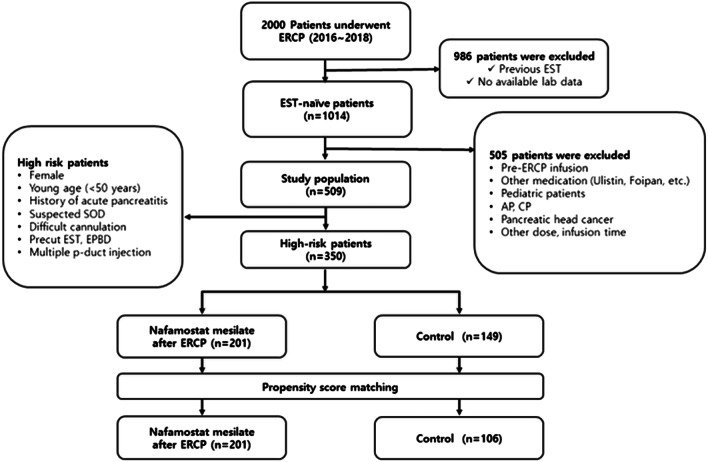
그림 출처: PubMed Central 공개 논문 (PMC9153157)
Conflict of interest statement
The authors declare that they have no competing interests.
그 밖의 정보
- 출판 형태
- Journal Article
- 저널
- BMC gastroenterology · eISSN 1471-230X
- 전자 출판
- 2022-05-31
- MeSH
- Benzamidines · Cholangiopancreatography, Endoscopic Retrograde* / adverse effects · Guanidines · Humans · Pancreatitis* / epidemiology / etiology / prevention & control · Retrospective Studies
- Substances
- Benzamidines · Guanidines · nafamostat
- 참고문헌
- 17편