
Cardiovasc Diabetol. 2023;22(1):18.
Improved prognosis with integrated care management including early rhythm control and healthy lifestyle modification in patients with concurrent atrial fibrillation and diabetes mellitus: a nationwide cohort study.
제1저자 이소령, 안효정 · 교신저자 최의근
소속 (8)
- Department of Internal Medicine, Seoul National University Hospital, 101 Daehak-ro, Jongno-gu, 03080, Seoul, Republic of Korea.
- Department of Internal Medicine, Seoul National University Hospital, 101 Daehak-ro, Jongno-gu, 03080, Seoul, Republic of Korea. choiek17@snu.ac.kr.
- Department of Internal Medicine, Seoul National University College of Medicine, Seoul, Republic of Korea. choiek17@snu.ac.kr.
- Department of Medical Statistics, College of Medicine, Catholic University of Korea, Seoul, Republic of Korea.
- Statistics and Actuarial Science, Soongsil University, Seoul, Republic of Korea.
- Department of Internal Medicine, Seoul National University College of Medicine, Seoul, Republic of Korea.
- Liverpool Centre for Cardiovascular Science, University of Liverpool and Liverpool Chest & Heart Hospital, Liverpool, UK.
- Department of Clinical Medicine, Aalborg University, Aalborg, Denmark.
Abstract
BACKGROUND Patients with concurrent atrial fibrillation (AF) and diabetes mellitus (DM) [AF-DM] have a high risk of cardiovascular and diabetes-related complications, but are less engaged in a comprehensive treatment approach. We evaluated the association of early rhythm control (ERC), lifestyle modification (LSM), and a combination of ERC and LSM with cardiovascular or diabetes-related complication risk in patients with AF-DM (type 2).
METHODS From the National Health Information Database, 47,940 patients diagnosed with AF-DM in 2009-2016 were included. We defined ERC as rhythm control therapy within two years of AF diagnosis and LSM as adherence to ≥ 2 of the healthy behaviors among non-current smoking, non-drinking, and regular exercise. We compared the primary (ischemic stroke) and secondary (macro- and microvascular complications, glycemic emergency, and all-cause death) outcomes in four groups: non-ERC and non-LSM (group 1), LSM only (group 2), ERC only (group 3), and both ERC and LSM (group 4).
RESULTS Of total, 10,617 (22%), 26,730 (55.8%), 2,903 (6.1%), and 7,690 (16.0%) were classified into groups 1 to 4, in sequence. The mean duration from AF diagnosis to ERC was 25.6 ± 75.5 days. During 4.0 (interquartile range: 2.5-6.2) years' follow-up, groups 2 and 3 were associated with 23% and 33% lower risks of stroke than group 1, respectively. Group 4 was associated with the lowest risk of stroke: hazard ratio (HR) 0.58, 95% confidence interval (CI) 0.51-0.67, p < 0.001. Regarding secondary outcomes, the lowest risks were also observed in group 4; macro- and microvascular complications, glycemic emergency, and all-cause death had HRs (95% CIs) of 0.63 (0.56-0.70), 0.88 (0.82-0.94), 0.72 (0.62-0.84), and 0.80 (0.73-0.87), respectively, all p < 0.001.
CONCLUSIONS For AF-DM patients, ERC and LSM exert a synergistic effect in preventing cardiovascular and diabetes-related complications with the greatest lowered risk of stroke. A comprehensive treatment approach should be pursued in AF-DM patients.
© 2023. The Author(s).
Keywords
Atrial fibrillationDiabetes mellitusEarly rhythm controlLifestyle modification
Figures
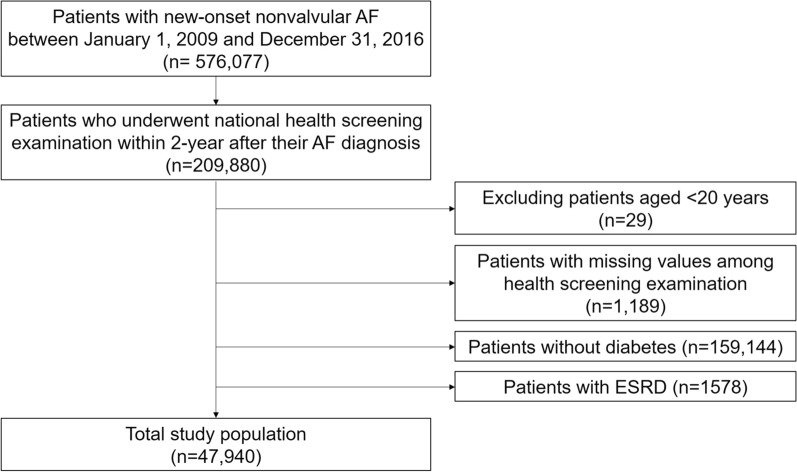
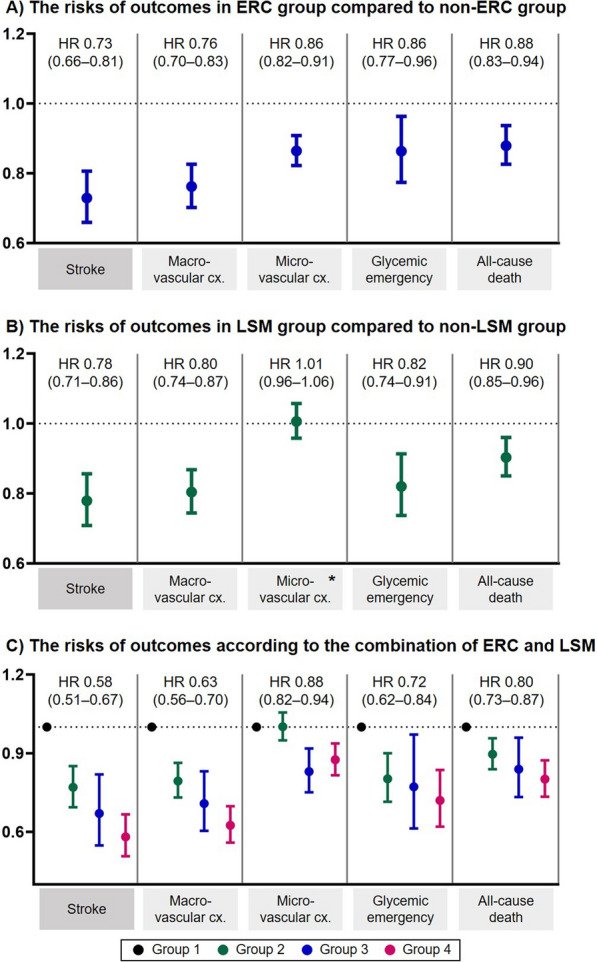
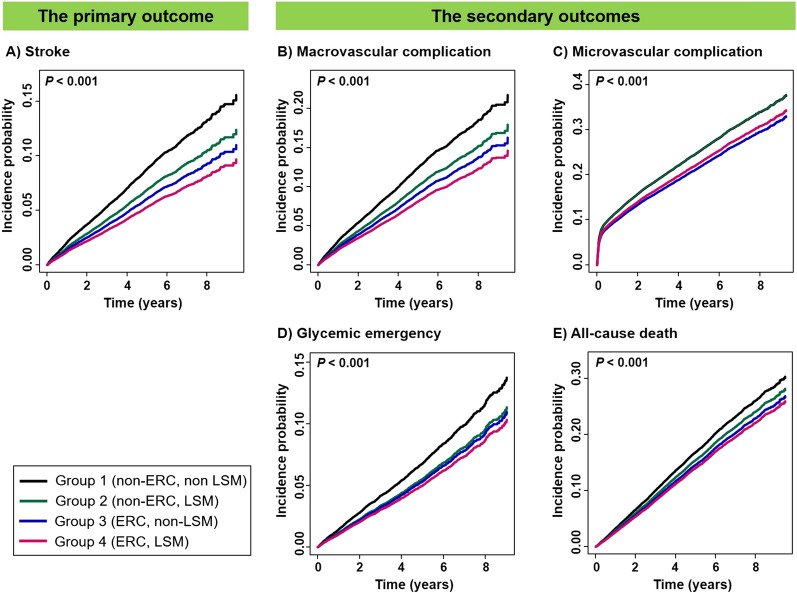
그림 출처: PubMed Central 공개 논문 (PMC9887851)
Conflict of interest statement
The authors declare no competing interests. EKC: Research grants or speaking fees from Abbott, Bayer, BMS/Pfizer, Biosense Webster, Chong Kun Dang, Daewoong Pharmaceutical Co., Daiichi-Sankyo, DeepQure, Dreamtech Co., Ltd., Jeil Pharmaceutical Co. Ltd., Medtronic, Samjinpharm, Seers Technology, and Skylabs. GYHL: Consultant and speaker for BMS/Pfizer, Boehringer Ingelheim, and Daiichi-Sankyo. No personal fees were received. The remaining authors have nothing to disclose.
그 밖의 정보
- 출판 형태
- Journal Article, Research Support, Non-U.S. Gov't
- 저널
- Cardiovascular diabetology · eISSN 1475-2840
- 전자 출판
- 2023-01-30
- MeSH
- Humans · Atrial Fibrillation* / diagnosis / epidemiology / therapy · Cohort Studies · Risk Factors · Prognosis · Diabetes Mellitus, Type 2* / complications · Stroke* / diagnosis / epidemiology / prevention & control · Diabetes Complications* / diagnosis / epidemiology / therapy · Healthy Lifestyle · Delivery of Health Care, Integrated* · Diabetes Mellitus* / diagnosis / epidemiology / therapy
- 연구비
- NIEHS NIH HHS 27302C0028
- 참고문헌
- 48편