
Cardiovasc Diabetol. 2023;22(1):188.
Comparative cardiovascular outcomes in type 2 diabetes patients taking dapagliflozin versus empagliflozin: a nationwide population-based cohort study.
제1저자 임재현, 최유정 · 교신저자 이희선, 김형관
소속 (9)
- Department of Internal Medicine, Seoul National University Hospital, Seoul, Republic of Korea.
- Department of Internal Medicine, Seoul National University College of Medicine, Seoul, Republic of Korea.
- Division of Cardiology, Department of Internal Medicine, Korea University College of Medicine, Seoul, Republic of Korea.
- Department of Statistics and Actuarial Science, Soongsil University, Seoul, Republic of Korea.
- Diagnostic Test Unit Section of Cardiovascular Imaging, Division of Cardiology, Cardiovascular Center, Department of Internal Medicine, Seoul National University Hospital,, Seoul National University College of Medicine, 101 Daehak-ro, Jongno-gu, 03080, Seoul, Korea.
- Division of Cardiology, Department of Internal Medicine, Seoul National University Hospital Healthcare System Gangnam Center, 152, Teheran-ro, Gangnam-gu,, Seoul, Republic of Korea. md.sunny.lee@gmail.com.
- Department of Internal Medicine, Seoul National University Hospital, Seoul, Republic of Korea. hkkim73@snu.ac.kr.
- Department of Internal Medicine, Seoul National University College of Medicine, Seoul, Republic of Korea. hkkim73@snu.ac.kr.
- Diagnostic Test Unit Section of Cardiovascular Imaging, Division of Cardiology, Cardiovascular Center, Department of Internal Medicine, Seoul National University Hospital,, Seoul National University College of Medicine, 101 Daehak-ro, Jongno-gu, 03080, Seoul, Korea. hkkim73@snu.ac.kr.
Abstract
BACKGROUND Sodium-glucose co-transporter-2 inhibitors displayed cardiovascular benefits in type 2 diabetes mellitus in previous studies; however, there were some heterogeneities regarding respective cardiovascular outcomes within the class. Furthermore, their efficacies in Asians, females, and those with low cardiovascular risks were under-represented. Thus, we compared the cardiovascular outcomes between new users of dapagliflozin and empagliflozin in a broad range of patients with type 2 diabetes mellitus using a nationwide population-based real-world cohort from Korea.
METHODS Korean National Health Insurance registry data between May 2016 and December 2018 were extracted, and an active-comparator new-user design was applied. The primary outcome was a composite of heart failure (HF)-related events (i.e., hospitalization for HF and HF-related death), myocardial infarction, ischemic stroke, and cardiovascular death. The secondary outcomes were individual components of the primary outcome.
RESULTS A total of 366,031 new users of dapagliflozin or empagliflozin were identified. After 1:1 nearest-neighbor propensity score matching, 72,752 individuals (mean age approximately 56 years, 42% women) from each group were included in the final analysis, with a follow-up of 150,000 ~ person-years. Approximately 40% of the patients included in the study had type 2 diabetes mellitus as their sole cardiovascular risk factor, with no other risk factors. The risk of the primary outcome was not different significantly between dapagliflozin and empagliflozin users (hazard ratio [HR] 0.93, 95% confidence interval [CI] 0.855-1.006). The risks of secondary outcomes were also similar, with the exception of the risks of HF-related events (HR 0.84, 95% CI 0.714-0.989) and cardiovascular death (HR 0.76, 95% CI 0.618-0.921), which were significantly lower in the dapagliflozin users.
CONCLUSIONS This large-scale nationwide population-based real-world cohort study revealed no significant difference in composite cardiovascular outcomes between new users of dapagliflozin and empagliflozin. However, dapagliflozin might be associated with lower risks of hospitalization or death due to HF and cardiovascular death than empagliflozin in Asian patients with type 2 diabetes mellitus.
© 2023. The Author(s).
Keywords
Cardiovascular deathCardiovascular riskDapagliflozinEmpagliflozinHeart failureSodium-glucose co-transporter-2 inhibitors
Figures
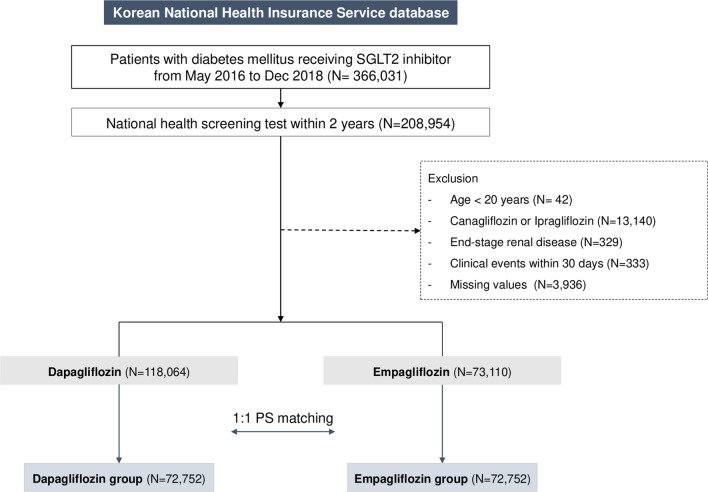
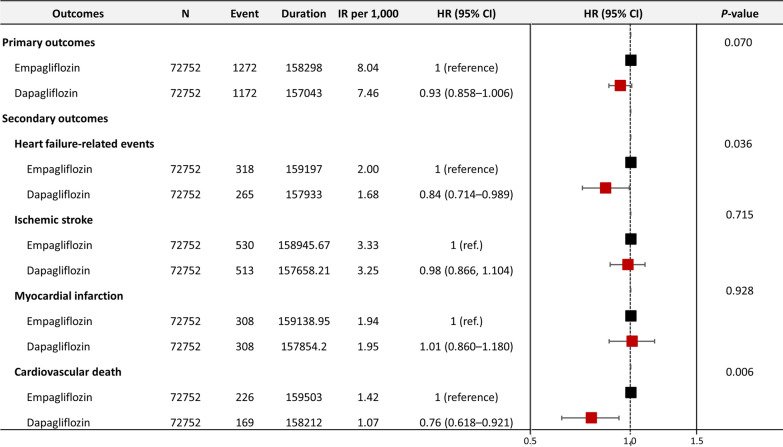
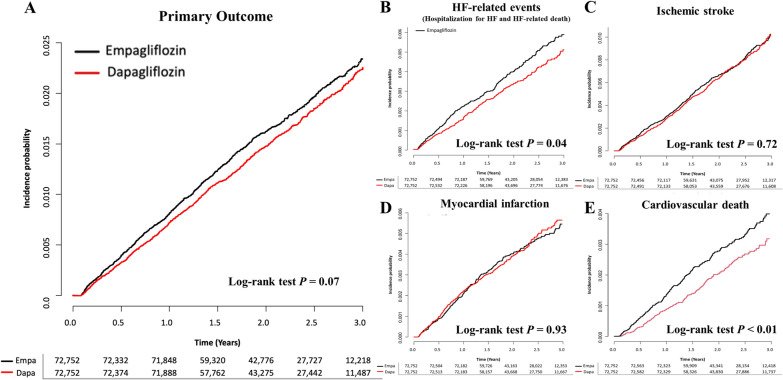
그림 출처: PubMed Central 공개 논문 (PMC10373410)
Conflict of interest statement
The authors declare no competing interests.
그 밖의 정보
- 출판 형태
- Journal Article, Research Support, Non-U.S. Gov't
- 저널
- Cardiovascular diabetology · eISSN 1475-2840
- 전자 출판
- 2023-07-26
- MeSH
- Humans · Female · Middle Aged · Male · Diabetes Mellitus, Type 2* / diagnosis / drug therapy / epidemiology · Cohort Studies · Glucosides / adverse effects · Benzhydryl Compounds / adverse effects · Sodium-Glucose Transporter 2 Inhibitors* / adverse effects · Heart Failure* / complications · Death
- Substances
- empagliflozin · dapagliflozin · Glucosides · Benzhydryl Compounds · Sodium-Glucose Transporter 2 Inhibitors
- 참고문헌
- 45편